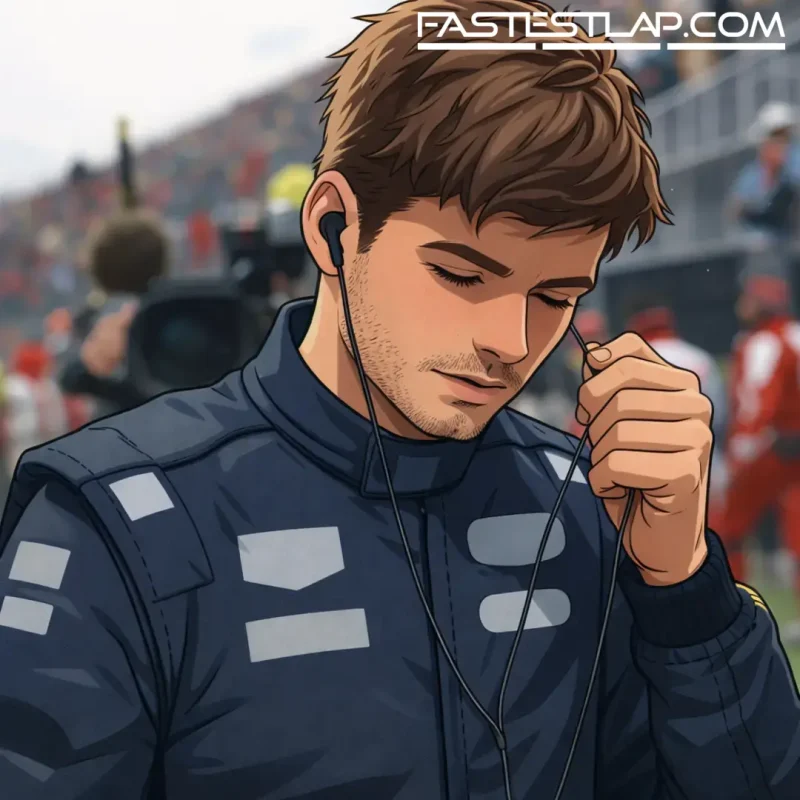
Max Verstappen doesn’t sound like a driver still “getting used to” Formula 1’s 2026 machinery. He sounds like someone who’s decided the current direction has drifted far enough from the point that it needs correcting — quickly.
Speaking after taking his first podium of this new regulations era with third place at the Canadian Grand Prix, Verstappen backed the proposed power unit adjustment planned for 2027 and described it, pointedly, as the bare minimum the sport needs to do to restore some sense of clarity.
Under the proposal, F1 would move away from the roughly 50/50 split between internal combustion and electrical power and shift to a 60/40 balance in favour of the combustion side from 2027. An agreement has been reached in principle, but Verstappen is well aware there are still hurdles before it becomes reality.
His impatience isn’t hard to understand. Earlier in the season he questioned how long he wants to keep doing this if the 2027 package isn’t altered, going as far as to warn it would be “mentally not doable” for him without that change. Canada, rather than easing the tension, simply gave him another platform to underline the point.
Asked whether these power units are starting to feel second nature after five rounds, Verstappen’s answer drifted away from the typical “we’re learning every weekend” script and into something more revealing: a comparison between F1 and the “pure” experience he says he felt racing the Nürburgring 24 Hours.
“For me, even this season, of course, I’ve been racing also different kinds of cars and especially last week, that reminds me how pure motorsport can be and how great the racing can be,” he said. “So, yeah, when I come back into Formula 1… while driving, yeah, it’s all a bit confusing.
“It’s not what Formula 1 should be about. It’s way too complex, all of this.”
It’s not the first time Verstappen has taken a swing at the way modern F1 asks drivers to operate, but what’s striking here is how explicitly he frames it as an accessibility problem — not for the drivers, but for everyone watching. In his view, the racing can still be good because the grid is stacked with talent, yet the sport is asking those drivers to juggle a set of operational rules so intricate that the audience can’t realistically track what’s happening.
“Most of the rules, the fans don’t even know what we are dealing with while driving, what is allowed when you’re behind or when you’re the car ahead, what we have to do on a formation lap or what we have to do in an out-lap, or how much battery that we’re allowed to charge,” Verstappen said.
“All these things are just such a shame that we have to deal with all these things.”
Read that again and you can hear the subtext: the drivers will adapt — they always do — but the product becomes harder to intuit. F1 has long tried to sell technological sophistication as a feature, not a bug. Verstappen isn’t denying the engineering challenge; he’s questioning whether the spectacle benefits when the defining moments are increasingly shaped by constraints and instructions that even committed fans struggle to map onto what they’re seeing.
That’s why he’s calling the 60/40 shift “minimum necessary”. Not a nice-to-have. Not a “step in the right direction”. Minimum.
“For me, F1 just needs to be more pure and I really hope that what they try to do next year will go through, because I think that is necessary, the minimum necessary, to make it a bit more natural and a bit more back to normal, or at least a bit more pure racing,” he said.
There’s also a second layer to this: Verstappen is tired of being told that the quality of the show proves the cars and rules are fine. He’s pushing back against a narrative that exciting wheel-to-wheel moments automatically validate whatever framework produced them.
“But like I said, as drivers, give us any kind of car, we’ll always race and give a good entertainment or a good show, doesn’t matter,” he said. “People say, ‘Oh, but look now, the show is great, the cars were fighting,’ but it has nothing to do with the car. It just needs to be more pure.”
It’s a fascinating argument, because it flips the usual logic. F1’s rulemakers often justify complexity in the name of performance, sustainability, or competitive balance. Verstappen’s saying: you’re getting the racing *in spite* of the complexity, not because of it — and you’re asking the audience to do too much homework to understand why one car is vulnerable on one lap and untouchable on the next.
Verstappen leaves Montreal seventh in the early Drivers’ Championship on 43 points, and there’s no disguising that Red Bull’s 2026 has been something to manage rather than something to dominate. The podium was a timely reminder he can still drag results out of difficult weekends — but his wider concern isn’t about one Sunday in Canada.
It’s about what he thinks F1 is becoming, and whether the people in charge are willing to simplify the parts that don’t need to be this hard.
For a sport that sells itself on being the pinnacle, Verstappen’s message lands with uncomfortable clarity: the pinnacle shouldn’t be confusing. And if 2027 doesn’t tidy up the mess, he’s already made it clear he won’t be thrilled about sticking around to live with it.