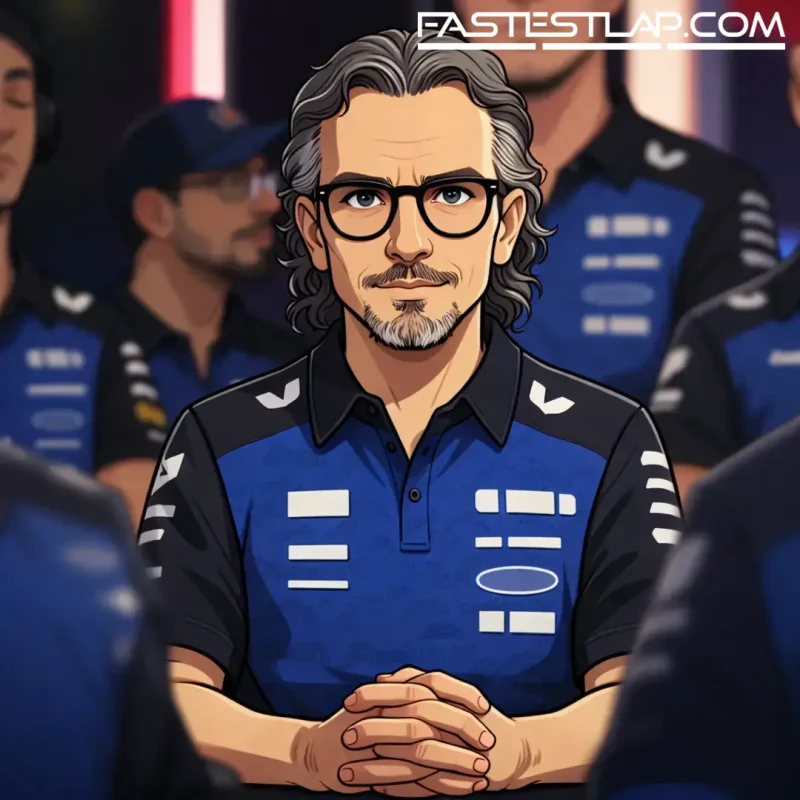
Red Bull is ready to vote through a late shift in Formula 1’s 2027 power unit split — even if Laurent Mekies admits it drags every manufacturer out of the cosy part of the rulebook.
Speaking on the proposed “agreement in principle” to rebalance next season’s power delivery, the Red Bull team principal confirmed Red Bull Powertrains Ford will be among the manufacturers backing the change as it moves through the sport’s formal governance steps. Mercedes is also expected to support it at this stage, though not every engine maker has put their name to it publicly yet.
The core idea is simple enough: tilt the 2027 cars back towards the internal combustion engine. The proposal would push the split to roughly 60:40 in favour of ICE power over electrical deployment, a notable nudge away from the current near 50-50 concept. In practice, it’s aimed at reducing how much the drivers have to manage battery state across a lap — and, in the eyes of its supporters, bringing the cars closer to a more “flat-out” style both in qualifying and in race trim.
Mekies didn’t pretend the timing is ideal, though. With 2026 already underway and manufacturers deep into their programmes, any meaningful tweak for 2027 lands as a late-moving target — precisely the kind of midstream adjustment engine departments loathe.
“We support any step that the sport wants to make to get closer to flat-out qualifying and to flat-out racing,” Mekies said. “As Red Bull Ford Powertrains, for sure, we support this change.
“You will find nobody comfortable with changing so late for next year and that’s why we have so many discussions. But certainly, we are happy to step out of that comfort zone for the benefit of the sport and to get something in place for ’27.”
That line about “comfort zone” matters. This isn’t a case of Red Bull casually waving through a minor clarification; it’s a philosophical adjustment to how the 2027 cars will make lap time. And while the sport has already made initial tweaks to the 2026 power unit package — adjustments agreed ahead of the Miami Grand Prix — the bigger 2027 move still has to survive the usual rounds of scrutiny and sign-off, even if the FIA, FOM and manufacturers have broadly aligned in principle.
The resistance, such as it is, appears less about whether a 60:40 split makes the racing better and more about the knock-on effects. One of the concerns being aired is fuel flow. If the sport asks for more sustained ICE contribution, that potentially means more fuel needs to be carried or burned — and that’s not just an engine question. A change in fuel tank size can cascade into packaging, weight distribution and, in extremis, the chassis layout philosophy teams are already shaping around.
There’s also been talk, still hypothetical at this point, of compensating elsewhere — even ideas like trimming race distance to account for fuel consumption. Nothing has been confirmed, and Mekies was careful to frame everything as “work in progress” rather than a done deal.
Still, Red Bull’s position is clear: if the sport believes the 2027 product needs to look and feel less like energy bookkeeping and more like drivers leaning on the car, it’s willing to swallow the discomfort.
“Is there a sense of unanimity? Of course, because it’s conversations that put us all out of our comfort zone,” Mekies added. “It needs quite a few discussions. It’s a work in progress, and I have confidence we’ll land in the right place.”
It’s a notably pragmatic stance from a project that’s already under intense spotlight. Red Bull’s works-era transition with Ford branding carries its own expectations, and any late regulation movement tends to be read through the lens of who gains and who loses. Mekies, though, pitched it as a straightforward trade: short-term pain in development certainty for a cleaner, harder-driving end result on track.
Whether the rest of the grid lines up behind that argument — and what, if anything, gets sacrificed to make the fuel and chassis implications workable — is what the next round of manufacturer meetings will decide. For now, Red Bull has made its call: if F1 wants a more full-throttle 2027, it’s voting yes, even if it makes everyone’s life harder in the meantime.