McLaren arrived in Montreal knowing it needed a clean, opportunistic Sunday to stop Mercedes disappearing up the road in the Constructors’ picture. Instead, it left Canada with a 10-second penalty, a gearbox failure, and the sense that when a weekend starts unravelling for this team in 2026, it doesn’t do so in half measures.
Oscar Piastri’s race was shaped by a stewards’ decision that even McLaren didn’t try to contest. The Australian was handed a 10-second penalty for causing a collision with Alex Albon at the hairpin — an impact that ended Albon’s race on the spot and left Piastri carrying damage that blunted any realistic recovery. He eventually came home 11th.
Andrea Stella was notably matter-of-fact about the call, describing it as “deserved” and framing it as a straightforward misjudgement rather than something requiring a post-race campaign.
“In terms of Oscar’s incident, the stewards penalised the incident and this is deserved,” Stella said. “I don’t think there’s much more to add. It was a misjudgement.”
That’s about as blunt as you’ll hear an F1 team principal be when there’s even a sliver of ambiguity to exploit — and it spoke volumes about how clear-cut McLaren felt the incident was. Stella did add context: Piastri was trying to claw back track position after a strategic gamble went sour, and that urgency can narrow margins. But, crucially, McLaren didn’t hide behind it.
The gamble in question came right at the start. With drizzle hanging around, McLaren split from much of the field by committing both cars to intermediates. For a moment, it looked inspired: Lando Norris surged into the lead, the kind of short-lived headline-grabber that makes pit walls feel like genius dens. But Montreal is merciless when the track turns quickly, and the decision was punished almost immediately as conditions dried.
Both drivers had to stop early to get back onto slicks, and whatever upside McLaren hoped to harvest from that initial call evaporated. Piastri’s penalty then turned the afternoon from damage-limitation to near-hopelessness. Stella admitted points were on the table in another universe — just not this one.
“In hindsight, definitely the points would have been possible, but we didn’t have a pace that could have allowed us to recover,” he said, noting that even a strong run like Franco Colapinto’s sixth place wasn’t a realistic target once McLaren’s early problems and Piastri’s car damage were factored in.
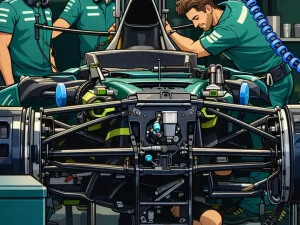
If Piastri’s story was one of a self-inflicted wound made worse by circumstance, Norris’ was simply rotten luck — twice. The reigning world champion didn’t even get to the finish, parking up with a gearbox problem after an earlier, less visible issue forced McLaren into an unscheduled stop.
“On Lando, we had two issues,” Stella explained. The first was overheating, serious enough that the team felt compelled to pit to clean the radiators — the sort of pragmatic, unglamorous intervention that never makes a highlight reel but can save an engine. The second was terminal.
“Then there was a gearbox problem, which is independent of this overheating,” Stella said. “This gearbox problem would have happened in all cases.”
In other words: even if Norris’ day had been tidier strategically, it was probably going to end with the same walk back to the garage.
Stella’s closing line — “not Lando’s day” — felt almost understated given the totality of it. But that’s the point. In a season where margins are tight and the calendar doesn’t allow for long sulks, teams talk themselves through the brutal weekends with clinical honesty and move on. McLaren will do the same here, though it can’t ignore the bigger consequence: it now trails Mercedes by 113 points in the Constructors’ Championship, a gap that starts to feel less like a wobble and more like a structural deficit if these kinds of Sundays keep cropping up.
Canada didn’t just sting because of the points lost. It stung because it was the sort of weekend where every department ends up with a smudge on its shirt — the pit wall for the opening call, the driver for the error under pressure, and the factory for reliability that didn’t hold. McLaren’s challenge now is ensuring Montreal stays an outlier, not a pattern.