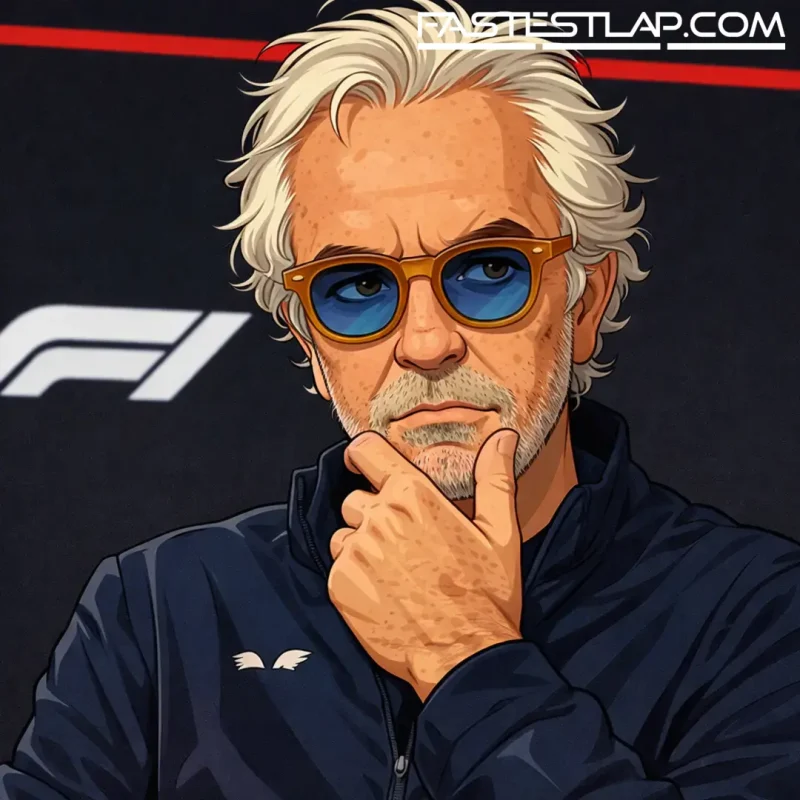
Flavio Briatore has never been one to let a good punchline go to waste, and Ferrari’s first serious swing at the electric, five-seat market has handed him an easy one.
The Alpine executive adviser — back in Enstone’s orbit since 2024 — has weighed in on the newly revealed Ferrari Luce with the sort of barbed humour that travels fast in motor racing circles. In a short video reaction, Briatore deadpanned: “Everyone’s asking me about the new Ferrari… it has one big advantage: the Chinese won’t copy this one.”
It’s the kind of line that lands because it’s doing two jobs at once. On the surface it’s a gag about styling and desirability. Underneath, it’s a little needle aimed at the idea that Ferrari can simply stretch its brand into any direction and expect universal applause.
Because applause hasn’t been what the Luce has received.
Ferrari’s move into an electric road car — and a five-seat configuration, no less — was always going to be a culture-war moment, the sort of launch that attracts as much identity policing as it does product scrutiny. The Luce’s reveal sparked immediate debate, and the backlash had a prominent figurehead: Luca di Montezemolo.
Di Montezemolo, the former Ferrari F1 team boss and chairman, didn’t merely raise an eyebrow. He went for the jugular, warning that “we risk destroying a legend,” and adding, pointedly: “I hope they at least remove the Prancing Horse from that car.” In Ferrari terms, that’s not just criticism of a model — it’s a challenge to the guardianship of the marque.
The market reaction, widely reported, suggested the discomfort wasn’t confined to purists on social media. Ferrari shares fell by more than eight per cent in Milan and more than five per cent in New York the day after the Luce was revealed. You can argue about cause and effect, but you don’t need to be an analyst to recognise a launch that didn’t land cleanly.
And yet, inside Ferrari’s own F1 bubble — where brand messaging and future-facing tech talk are part of the weekly diet — two of the most valuable voices the company has are firmly on side: Lewis Hamilton and Charles Leclerc.
Hamilton, now Ferrari’s lead star for 2026, gave the Luce a glowing review after a test drive, praising its “power delivery” as “amazing.” More interestingly, he leaned into a detail that will matter to anyone who thinks EVs are doomed to feel synthetic: he said the best part of the technology was how connected the car still felt to the ground, even over kerbs.
That’s a very Hamilton way of endorsing something — not by talking range figures or charging times, but by describing the sensation through the steering wheel and seat. Whatever you think of the Luce aesthetically, that’s an attempt to frame it as a driver’s car, not a compliance exercise with a Cavallino badge.
Leclerc’s praise was more about the cabin, which has been tagged by some critics as a saving grace. He liked that Ferrari has gone “back to having more physical buttons” — a small but telling detail in an era where too many cars, at every price point, have decided touchscreens should run everything. Hamilton, meanwhile, singled out the glass gear stick as a favourite feature, a nod to the kind of tactile theatre Ferrari buyers still expect.
There’s a wider dynamic here that’s hard to ignore. When a Ferrari icon like di Montezemolo goes public with that level of disdain, it creates a vacuum — and vacuums in Maranello get filled by whoever has the biggest megaphone. Right now, that’s Hamilton. For Ferrari, having its seven-time world champion fronting the “this still feels special” argument isn’t just helpful, it’s strategic.
That doesn’t make Briatore wrong to take a swipe, of course. Briatore has lived through enough “this will revolutionise the brand” moments in motorsport and automotive to know how quickly mythology can be dented by something that simply looks… off. His joke also fits the paddock’s long-running instinct to puncture Ferrari’s self-seriousness whenever the opportunity presents itself.
For all the noise, Ferrari is pressing on. The Luce is slated to carry a $640,000 price tag, with customer deliveries due to begin in the fourth quarter of 2026. The number is suitably stratospheric — Ferrari rarely does “entry-level” — and the timeline makes clear this isn’t a concept-car flirtation. It’s a committed product cycle.
Whether the Luce ultimately becomes a collector’s darling, a divisive oddity, or the start of a new normal for Ferrari will take years to judge. Right now, what’s clear is that the car has split the room in the most Ferrari way imaginable: an elder statesman warning of sacrilege, a pair of current F1 drivers selling the sensation, and a rival-team powerbroker cracking jokes from the sidelines.
In other words, the Luce hasn’t just launched a new model. It’s lit up an argument about what Ferrari is allowed to be next — and who gets to decide.