
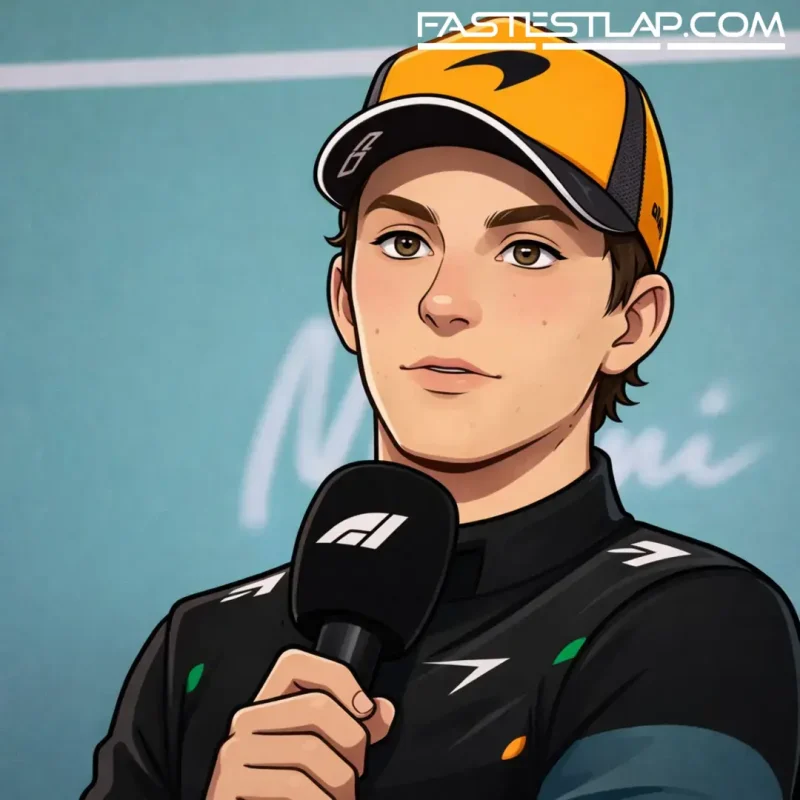
Oscar Piastri isn’t buying the idea that a simple tweak to the 2027 power unit split will magically hand drivers their “flat-out quali” moment back.
Speaking in Miami ahead of the weekend, the McLaren driver welcomed the FIA’s announcement that the key stakeholders have reached an agreement in principle over changes to the next-generation engine formula — but he was clear-eyed about what it can, and can’t, achieve if it stops at adjusting the numbers.
The proposal on the table is to move away from the planned 50:50 internal combustion/electrical power balance and towards a 60:40 split in favour of the ICE, with the obvious intent of reducing the lift-and-coast feel on out-laps and restoring a more straightforward, attack-everywhere qualifying lap.
“I think it’s a step in the right direction, but it’s not the fix,” Piastri said. And he didn’t need long to explain why.
His argument is rooted in something drivers have been grumbling about in various forms for years: the disconnect between what the throttle pedal asks for and what the hybrid system is willing (or able) to deliver at any given moment. Even when the sport was running far more ICE-heavy splits, the deployment picture wasn’t always as clean as fans might assume from the headline ratios.
“I think even with the previous engines we had, which were 80:20 or 85:15 split, even at some circuits we didn’t have full deployment everywhere,” he said. “We were very close, and a lot of the circuits we did, but until you find a split where you can maintain that full electrical power everywhere, it’s always going to be a little bit odd for us as drivers on the straights.”
That “odd” is doing a lot of work. Drivers can live with managing tyres, energy, temperatures and traffic — it’s the job — but what frustrates them is the knife-edge compromise before they even start a push lap. Piastri pointed out that the problem isn’t purely the percentage split; it’s the choreography required to get the car into a sweet spot at the exact second you cross the line.
“No matter what the split is, you’re going to have these troubles with opening a qualifying lap, getting the battery in the right level,” he said. “There is such a fine line and difficult balancing act of having the battery in the right state, because either you start the lap with not a full battery or you start with no boost pressure in the turbo, and there’s not an easy fix.
“There’s not really a solution to that, apart from changing hardware.”
That’s the key sentence, and it’s why Piastri’s take carries weight: he’s not rejecting the direction of travel, he’s warning that a spreadsheet solution won’t iron out a mechanical and systems-level compromise. If the sport genuinely wants consistent, no-questions deployment and simpler prep, it may have to accept that the architecture — not just the split — becomes the battleground.
For now, though, Formula 1 is still at the “agreement in principle” stage. The changes have been broadly well received in the paddock, but they still require an official vote before anything is locked in. And even if they pass, Piastri’s view is that it’ll be an improvement rather than a cure.
While the politics of 2027 power unit direction rumbles on in the background, Piastri’s more immediate concern is converting McLaren’s pace into the result that keeps slipping away. He arrived in Miami still chasing his first win since the 2025 Dutch Grand Prix — a 14-race run that sounds harsher on paper than it feels when the car is regularly in the mix.
Asked how he’s handled the wait, Piastri’s answer was matter-of-fact: it’s easier to stay patient when you’re not scrapping in the midfield wondering if the opportunity will ever come.
“Not always. I mean, we’re close,” he said. “I think the last couple of races with different circumstances or different decisions, we could have had two race wins as a team, so you know, we know we didn’t start here in the best place, but we’ve found our feet pretty quickly.
“It’s not that hard, because we know we’re close, and at the moment we know that if we are perfect, which we’ve come close to recently but not quite nailed, we know if we’re perfect, we can still win, and that’s what you’re always chasing.”
It’s an interesting framing from a driver who’s rarely dramatic in public. There’s a quiet edge to it: not frustration at a lack of speed, but irritation at the margins — the “different circumstances or different decisions” that separate a podium from a win when the field is tight and the weekends are increasingly defined by execution, not raw advantage.
In that sense, his comments about 2027 fit the same theme. F1 can nudge a ratio and sell a return to flat-out qualifying, but unless the underlying system behaves in a more predictable, driver-friendly way, the sport risks creating another era where the fastest lap is as much about preparation and energy-state compromise as it is about commitment.
Piastri isn’t arguing against progress. He’s just reminding everyone that if you want a fundamentally different feeling car, you’ll probably need more than a different percentage on a slide.









