Nico Rosberg has never really tried to airbrush the rough edges off his 2016 title run, but he’s now gone a step further: the Mercedes collisions with Lewis Hamilton, he says, were “probably more my fault than his”.
It’s a striking admission given how those three seasons shaped the turbo-hybrid era’s defining in-team rivalry. Rosberg and Hamilton didn’t just race each other hard; they forced Mercedes to confront what happens when you put two title-calibre drivers in the same car, remove team orders, and let the championship play out inside one garage.
Speaking on the High Performance Podcast, Rosberg framed it less as a story about aggression for its own sake and more as a deliberate re-wiring of instinct. By his own telling, “the real Nico Rosberg” was too accommodating in wheel-to-wheel fights, too prone to live for the next lap rather than the next corner. To beat Hamilton in the same machinery, he felt he had to become someone else on Sundays.
“Oh, totally,” Rosberg said when asked whether he needed to stop being his natural self. “Because the real Nico Rosberg is way too nice.
“I had to push and be tougher sometimes, even though it didn’t come naturally to me.”
That’s the part that tends to get lost whenever 2016 is boiled down to Barcelona’s Turn 4 pile-up or the broader mythology of ‘teammates from hell’. Rosberg describes the change as planned and practised — visualisation, repetition, even the posture he adopted in meditation — all aimed at one outcome: not yielding.
In other words, this wasn’t a driver simply seeing red. It was Rosberg deciding that if the psychological balance of power with Hamilton didn’t shift, he’d never have a realistic shot over a full season.
He even dragged the conversation into the current grid, pointing to Lando Norris’s on-track exchanges with Max Verstappen as a contemporary version of the same problem. Rosberg’s view is blunt: if a rival believes you’ll always blink, they’ll keep leaning on you.
“Every wheel-to-wheel battle against Max, he lost out,” Rosberg said of Norris. “Because what Lando needs to do once is just hold his ground, cause a crash.
“That will send a message to Max: ‘Oh, he’s changing, he’s becoming more ferocious. Maybe I need to calm it down a bit next time against him, because otherwise we’re going to crash.’ And you just have to do that.”
Rosberg knows how that sounds, which is why he immediately reached for the example everyone remembers. Asked if he’d essentially used the same tactic with Hamilton, he deadpanned: “Well, we crashed, right?”
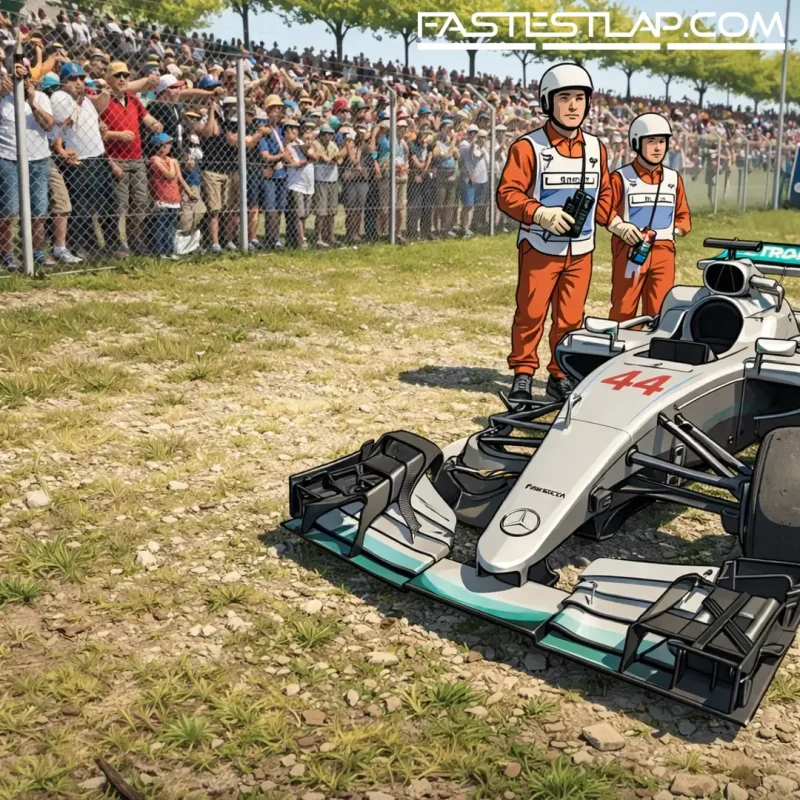
The 2016 Spanish Grand Prix remains the most infamous flashpoint — not because the mechanics were especially complicated, but because the meaning was unavoidable. Two Mercedes, first lap, no outside interference, both drivers refusing to concede. Rosberg defended the inside as Hamilton arrived with a tow; Hamilton ran out of track and ended up on the grass rather than backing out; the inevitable contact wiped out both cars.
The crash detonated inside Mercedes. Toto Wolff has since revealed he threatened to fire both drivers, a reminder that even in an era when Mercedes could sometimes afford a Sunday like that in points terms, it couldn’t afford the precedent. Letting the rivalry become the team’s identity was the real risk.
Rosberg, though, sees Barcelona through a different lens. The collisions weren’t a desirable outcome, but they were evidence the message had finally landed.
“That’s just me consciously saying I have to be more firm, I have to not yield,” he said. “Naturally, I would yield, like I did so often before that, and I had to push myself hard… visualising myself not yielding and being firm in my position.”
Then came the line that will sting for anyone still litigating blame from those years: “Because Lewis is such a genius, most of the time it was more my fault than his fault.”
It’s not so much Rosberg absolving Hamilton as it is acknowledging the brutal arithmetic of fighting a driver he genuinely rates as operating on a different level. When your opponent has the sharper instincts and the higher ceiling, you end up forcing moments — and forced moments tend to be messy.
Yet Rosberg insists the cost was worth paying. The goal wasn’t to win an argument over who turned in first; it was to change the terms of engagement. Hamilton, he believes, had become used to the idea that Rosberg would ultimately choose survival over collision.
“But it didn’t matter, in hindsight, for me, I had to do that because it sent a message to him,” Rosberg said. “I think it took him back a little bit. ‘Oh, something’s changing here with Nico. He’s not the Mr. Nice Guy anymore’, and that was a very important ingredient to then having a chance to actually beat him one day.”
There’s an irony here that Rosberg seems comfortable with: the version of himself that could become world champion was also the version that occasionally tipped over the line. And after he finally pulled it off, he walked away immediately, citing the toll it took to sustain that level of intensity against Hamilton.
The sport has seen plenty of great team-mate rivalries, but very few that felt as psychologically transactional as Mercedes 2014–16 — each driver trying to condition the other, each incident carrying the weight of future ones. Rosberg’s latest comments don’t reopen that period so much as underline what it really was: a slow, deliberate escalation in which ‘nice’ wasn’t a personality trait, it was a competitive disadvantage.
Hamilton, of course, went on to add four more consecutive drivers’ titles with Mercedes after Rosberg’s retirement before making his headline move to Ferrari in 2025. Rosberg got his one shot, took it, and left with the sort of clarity only the winner seems allowed: sometimes the hardest part of beating a great team-mate isn’t finding the lap time — it’s becoming the kind of racer who won’t give it back.