Red Bull’s season has had the feel of a team trying to drive through treacle — and then, suddenly, finding a strip of dry asphalt.
After banking a meagre 16 points across the opening three races of 2026, the Milton Keynes outfit has taken 41 from the last two rounds. That doesn’t turn them into title favourites overnight, but it does change the conversation. Laurent Mekies is adamant what we’re seeing isn’t a couple of flattering results, but the first proper evidence that Red Bull’s upgrade direction is finally biting.
The context matters. Red Bull’s early-season form was grim by its own standards: a best finish of sixth from the first three grands prix, and a car that looked reluctant to be pushed to the limit. Then came an unexpected gift of time. With the Bahrain and Saudi Arabian races cancelled, teams were handed a rare mid-season pause — and Red Bull used it like a mini winter break.
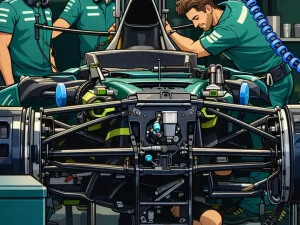
The RB22 reappeared in Miami with a chunky package: seven new parts bolted on, followed by smaller tweaks in Montreal. Miami immediately looked like a step — Max Verstappen qualified second when racing resumed — and Canada has been framed internally as the weekend that confirmed it wasn’t a one-off.
“Big picture, I see at the very least we have confirmed the Miami steps,” Mekies said after Montreal. That’s the key phrase: confirmed. In a season where performance swings can be track-specific and weather-dependent, teams are wary of drawing straight lines. Mekies isn’t pretending Red Bull has cracked the code, but he does believe the numbers now point in the right direction.
He referenced the qualifying gap as a headline metric — around three tenths — but it’s the race picture that appears to have encouraged Red Bull most. In Miami, they ended up 40 seconds short of the win; in Canada, Mekies felt they were closer than the deficit suggested last time out, and closer than the half-second gap they’d been staring at.
That’s a subtle but important distinction. A car can be “three tenths down” in qualifying yet still feel like it’s on a different planet to the leader on Sunday. Red Bull, for the first time this year, seems to believe its pace is moving from “occasionally respectable” to “repeatable enough to build on”.
Still, Mekies put a firm handbrake on any grand claims. Montreal can be a peculiar judge of aerodynamic progress — it rewards efficiency and traction as much as it does outright downforce — and Mekies openly acknowledged the possibility that circuit characteristics have helped flatter the step.
“Now, there is probably no reason to get too excited… you could also have a track layout effect,” he said, before returning to what he sees as the most telling detail: other teams brought updates too, and Red Bull still appeared to take ground. In the development race, that matters as much as any single finishing position.
There’s another layer to Red Bull’s situation that’s harder to quantify than lap time traces: confidence in the car. Mekies was unusually candid about the team’s willingness to “take risk” when it senses Verstappen and Isack Hadjar aren’t able to lean on the RB22.
“We don’t do straightforward,” he said. “As soon as we are in situations where we don’t feel Max and Isack are able to push, we take risk.”
That’s Red Bull in a nutshell — but it also hints at why their season has been so lurchy. A car that requires continuous experimentation to unlock its potential can deliver big jumps, but it can also leave drivers spending practice sessions searching for a window that never properly opens. Mekies portrayed Canada as a weekend of learning: trying things, accepting that it may cost something in the short term, and building understanding for both qualifying and race conditions.
It’s a refreshingly honest admission that the “ultimate potential” of this car is still not fully mapped. “How far away from the ultimate potential of the car here? Nobody really knows,” Mekies said — a line that will resonate up and down the paddock, because it’s exactly the sort of uncertainty that separates the front-runners from the teams chasing clarity.
The numbers, however, don’t lie about the scale of Red Bull’s task. They sit fourth in the constructors’ standings on 57 points, a staggering 162 behind Mercedes. So yes, the upgrades have breathed life into their year — but the championship picture remains brutally uncompromising.
What Miami and Montreal have done is give Red Bull something it hadn’t really had before: a plausible platform. If the car is now fundamentally quicker, the next step is making it more usable, more predictable, and less dependent on high-wire setup gambles. Verstappen’s weekend in Canada had its scruffy moments, and that matters because when the car is right, Verstappen is usually anything but.
Red Bull isn’t “back” in the sense that the sport uses that phrase lazily. But there are signs — real ones — that the team has finally arrested the slide and found a development thread worth pulling. In a season already threatening to run away from them, that may be the most valuable upgrade of all.