The FIA’s latest set of talking points from the F1 Commission meeting won’t set the paddock alight on their own, but the subtext is familiar: 2026 has delivered cars that are doing more than expected, and the rulemakers are already nudging the 2027 package to pull performance back into the box.
Officially, the FIA is keeping the detail light. The Commission agreed “minor changes” to the 2027 technical regulations — subject to sign-off from the FIA World Motor Sport Council — with tweaks centred on aerodynamic and bodywork components, plus an extra day of pre-season running. That’s the headline. The story, though, is why those knobs are being turned now.
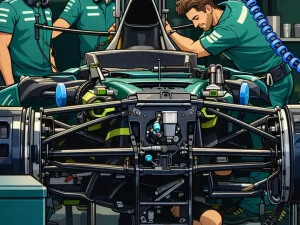
The understanding in the paddock is that this season’s 2026 machinery arrived with more downforce than had been anticipated when the new era was framed. That has consequences. More load means more cornering capability, and in turn it shapes everything: how teams approach ride control, how they choose to spend development resource, and how the racing product behaves when cars sit in traffic.
So the direction for 2027 looks pretty clear: edge overall downforce down. On paper that sounds like a pure performance haircut — and it is, to a degree — but it’s rarely that simple. Lower downforce often comes with a car that’s “slipperier” in aero terms, and that can bring straight-line efficiency back the other way. For teams, that’s both an opportunity and a headache: opportunity because there’s always lap time in efficiency; headache because reducing load can make the platform more sensitive and force compromises in slower corners and on traction. Expect the usual dance as the engineers try to claw back what the regulations aim to remove, just in different places.
There’s a timing element here too. Changing aero and bodywork rules for a season that’s only one year away is a deliberate signal. It tells teams the FIA believes the development curve on the 2026 cars is rising quickly enough that it wants to intervene before the field simply overwhelms the intended performance window. That doesn’t mean a full reset — the language is “minor changes” — but in modern F1 minor can still be meaningful, especially when it targets the surfaces that dictate how much energy the car can generate.
Alongside the technical tidying, the Commission also agreed to expand pre-season testing for 2027. After 2026 offered teams a significant amount of time — up to nine days — to understand a completely fresh set of cars, 2027 had initially been pencilled in to revert to the more familiar three-day format. The Commission has now approved a move to four days.
That extra day matters more than it sounds. The teams are already operating in a world where simulator correlation and wind tunnel confidence decide how aggressively you can push an upgrade cycle. One more day of real-world running can save weeks of argument between departments, and it gives the smaller operations a little more breathing room when reliability gremlins appear. It also hints that the FIA accepts the knock-on effects of late aero/bodywork adjustments: if you’re going to tweak the shape of the car, you can’t then pretend three days is always enough to validate it properly.
The other notable change is a tightening of the rules around TPC — Testing of a Previous Car. The FIA says it has introduced “limitations on conducting testing at circuits due to hold a race in the subsequent year’s championship.”
Previously, teams were prohibited from running TPC at any circuit within two months of its appearance on the F1 calendar. The new language indicates that restriction is being extended, lengthening the period teams must wait before they can take an older car to a venue that’s on next season’s schedule.
This is one of those housekeeping rules that doesn’t make for glamorous copy but absolutely affects behaviour. TPC has become a valuable tool not just for marketing days and driver mileage, but for operational practice — running procedures, bedding in engineers, evaluating drivers, and generally doing the sort of trackside work you don’t want to risk during a race weekend. By stretching the “no-testing” window at circuits that will host a grand prix the following year, the FIA is trying to protect competitive equity and limit the value of circuit-specific running disguised as something else.
In combination, the three strands — a small aero/bodywork correction, an extra test day, and a more restrictive TPC perimeter — paint a consistent picture of where F1 governance is at in 2026. The sport wants to avoid the perception that teams are immediately outsmarting the intent of a fresh regulations cycle, but it also doesn’t want to hamstring operations so hard that reliability and safety become collateral damage. Hence the balancing act: trim potential performance, then give teams a touch more official track time, while closing off some of the unofficial loopholes.
None of this is final until the World Motor Sport Council stamps it, and the FIA has intentionally left the specifics vague at this stage. But don’t confuse “minor” with “irrelevant”. In a formula where the lap time is often hidden inside airflow management and preparation quality, the smallest shifts in regulation and track access can end up steering the competitive landscape more than anyone admits in public.