Fernando Alonso isn’t dressing it up. Aston Martin’s 2026 is, for now, a survival exercise — and he’s already bracing for a run of weekends where the aim is damage limitation rather than headlines.
The Spaniard has effectively conceded the team is likely to hover around the back end of the field until at least after the summer break, suggesting there are roughly another six races to grind through before the sort of upgrade that can change the picture properly arrives. In that context, Monaco becomes less about miracles and more about execution: doing the small things flawlessly on a circuit that punishes even minor compromises.
That’s where Honda’s side of the project is trying to claw back some control. Shintaro Orihara, Honda’s chief engineer, says the manufacturer has gone into what he called “dedicated preparation” mode specifically to meet Monaco’s quirks — not as a marketing line, but as a practical response to the sort of weekend where a power unit’s behaviour can shape everything from qualifying confidence to race manageability.
“Circuit de Monaco is very unique, and our power units require dedicated preparation to adapt to the conditions,” Orihara explained. “We have conducted specific driver-in-loop (DiL) sessions at the AMR Technology Campus to optimise our energy management setting.”
That line about energy management matters more at Monaco than it might at, say, a conventional power circuit where you can hide sins with straight-line speed. In Monte Carlo, you’re living in low-speed traction zones, you’re constantly threading the car through tight direction changes, and you’re repeatedly asking for predictable response at the exact moment the rear tyres are most liable to snap. If the delivery isn’t clean — if harvesting and deployment don’t feel natural to the driver — lap time just evaporates.
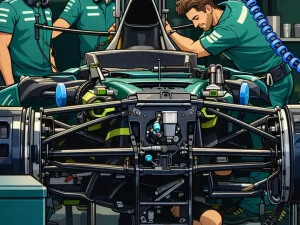
Orihara was blunt about the other big Monaco-specific headache: cooling. With the slow-speed nature of the lap, airflow through the car is compromised, which can leave teams walking a thin line between keeping temperatures in check and not opening the bodywork up so much they pay for it in drag and balance.
“On the cooling side, Monaco’s slow speed sections make this challenging,” he said. “We need to find a good cooling specification, working closely with Aston Martin Aramco to achieve this for the power unit in clean air and heavy traffic, which is common here.”
It’s a telling detail that he highlights heavy traffic. Monaco is one of the few places where you can feel like you’re in a race-long train even when you’re not technically fighting anyone — and when you are stuck in traffic, the thermal load only gets worse. With the field so close, losing a bit of efficiency can cascade quickly: you’re forced into protective modes, which changes driveability, which hurts confidence, which costs the final couple of tenths that decide whether you’re in the fight or marooned in Q1.
Honda is leaning heavily on the early track time to get on top of that. Orihara described the three hours of practice as “critical” for refining energy management and how the drivers use the lap to make the system work for them — a nod to the fact Monaco’s rhythm is as much about timing and positioning as it is outright speed.
“This weekend we have three hours of practice so it’s critical to optimise energy management and track usage throughout these,” he said. “Gaining the drivers’ feedback during this will also be paramount as energy management has a significant impact on driveability.”
There’s also an unusually direct admission in the way Orihara framed the performance target. At Monaco, he suggested, lap time can be found not through some magic number on the dyno, but by giving the driver a car that does what it says on the tin at low speed.
“Monaco has a lot of slow speed corners, so it’s fundamental to maximise driveability to give them maximum confidence,” he added. “We can find lap time from driveability here.”
For Alonso, that’s the only currency worth chasing right now. When a team is waiting on bigger steps later in the season, these weekends become an exercise in making the existing package less painful to drive and more repeatable across a lap — especially at Monaco, where one moment of hesitation is the difference between threading the needle and kissing the barrier.
Aston Martin’s immediate reality hasn’t changed: the breakthrough won’t be delivered by one tidy set-up call or a brave strategy call on Sunday. But if Honda can help stabilise the platform through cleaner energy deployment and a cooling configuration that doesn’t box the team into conservative running, it at least gives Alonso a chance to do what he still does better than most — squeeze something respectable out of a difficult car on a circuit that rewards precision above all else.