Monaco has a funny way of turning the paddock’s biggest narratives inside out. One weekend you’re obsessing over who’s found 15 horsepower; the next you’re watching the same teams quietly reshuffle their priorities because the circuit simply doesn’t care. That’s the backdrop to a Tuesday news cycle that ranged from old Mercedes scars being picked open again to the FIA laying down the first breadcrumbs for 2027 — with Ferrari, inevitably, sitting at the centre of the conversation.
Start with Lewis Hamilton, because in 2026 he’s become a walking reminder that context matters. Yes, he’s now in red, and yes, he’s admitted Ferrari’s SF-26 is “massively down” on power compared to Mercedes’ benchmark unit. In most places that’s an anchor. In Monaco, it’s an asterisk.
Hamilton’s point wasn’t dressed up as excuse-making; it read more like a reality check. Monte Carlo is the rare weekend where the stopwatch is less about the end of the straight and more about the quality of the first 30 metres after the apex — traction, bite, and how calm the rear stays when the road pitches away under braking. If Ferrari has built a car that’s kinder in slow-speed rotation, they can plausibly hide a deficit that would be loudly exposed at, say, a track defined by long-throttle commitment.
Lando Norris effectively underlined the same theme from a different garage. Mercedes may have carried the “main force” tag this season, but Norris is looking at Monaco and seeing a Ferrari opportunity — specifically on Saturday, where this race is so often decided. His read is blunt: Ferrari is “far better than anyone else” in low-speed corners. That’s the sort of paddock compliment that tends to come with an unspoken warning: if you don’t put them behind you in qualifying, you might not see them again.
Of course, Monaco’s other certainty is discomfort — and Max Verstappen served up the line of the day by joking he might need to “order a new back” to survive the bumps. It’s not just gallows humour, either. He’s openly uneasy about how Red Bull behaves on uneven surfaces, and he’s not yet pinning down the cause. On a street track where the car spends as much time being jolted as it does being driven, that matters, not only for Verstappen but for team-mate Isack Hadjar too. If the platform isn’t settled, the driver can’t commit — and commitment is the only currency that buys you time around the walls.
Away from Monaco’s immediate headaches, there was a quieter but more consequential development: the FIA’s summary of the latest F1 Commission meeting, where “minor changes” to the 2027 car package were agreed on aerodynamics and bodywork. The language is always deliberately gentle at this stage — “minor” is a useful word in politics — but the direction is telling. The intention is understood to be a reduction in overall downforce, and there’s also an extra day of pre-season testing on the slate.
That’s the kind of line that sounds procedural until you think about who it helps. Cutting downforce, even slightly, isn’t a neutral adjustment; it changes the sensitivity of the cars and can shift the competitive sweet spots teams have spent years building towards. Add more testing and you’re effectively admitting that the new window needs time in the real world, not just in the sim. For the front-runners, it’s a chance to validate early. For the midfield, it’s a lifeline — more laps to understand what you’ve built before the season turns into damage limitation.
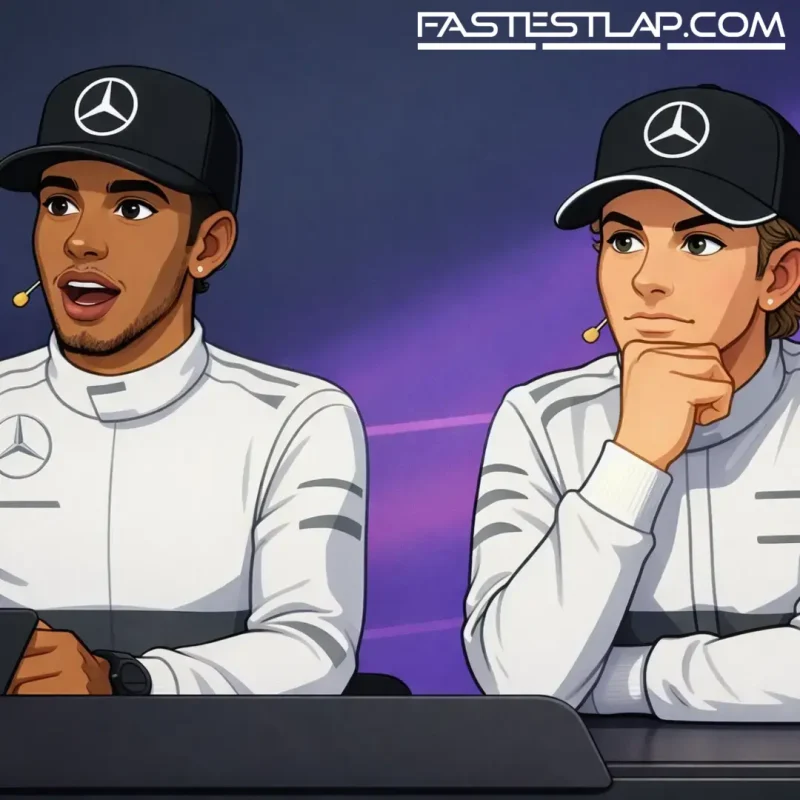
Then, in the middle of all this forward-looking agenda-setting, Nico Rosberg reached back to the most psychologically brutal title fight of the hybrid era and offered a disarmingly frank perspective on 2016. Speaking about the collisions and flashpoints with Hamilton — Barcelona still the most notorious — Rosberg said that because Hamilton is “such a genius”, “most of the time it was more my fault than his fault.”
It’s an arresting admission, not because it rewrites history, but because it explains it. Rosberg described how he essentially trained himself not to yield, visualising firmness and rehearsing the moments where instinct tells you to blink. That’s a champions’ tool — and also a recipe for contact when two drivers refuse to be the one who backs out. His conclusion was as honest as it was revealing: preparation helped him hold his ground, but it also nudged him into the margin where there’s no space left for two cars.
Put all of that together and Monaco starts to look like more than a glamour stop on the calendar. It’s a stress test for this season’s pecking order, a chance for Ferrari to turn a clear power weakness into a manageable footnote, and a weekend where Red Bull’s ride issues could be amplified into a real competitive limiter. Meanwhile, the sport is already nudging the chess pieces for 2027, even as old rivalries resurface to remind everyone how thin the line is between conviction and calamity.
And that, really, is Monaco’s trick: it makes the obvious less important, and the small things decisive.