Mercedes may have started 2026 like a team on rails, but Montreal offered a reminder that dominance in the timing screens doesn’t automatically translate to calm on the pit wall.
George Russell and Kimi Antonelli have been living in their own championship for five races now, Mercedes sweeping the lot and even banking P1 in the China Sprint along the way. Antonelli’s four grand prix wins have opened up a 43-point advantage over Russell, with Charles Leclerc the closest “best of the rest” another 13 points back. In the teams’ race, Ferrari is already staring at a 72-point deficit.
On paper, that’s the sort of margin that buys you freedom: let the drivers race, let the show breathe, let the sport enjoy itself. In practice, Montreal was the weekend that made Mercedes consider the price of letting its two title contenders settle it entirely between themselves.
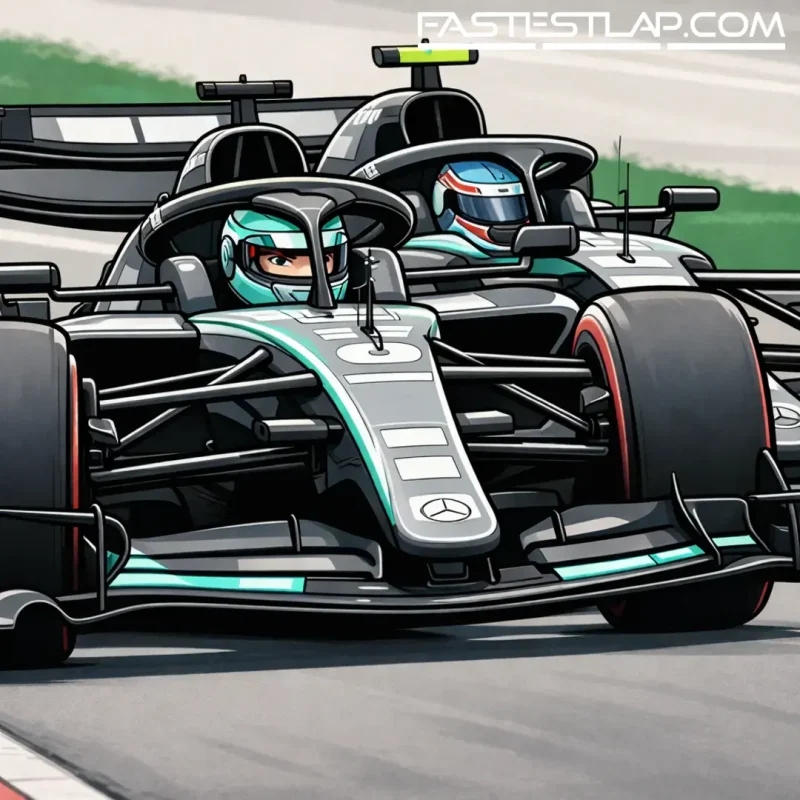
The flashpoint wasn’t subtle. In Saturday’s Sprint, Antonelli was furious after Russell forced him off the track. Over the radio and afterwards, the rookie called it “unfair” and argued it merited a penalty. Sunday didn’t cool anything down. The pair found each other again, traded places at the hairpin as both made mistakes, and flirted with the sort of tyre-on-grass moments that turn a championship narrative into a repair bill. This time Russell felt Antonelli had been the one pushing the boundaries.
It ended with a twist nobody wanted: Russell’s W17 suffered what was described as a “catastrophic” battery failure on lap 30, leaving him parked up and Antonelli free to take another win. The points swing was brutal, and it only sharpened the sense that Mercedes’ main threat might not be red cars or blue cars, but the thin line between “healthy competition” and “unnecessary risk”.
Helmut Marko, never a man to undersell a problem he hopes will benefit his side of the garage, was predictably blunt when asked about Mercedes’ early-season grip on this new rules era. For Marko, Mercedes’ technical advantage is obvious — and, in his telling, almost immovable unless the drivers do the damage themselves.
“Mercedes is clearly the strongest team,” he said, praising not just the chassis but the power unit and, pointedly, the battery. He framed it as a return to a level of completeness Mercedes hasn’t consistently had since 2021: the best engine, a battery package setting the benchmark, and now a genuinely competitive chassis wrapped around it.
Marko also acknowledged what everyone in the paddock has clocked within a handful of races: this isn’t a clear No.1/No.2 situation. Antonelli is the fast, fearless young gun who “lets the car fly”. Russell is the more seasoned operator, and Marko expects him to “strike back”. The subtext is obvious — two drivers with legitimate claims to lead a title campaign rarely make each other better without occasionally making life harder for the team.
“That they tear each other apart in the process is the only hope,” Marko said. “Otherwise Mercedes is gone.”
That’s the competitive reality Mercedes is trying to manage. The car is good enough to win with either driver. It might even be good enough to survive a bit of internal friction. But Montreal was a reminder that the most expensive mistakes aren’t always contact; sometimes they’re the near-misses that normalise risk, the moments that convince two racing drivers they can keep threading the needle until the day it finally snaps.
Toto Wolff sounded like a team boss who enjoyed the spectacle right up until he replayed the clips.
“It’s always easy at the end now to say ‘well, that was great for the team and great for the sport, and didn’t we all enjoy watching the battle’,” he said after Sunday. “And that is true to a degree, but there is another side… it was close a few times.”
Wolff’s concern wasn’t that either driver was being deliberately reckless. It was that even “normal” racing errors — Antonelli tucking in and locking a tyre, the tight moment through the final chicane — could have produced the one outcome Mercedes cannot afford while holding the quickest package: a double DNF created entirely in-house.
His language was telling, too. This wasn’t a warning shot about punishment; it was the start of a process. Analyse the risk, talk it through, decide whether it crossed Mercedes’ internal line, then adjust. That last part is where the sport’s old vocabulary starts creeping in: limits, protocols, and, when necessary, intervention.
Wolff stopped short of declaring team orders, but he didn’t exactly hide the direction of travel. “How can we avoid these very, very tough situations?” he asked, framing it as a question of being “a little bit too close” rather than trying to kill the racing outright.
When asked if he feared the drivers’ personal agendas could hurt Mercedes’ broader objectives, Wolff didn’t bite. He suggested the radio messaging could be cleaner — “room for improvement” — while defending the essential fact that both are racing for a championship and behaving like it.
The uncomfortable truth for Mercedes is that the healthier its advantage looks, the less tolerance it has for self-inflicted wounds. When you’re fighting another team, you can justify risk as necessity. When you’re fighting your team-mate in the fastest car, risk starts to look like indulgence — especially when the constructors’ lead is already the foundation of the whole programme.
There’s another complication, too: the calendar doesn’t always reward the best car in the same way. Marko, for one, isn’t convinced Mercedes will have it all their own way in Monaco. He’s backing Leclerc to be a factor on a circuit that leans heavily into slow-corner traction and qualifying position, arguing Mercedes will “have a hard time with the slow corners” and calling Leclerc his favourite over one lap at home.
Whether Monaco proves him right or not, the broader point lands: if Mercedes’ rivals are looking for daylight, they’re watching the Mercedes pit wall as much as the lap times. Montreal didn’t just give them hope — it gave them a theory of the case. In 2026, the quickest way to beat Mercedes might be to let Mercedes beat itself.