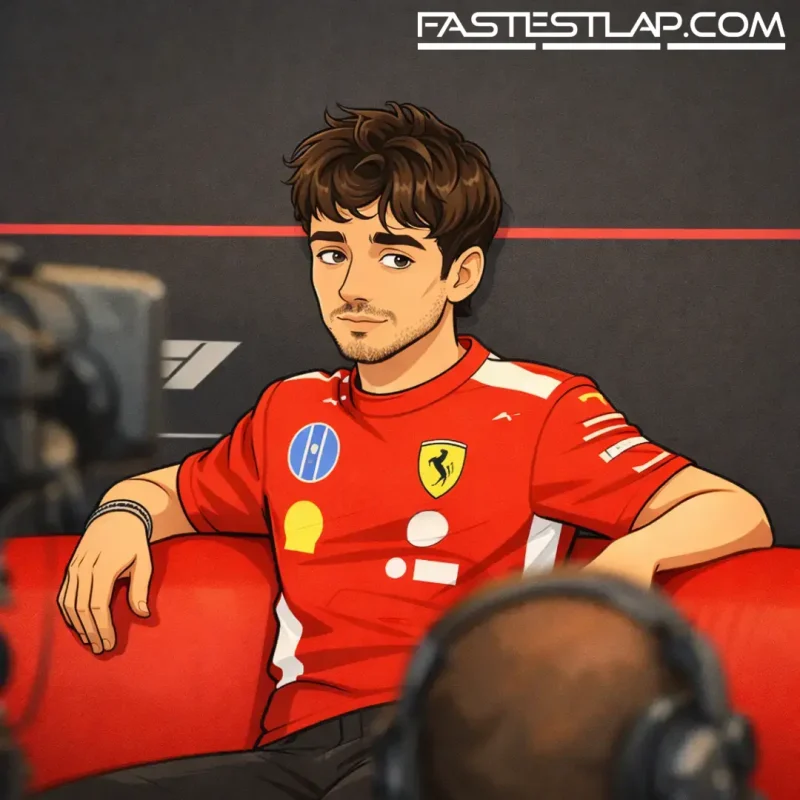
Charles Leclerc isn’t about to follow Lewis Hamilton down the “old school” path when it comes to Ferrari’s simulator work — even if Hamilton’s first weekend after binning it produced his strongest result yet in red.
Hamilton raised eyebrows ahead of the Canadian Grand Prix when he said he’d stepped away from Ferrari’s sim programme for race preparation, citing a disconnect between what he was feeling in the virtual world and what the car was doing on track. Then Montreal happened: second place behind Mercedes’ Kimi Antonelli, and a weekend in which he had the edge over Leclerc across qualifying and the race.
It was the sort of storyline the paddock loves — the veteran simplifies his routine, trusts instinct, and suddenly looks like he’s found something. But inside Ferrari, Leclerc is treating it less like a revelation and more like… Hamilton being Hamilton.
Asked in Monaco whether his team-mate’s sim snub changes anything on his side of the garage, Leclerc was blunt: not a chance.
“It doesn’t affect my preparation at all,” Leclerc said. “At the end, I think we all have our preferences.
“For me, the simulator has been working very well. This is what I’ve done since arriving in Formula One, and I’m not going to change that.”
Leclerc’s point is a simple one, and it’s hard to argue with from Ferrari’s perspective. The simulator isn’t just a driver comfort blanket; it’s woven into how modern teams make decisions, validate directions and sharpen the set-up window. Even if Hamilton is opting out on race-week preparation, Leclerc is effectively saying the tool remains central to his own process — and, by extension, to how Ferrari develops the car.
“It’s been a very powerful tool for me and in the past, also very often, we do changes on the car based on what we try on a simulator back at home,” he said. “So it’s part of the developing process of the car, and, yeah, it works for me, so I’ll keep going there.”
Hamilton, for his part, hasn’t hidden behind euphemisms. He described the simulator as “powerful” in theory, but suggested the risks — presumably in chasing solutions that don’t translate — outweigh the benefits for him right now. And he framed it in familiar terms: he’s won titles without it, he’s comfortable relying on feel, and he doesn’t see it as essential.
“Whether or not I use it to prepare for another race? Probably not,” Hamilton said in Canada. “There are just too many risks.
“If you look at the two best races I’ve had, I didn’t use a simulator and that’s honestly how it was.
“Pretty much all the championships before, except for probably 2008, I didn’t use the sim, so it’s not a necessity. It’s a tool that can be powerful, but, for me, I’m old school. I’m probably better without it.”
Not everyone is buying the logic — at least not yet. Former Ferrari race engineer Rob Smedley questioned how much could truly be concluded from a single data point, suggesting Ferrari personnel largely met Hamilton’s stance with a shrug rather than a conversion.
“He has a sample size of one,” Smedley said on the High Performance Racing podcast. “All of a sudden, it’s statistically true that if you don’t go on the simulator, you’re on the podium.”
What makes this interesting isn’t that two drivers prepare differently — that’s normal. It’s that, in 2026’s tight margins, Ferrari has two front-line drivers effectively running contrasting philosophies in how they get themselves ready. Hamilton is leaning into simplification and experience. Leclerc is doubling down on a system he trusts, and one Ferrari’s engineers clearly still want at the heart of their feedback loop.
And while Montreal gave Hamilton the headline, Leclerc has the slightly stronger position in the standings. He leads Hamilton by three points, with the pair third and fourth in the Drivers’ Championship behind the Mercedes duo of Antonelli (131 points) and George Russell (88).
Whether Hamilton’s sim boycott becomes a trend or a footnote will depend on what happens next. If Ferrari hits a patch where correlation is critical — a new package, a balance shift, a tricky run of circuits — the team will inevitably want as many reliable tools in play as possible. If Hamilton keeps delivering without it, he’ll keep doing things his way. Either way, Leclerc has already drawn his line: the simulator is staying in his routine, because for him it still tells the truth.