
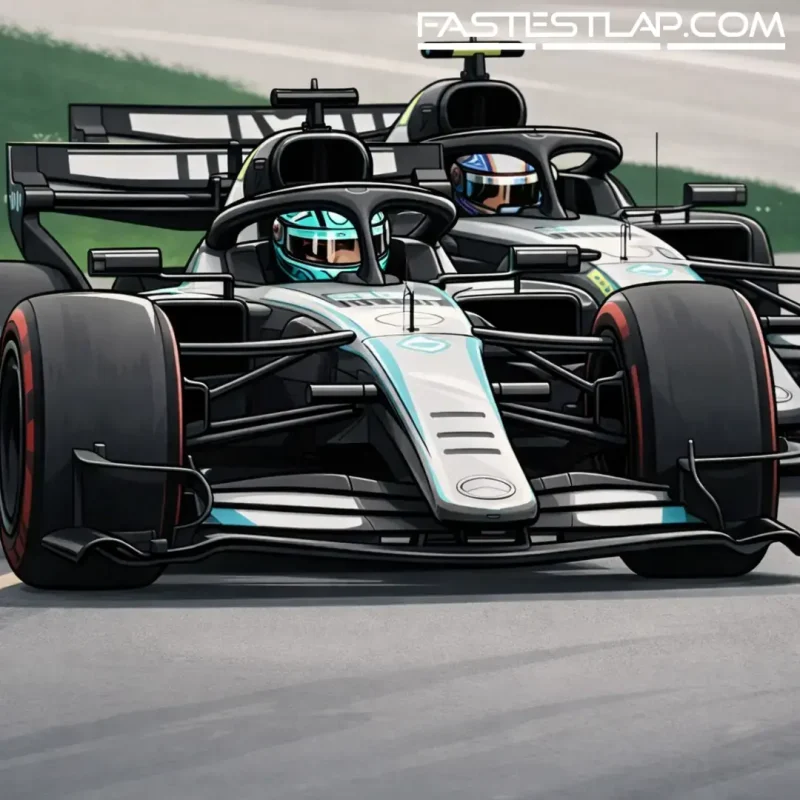
Mercedes didn’t leave Montréal with the clean, controlled points haul it wanted, but it did leave with something arguably more valuable in a title fight: clarity. After a Canadian Grand Prix in which George Russell and Kimi Antonelli traded the lead with a level of commitment that made even seasoned pit walls wince, the team has doubled down on a simple stance — race each other, but don’t be reckless.
Antonelli’s account of the post-race debrief painted it as less of a crackdown and more of a reality check. Mercedes sat the two down, replayed the key moments, and landed on a familiar set of boundaries: they’re free to go at it provided there’s respect, and provided neither puts both cars in a position where contact or damage becomes the likely outcome.
It’s the sort of “rules of engagement” that sounds vague until you remember the context. In Canada, Mercedes had its two cars at the pointy end, and neither driver backed out of the kind of elbows-out racing that tends to set alarm bells ringing at Brackley. This wasn’t a token scrap for seventh; this was a fight for the lead between two drivers who both see themselves as championship material right now.
Antonelli, still early in his F1 career but already speaking like someone who understands how quickly the mood can turn inside a top team, didn’t pretend it’s easy to balance the individual and the collective. He leaned into the idea that Mercedes doesn’t want to impose artificial team orders, while acknowledging the obvious: the constructors’ points matter, the factory matters, and the people back in Brackley and Brixworth don’t get rewarded for dramatic intra-team highlights if it ends in carbon fibre confetti.
What Antonelli also did — perhaps unintentionally — was underline why Mercedes is wary of over-managing this. He’s leading the drivers’ championship by 43 points at this stage of the season, and that kind of margin changes the psychology. A young driver with momentum and a cushion doesn’t arrive at the next race thinking about settling for “good team points”. He arrives thinking about stamping authority.
Russell, for his part, sounded like a driver who’s been around enough team principals and post-race summits to know when the message is really “be careful” and when it’s “you’re both on notice”. He insisted there’s no concern, framing the debrief as the team putting trust in its drivers rather than reaching for control.
That might seem like standard driver-speak, but Russell’s situation adds bite to it. His Canadian weekend ended with a reliability problem and a retirement — exactly the kind of result that can turn a title campaign from a steady burn into a scramble. When you’ve just watched points disappear for reasons outside your control, the last thing you want is to be told to stand down when you do have the pace to win.
Russell also made a point that’s easy to miss when fans focus on the on-track spectacle: racing your team-mate isn’t just a duel, it’s a stress test for everyone else. Engineers, strategists, the pit wall, even Toto Wolff — they’re all watching a scenario they can’t fully script. They can call strategy, manage gaps, nudge behaviour on the radio, but they can’t drive the car. If it goes wrong, they wear it.
And yet Mercedes is still choosing to live with that discomfort. That says plenty about where the team believes it is in 2026. You don’t allow a genuine free fight at the front unless you’re confident you can win races consistently — and unless you believe the internal competition is helping you, not hurting you.
The more interesting question now isn’t whether Mercedes will slap a “hold position” on the radio at the first sign of trouble. It’s whether this version of “free to race” survives a real championship pinch point. Canada was intense, but it wasn’t the kind of late-season, high-stakes flashpoint where a single overtake attempt can define a year. The language from both drivers suggests they expect to keep pushing — Antonelli even hinted they’ll do it “a bit more smartly” — but smart is a sliding scale when wins and titles are on the table.
For now, the team has drawn the line exactly where you’d expect: respect, awareness, no unnecessary risk. The rest is down to two drivers who clearly don’t fancy being managed like juniors. Mercedes can review the footage and talk about scenarios all it likes, but the real test will come the next time Antonelli sees Russell in his mirrors with DRS and a point to prove — and neither one is in the mood to blink.









