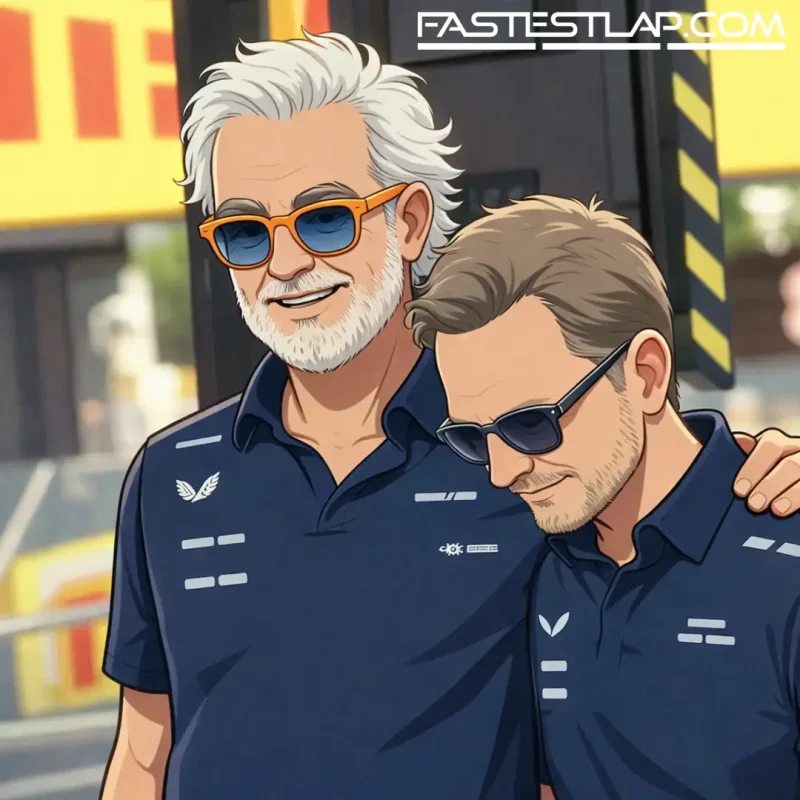
Flavio Briatore isn’t pretending there’s a neat, straight line from Christian Horner’s name being floated around Alpine to a deal being done. But if Horner does turn up as part of the group trying to buy into the Enstone outfit, Briatore’s made it clear he won’t be the roadblock.
“I’d be happy to work with anybody, honestly. I don’t think this is the point,” Briatore said, striking a tone that was equal parts welcoming and exasperated by the noise around the process. He stressed he doesn’t actually know whether Horner is involved in a bid, but added: “For me, welcome, I have zero problem, especially with Christian. I have a super relationship with Christian.”
That relationship, Briatore noted, goes back two decades and includes a period of collaboration when Horner was working with Renault power at what Briatore framed as a joint project. It’s a reminder that, whatever the paddock’s current habit of filing personalities into rival camps, the sport’s decision-makers have often worked together before — and can again when interests align.
Horner, out of the paddock since last year’s British Grand Prix, is now free to return to Formula 1. Alpine has emerged as one of the more credible routes back, with the key detail being that minority shareholder Otro Capital is looking to sell its 24 percent stake in the team. Horner has been linked to a consortium that’s submitted a bid, one of several parties circling an asset that’s simultaneously high-profile and politically complicated.
Because this isn’t just a straight sale between private investors. Renault Group, as the majority owner, is understood to hold a veto over who comes in. And that changes everything — particularly when you’re talking about a minority purchase, where the buyer’s upside and influence are inherently capped.
Briatore didn’t hide his scepticism at the numbers being discussed. “I see it [as] very difficult for somebody to spend 600 million to buy a minority in one company if it’s not agreed with the majority,” he said. “I don’t understand the political doctrine, honestly, because in this moment it’s not going to work.”
That line lands because it speaks to the reality behind the headlines: the value of that 24 percent isn’t just a function of Alpine’s market worth, it’s a function of what Renault is willing to allow that 24 percent to mean. Briatore’s point is blunt — without Renault’s blessing and a clear sense of what a minority investor can actually do, the price tag starts to look more like a negotiating stance than a deal-ready valuation.
The paperwork around the process underlines the leverage Renault has. The sale mechanism includes a right of refusal for Renault Group, effectively allowing it to take full ownership if it wants before potentially selling a slice on to a different investor. It’s a structure that gives the manufacturer control over the identity of any partner — and, as a consequence, gives it a hand on the tiller of the valuation too.
There’s another wrinkle: a clause that prevents Otro from selling its shares until September, albeit with the suggestion that mechanisms exist to accelerate the timeline if all parties want it moved along. In other words, even with interest in the stake, there are procedural gates to pass through before anyone starts talking about Horner in an Alpine garage rather than in speculative whispers.
And those whispers have been loud. A Mercedes-Benz GmbH bid was also registered, a flashpoint because of the discontent around common ownership in F1. That attempt ultimately went nowhere, with Mercedes exiting the process after its submission proved unsuccessful.
All of which leaves the situation where it arguably began: Renault wanting control over the identity and utility of any new partner, and Otro wanting an exit that reflects the post-Drive to Survive boom in team valuations. Otro bought into Alpine in mid-2023 for roughly $215 million; it is now seeking a valuation north of $620 million, based on a $2.6 billion valuation of the team. That’s a massive leap in three years, and whether it’s achievable depends less on spreadsheets than on the strategic story Renault can sell to the next investor.
Briatore, for his part, tried to separate the team’s day-to-day from the shareholder churn above it. “Otro is a Renault Group problem, it’s not really the team’s problem,” he said. That’s doing a bit of work, because in F1 those things are never fully separate — but it does reflect how Enstone will want to present itself to prospective backers: stable, focused, not distracted by boardroom mechanics.
He also hinted at the underlying tension: Renault, it’s believed, doesn’t want another passive investor. The Otro tie-up arrived with plenty of fanfare and celebrity gloss, designed to add marketing heft as much as anything. If the relationship has frayed, it’s because Renault now wants a partner who brings more than a name on a cap table — someone who can materially shift performance, organisation, or commercial reach.
That’s where Horner’s name carries obvious intrigue. Even as a part-owner rather than a team principal, his presence would come with its own gravity — operational nous, political weight, and the kind of credibility that tends to change how a team is perceived inside the paddock. Whether that’s exactly what Renault wants is another question. But Briatore, at least publicly, is leaving the door wide open.
“For me, whatever solution is found by Renault, I’m very happy to accept whatever solution is,” he said. Then came the key sentence, the one that frames every bid on the table: “But whoever buys the share from Otro needs the blessing from Renault.”
In Alpine’s ownership saga, that isn’t a footnote. It’s the whole plot.