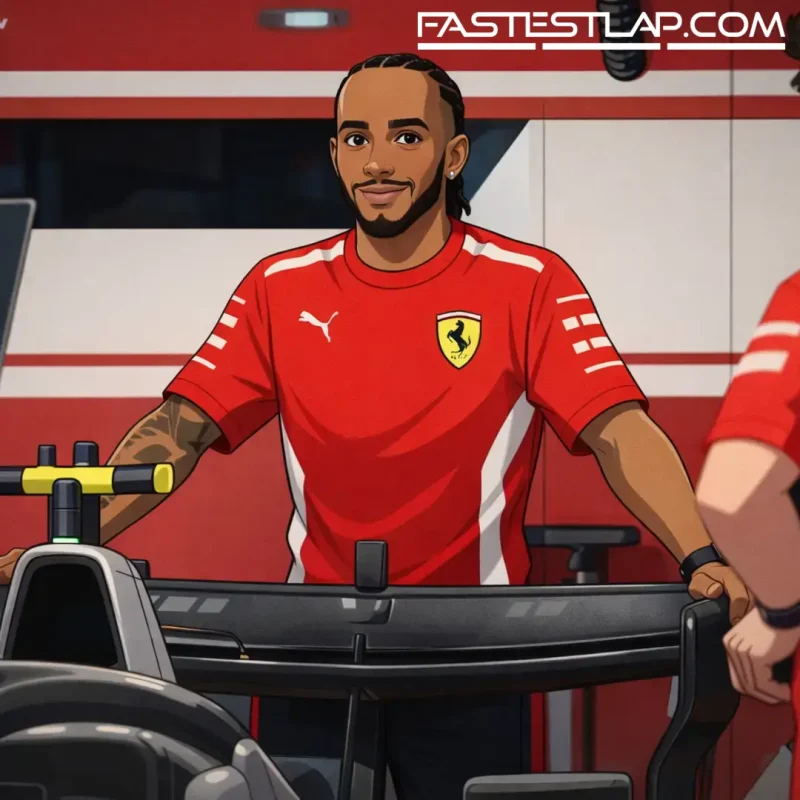
Lewis Hamilton doesn’t tend to hand out gushy compliments lightly, particularly when it comes to the machinery behind the scenes. So when he starts talking about an “Italian Bono” at Ferrari, it’s less a throwaway line and more a tell: something fundamental has shifted in the way his side of the garage is operating in 2026.
That “Bono” reference, of course, is to Pete Bonnington — the race engineer who became Hamilton’s constant at Mercedes and a central pillar of that era’s relentless efficiency. At Ferrari, Hamilton believes he’s finally found a comparable rhythm with Carlo Santi, the engineer now on his radio after the team’s internal reshuffle over the winter.
“Having that driver-engineer collab, it’s hit and miss sometimes,” Hamilton said in Monaco. “With me and Bono, we hit it right from the beginning… I do feel like Carlo is like my ‘Italian Bono’.”
It’s the kind of comparison Hamilton doesn’t make unless he means it. And the subtext is hard to miss: the first year at Maranello wasn’t just about learning a new car and a new culture — it was also about trying to make a crucial working relationship click when it simply wasn’t doing so.
Ferrari initially paired Hamilton with Riccardo Adami when he arrived, but that partnership never settled. The 2025 season was littered with tense radio exchanges, the sort that tend to become shorthand for deeper friction: not necessarily personal animosity, but a mismatch in style, tempo, and expectations. The driver wants information delivered a certain way, at a certain time; the engineer has their own habits, their own cadence, their own way of managing pressure. Get it right and the whole operation breathes. Get it wrong and everything feels harder than it should.
Hamilton’s description of Santi is revealing in that respect. He talks about calm, experience, and a shared willingness to dive into details — all traits that matter when you’re trying to create trust in the heat of a race, or when you’re trying to turn a vague sensation in the cockpit into an actionable change on a setup sheet.
“He’s an older guy that’s been around the block,” Hamilton said. “He’s very calm. This is a detail that we were able to go into together.”
In other words: fewer crossed wires, fewer moments where Hamilton is left feeling he’s fighting the car and the messaging at the same time. For a driver who has always been at his best when he can build momentum — session to session, weekend to weekend — that matters. A lot.
Hamilton also made it clear this isn’t just about one voice in his ear. He framed the change as part of a broader effort by Fred Vasseur to build a working environment that actually suits him — not in a “special treatment” sense, but in the practical reality that elite drivers tend to need their side of the team configured around how they extract performance.
“Fred has been great, working with me and helping me, for example, with engineers,” Hamilton said. “The engineer set-up is a million times better than it was last year.”
That’s a striking line — and a slightly brutal one, too, given what it implies about 2025. But it also speaks to Ferrari’s willingness, at least under Vasseur, to be less sentimental about structure and more ruthless about function. For years, one of the paddock’s quiet criticisms of Ferrari has been that it could be slow to react internally, or too proud to admit something wasn’t working quickly enough. Hamilton, by his own account, is seeing the opposite now: adjustment, and then immediate payoff.
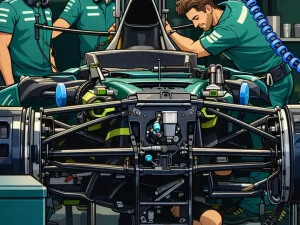
He points to work done since last season, including items he says he requested after simulator sessions. He even namechecks suspension as an example of something he asked for and now has.
“Last year, testing on the sim and asking for certain things in the car, we have those today,” Hamilton said. “It’s great to be able to be a part of working with everyone to move the ship and steer it in the right direction.”
That’s Hamilton doing what he has always done well: using his experience not just to drive around problems, but to influence the direction of travel. At Mercedes, that feedback loop became almost institutional. Ferrari has often been accused — fairly or not — of not extracting enough from its drivers’ feedback, or of struggling to translate it into consistent development choices. If Hamilton feels listened to now, and if the engineering group is matching his language with clear responses, it’s no surprise he’s sounding more like himself.
None of this is Hamilton claiming Ferrari has “arrived”. He’s careful to point out the gaps remain, and that there’s still work to do.
“We still have a long way to go, we still need to improve in some areas,” he said. “But I think we’re on the right path.”
Still, the most interesting part of Hamilton’s Monaco comments isn’t the optimism — it’s the specificity. He isn’t talking in slogans. He’s talking about process: the relationships, the calm competence, the ability to get into the weeds without it turning into noise. In modern F1, where margins are thin and weekends can be derailed by the smallest misunderstanding, that’s not a soft factor. It’s performance.
And for Hamilton, after a first year that too often looked like a negotiation with his own pit wall, finding an “Italian Bono” might be the most significant upgrade Ferrari have made all season.