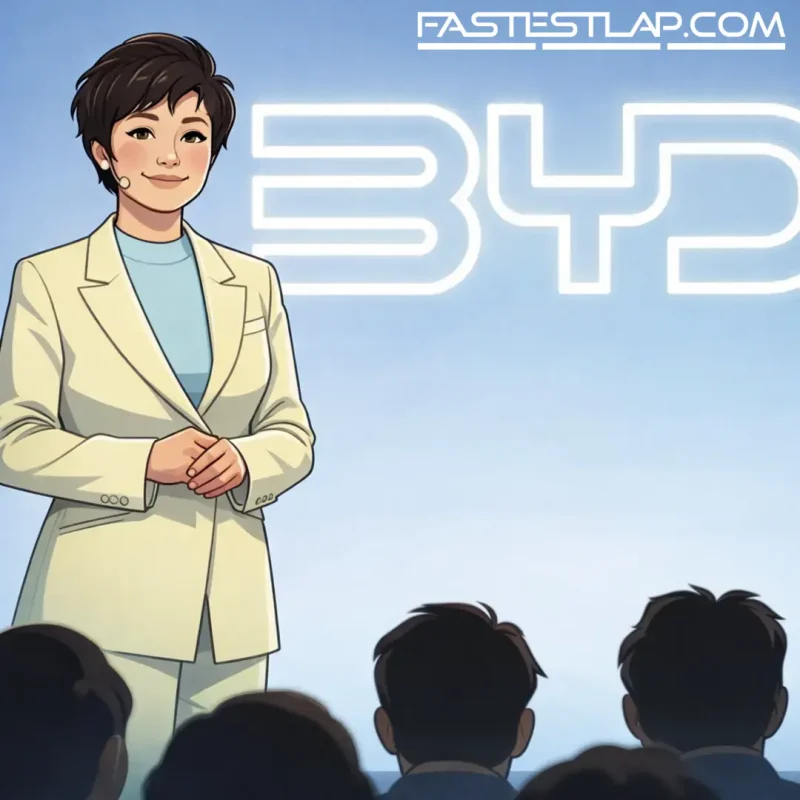
BYD’s flirtation with Formula 1 stopped being a vague “we’re interested” soundbite the moment Stella Li started stacking meetings in Monaco with the two people who matter most: Stefano Domenicali and Mohammed Ben Sulayem.
Over the Monaco Grand Prix weekend, BYD’s vice-president sat down with F1’s chief executive and the FIA president in separate discussions — the kind of diary space you don’t get unless the other side thinks there’s at least something worth hearing. Li met Domenicali on Friday, then spoke with Ben Sulayem on Saturday after the FIA president arrived that morning.
In the paddock, BYD’s interest has been treated as credible in the sense that the company’s scale and ambition are self-evident. The scepticism sits elsewhere: this is a manufacturer with no meaningful motorsport track record, and Formula 1 is not an industry you can brute-force your way into simply because you’re good at building road cars quickly. Several senior figures have privately questioned how close BYD is to having the infrastructure, processes and people to do more than talk — with one view being that any realistic attempt to enter as a new team is “years away”, and another that this is, for now, a fact-finding mission with a publicity halo.
Li has been open about the fact BYD is doing its homework. Speaking earlier this year to Chinese media, she confirmed the company’s interest, then expanded on it during an interview in Monaco. Her pitch for why F1 appeals won’t surprise anyone who’s watched the sport’s commercial rise: the energy, the emotion, the cultural footprint.
“I think Formula 1, it’s all pure energy, the emotional connection to the people, and then it’s the culture,” Li said. “For BYD, we are a technology leader.”
That’s the line that makes the next part awkward — because the sport BYD is circling is also debating what it wants to be, technically, in the next cycle. F1 is heading into 2026 under new regulations, but the bigger political noise right now is about what comes after that, and how much electrification the FIA actually wants. The federation has signalled a desire to step back from the direction taken by the current V6 hybrids; the talk in the background points towards a simplified V8 with only a modest electrical component. The FIA has suggested that could happen once the current Concorde Agreement expires ahead of 2031, with or without perfect harmony from the manufacturers already committed.
That matters because BYD’s entire modern identity is built on “new energy vehicles” — hybrid and full electric — and on a vertically integrated business model that turns battery and power electronics capability into a competitive weapon. On the face of it, F1 potentially rowing back on electrification looks like a philosophical mismatch.
Li didn’t try to pretend those dots connect neatly. Instead, she framed BYD’s Monaco conversations as an exercise in understanding where the sport is going — and left the door open to a world in which BYD’s technology could still have relevance even if the engine note gets louder.
“[They] did not change anything, so that’s the reason we are just understanding what they are doing,” Li said. “It’s not only that, that’s the only part, but the thing about it is, even you want to use a combustion engine, you need the best material science, which BYD is very strong.”
It’s also telling that Li wouldn’t be pinned down on what “entering Formula 1” actually means. The simplistic assumption is a brand-new BYD works team — but that’s the hardest, slowest and most expensive route, and it comes with the added headache of convincing the sport there’s value in expanding the grid.
Other possibilities have been floated in the paddock: buying an existing team (none are publicly for sale), or taking a meaningful stake in one — the sort of arrangement that already exists elsewhere, like the 24 per cent holding Otro Capital has in Alpine. Li didn’t confirm any preference beyond keeping the menu open.
“We are seeking any opportunity to see if BYD technology can help FIA, can help all other teams,” she said. “Second ambition, as BYD, we also need to build a brand here. So this is the scope.”
That wording is doing a lot of work. Helping the FIA? Helping “all other teams”? It sounds less like a standard OEM power play — slap your badge on an engine and call it a day — and more like a company feeling out where it can plug into the F1 ecosystem without committing to the full madness of running a team from scratch.
Then there’s the Christian Horner wrinkle. Li has already held talks with the former Red Bull CEO and team boss in Cannes about what might be possible together. Horner’s record makes him a magnet for any serious project, but he’s also understood to want an ownership position if he returns to the pitlane — which instantly turns any courtship into something more complicated than hiring an executive.
Li was warm when asked about him.
“Yeah, he is a great guy, a good friend, we like him,” she said, smiling.
The obvious question is timeline. Even optimistic voices around BYD aren’t painting this as something that appears on the grid imminently, and Horner — successful, available, and with options — may not be inclined to sit on his hands for multiple seasons waiting for an idea to become a facility, then a car, then a functioning organisation.
One intriguing sidenote is where BYD isn’t looking. Despite Formula E aligning far more cleanly with its road-car ethos, it’s understood BYD isn’t currently exploring entry into the all-electric series. Li’s explanation for focusing on F1 was effectively that the sport’s leadership is asking the same future-facing questions and sees value in what BYD can bring.
“This is very interesting because they are also very much exploring the future, the technology, and they understand what BYD have,” Li said of her Monaco meetings. “I believe, for us, we try to understand what’s the interest they have, and how they can, with BYD, work together. This is kind of a mutual interest, together.”
The politics of any future entry are also less chaotic than they were. Under the new Concorde Agreement, the FIA and Formula One Management are supposed to run a more genuinely collaborative process if and when Expressions of Interest are opened for new teams. The previous system produced an uncomfortable stand-off where an entry that evolved into the Cadillac project passed the FIA’s checks but wasn’t approved by FOM. Even so, it’s understood any new EoI process isn’t imminent.
What is imminent — and relevant — is the engine conversation. Ben Sulayem’s Monaco schedule included plans to meet all current power unit manufacturers as the FIA tries to settle on an engine split that would move to 60/40 in favour of the combustion engine, with discussions continuing around next year’s regulations and the next cycle beyond that.
Read those two Monaco storylines together and you get the real picture: BYD isn’t just knocking on F1’s door. It’s turning up precisely when the sport is arguing about what its next decade of technology should look like — and making sure the people writing that future know BYD wants a seat in the room, even if it hasn’t decided which chair it’s aiming for.