
The FIA’s power unit “safety net” for 2026 is about to do exactly what it was designed for — and, in the process, it’s quietly confirmed an early pecking order that’ll make uncomfortable reading in Maranello and Hinwil.
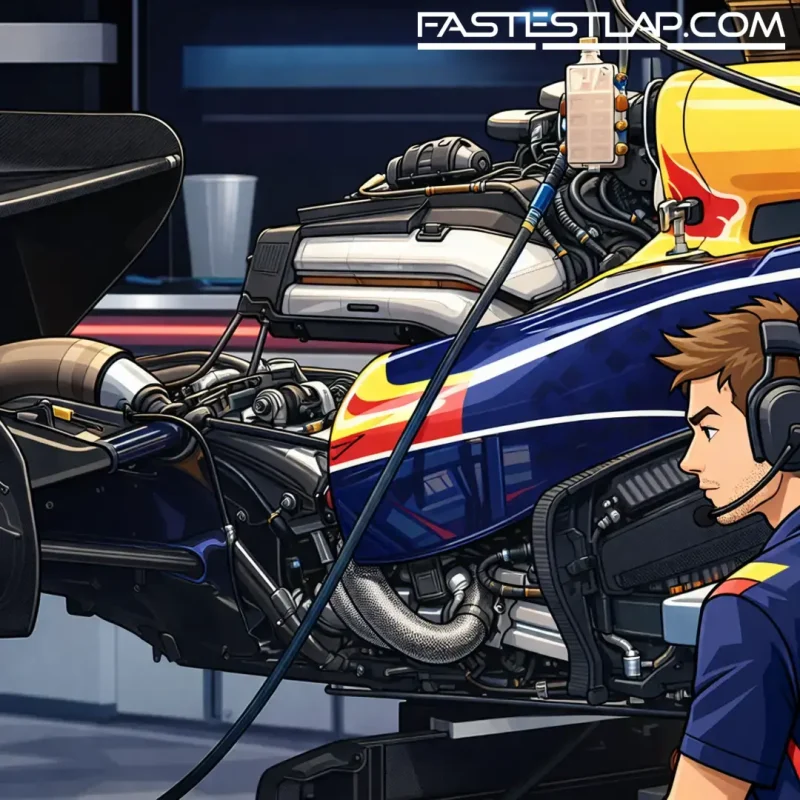
Multiple well-placed paddock sources say Red Bull Powertrains has been indexed as the benchmark internal combustion engine in the FIA’s ADUO (Additional Development Upgrade Opportunities) analysis. The governing body hasn’t published the full benchmarking outcome yet, but the headline is already doing the rounds: Red Bull’s DM01 is the reference point, and everyone else is being measured against it.
That matters because ADUO isn’t a trophy; it’s leverage. It’s the FIA’s mechanism for letting power unit manufacturers crack open homologated hardware and apply targeted upgrades inside defined windows, with the number of opportunities tied to where a manufacturer sits in the performance index. If you’re on top, you get less room to move. If you’re lagging, you get more chances to catch up. The whole point is to stop 2026 turning into a one-engine formula before it’s even found its feet.
The first key nuance is what’s being indexed. This benchmarking is understood to be focused on the internal combustion engine rather than the overall power unit. That distinction is crucial in an era where the headline numbers can be distorted by how teams deploy energy, how aggressive they are with maps, or even how their chassis packaging influences operating windows. The FIA’s net is aimed at the core of the hardware — and right now, it’s Red Bull Powertrains setting the bar.
The second nuance is why the result has landed with such a jolt in the paddock. Red Bull Powertrains, still the sport’s newest factory-scale programme, is being compared directly with manufacturers who’ve been building hybrid-era F1 engines for a decade and beyond — plus Audi, which has arrived with all the weight and expectation that comes with it. Yet the index, as described by sources, puts Red Bull ahead.
Mercedes is understood to be next-best, but more than two percent behind the benchmark. Under the ADUO structure, that gap would leave the Brixworth operation with one upgrade opportunity.
Behind them, the picture is harsher. Ferrari, Audi and Honda are said to sit at the back of the index and, as a consequence, each would qualify for two upgrade opportunities.
Lewis Hamilton has already alluded to the shape of this after Monaco, discussing the allowances in a way that aligned with the same order: Red Bull Powertrains in front, Mercedes next, then Ferrari, Audi and Honda. It was the sort of remark that lands because it doesn’t sound like conjecture — more like a driver letting slip what’s already been briefed internally.
For Ferrari, the immediate temptation will be to frame ADUO as an escape hatch. It is — but it’s also a public admission that you’re chasing. Two upgrade opportunities are valuable, yet they’re not a magic wand if the underlying architecture isn’t where it needs to be. The FIA’s intent here is balance, not reinvention.
Audi, at least, is being candid about where it stands. The manufacturer confirmed it has qualified for at least one allowance and pointed the finger squarely at its power unit deficit rather than the rest of the package.
“This is entirely in line with what to be expected as our data has consistently shown that whilst the chassis of the R26 is delivering well, the major gap to our competitors is to be found in the engine,” an Audi spokesperson said.
“This is no surprise, especially considering this is the first time Audi has developed a Formula 1 power unit.
“ADUO remains an important tool for the FIA to help level the playing field as we all strive towards a more competitive and technologically forward thinking sport.”
That’s a sensible message — and a necessary one. Audi can’t afford a narrative where the project is painted as stumbling out of the blocks, particularly when it’s trying to establish credibility in a paddock that doesn’t give out patience for free. The team’s line is essentially: the chassis is doing its job, the power unit has the gap, and the FIA’s system is functioning as intended.
On the other side of the garage door, Red Bull’s moment comes with asterisks of its own. Being the benchmark doesn’t mean the job is finished — it means you’re the one with the smallest safety net. Under ADUO, the leaders don’t get to keep iterating with the same freedom. That’s the trade-off. If rivals have two bites at the cherry and you don’t, you’d better be confident your foundation is strong and your reliability book is tidy.
It also sharpens the significance of Red Bull Powertrains’ technical partnership with Ford. Ford’s motorsport boss Mark Rushbrook has been vocal about what the collaboration has achieved and how much pride there is in seeing that power unit running not only at Red Bull Racing but also at Racing Bulls.
“We’re very happy with where we are right now,” Rushbrook said, pointing to the strength of the partnership in Milton Keynes and the leadership group driving the programme. He was also frank that it hasn’t been spotless — “we have had issues, without question” — but framed that as part of the process, with the commitment to keep pushing.
There’s an interesting tension buried in those comments. Ford and Red Bull are pleased with the trajectory, yet the ambition is obviously bigger than being “top half” of the grid. And ADUO, by design, tries to prevent any early advantage becoming a season-long stranglehold. If Red Bull really has nailed the ICE benchmark, the next phase is about defending that advantage while others are handed extra opportunities to erode it.
This is where 2026’s politics will get prickly. The sport has wanted new manufacturers, new storylines, and a tighter competitive spread. ADUO is one of the tools to help get there. But when the first serious index points to the newest programme as the benchmark — and leaves some of the established names with two upgrade lifelines — it flips the expected script.
Now it’s on the FIA to publish the findings and formalise the allowances. And it’s on the manufacturers to prove, in public, that those upgrade windows are being used to close gaps rather than to litigate them. Because the moment ADUO becomes a talking point every Sunday, it stops being a balancing mechanism and starts being a battleground.









