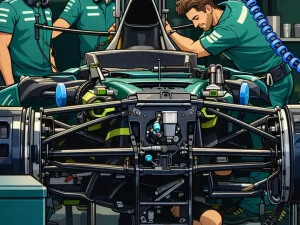
Colton Herta’s first official taste of a Formula 1 weekend will come in the most familiar of settings: Barcelona, a circuit every driver in the paddock can lap in their sleep. Cadillac has confirmed the 26-year-old American will step into Sergio Perez’s car for Friday’s opening practice session at the Spanish Grand Prix, ticking off the first of the team’s mandated rookie FP1 outings for 2026.
It’s a significant milestone for Herta, not because an FP1 cameo guarantees anything – it doesn’t – but because it formalises a path he’s been pointed down for a while now. He’s walked away from a successful IndyCar career, relocated his ambitions to Europe with a HiTech Formula 2 programme, and now he’ll finally get the one thing that matters in this business: proper, timed mileage in an F1 car on a live grand prix weekend.
Barcelona is also a quietly shrewd place to do it. Teams like to burn one of these sessions here because the reference points are so robust. Engineers know what “normal” looks like at the Circuit de Catalunya; drivers know the bumps, the wind shifts, the way the tyre behaves through the long right-handers. That makes it easier to separate the noise from the signal when you drop a rookie into the cockpit and ask them to run the programme without turning the morning into a salvage operation.
Herta, for his part, is pitching it exactly as you’d expect: keep it clean, deliver the run plan, don’t get carried away.
“I’m excited for Barcelona,” he said. “I feel ready to get out there. I’ve had time in the simulator at Charlotte, learning the track and the procedures to follow during the session.
“I’ve also been working with the team at Silverstone and at the track over the past few races, following how they work so I can get up to speed as quickly as possible.
“The aim is to have a clean session and help the team gather the data it needs, as well as getting used to the F1 car.
“It’s going to be a busy weekend as I’m competing in F2 at the same time, but pressure is a privilege so I’m looking forward to it.”
That last line lands because it’s true: this isn’t a marketing lap. Cadillac doesn’t need to “try” an American in public to justify its identity; the team’s already on the grid. What it does need, though, is meaningful reference data on a driver it clearly rates enough to invest time and preparation in – simulator work in Charlotte, integration at Silverstone, paddock exposure over recent races. FP1 is a small piece of the puzzle, but it’s a real one, and it puts Herta’s feedback, adaptability and pace under a microscope in a way a private test never quite can.
The timing is also interesting given the swirl of noise Cadillac has had to stamp out recently. Herta’s name has been loosely attached to Valtteri Bottas’ race seat, fuelled by the sort of mid-season rumour that spreads because it’s easy, not because it’s accurate. The claim: Bottas was underperforming relative to Perez and could be vulnerable.
Bottas didn’t just dismiss it; he swatted it away with the kind of bluntness drivers reserve for paddock fiction.
“Well, it’s part of the sport. It’s not the first time I’ve faced those kinds of rumours,” he said in Monaco. “But it’s a bit of a shame that somebody just makes up complete bullshit, but that’s normal in this sport.
“I know my situation, the team knows my situation, they support me 100 per cent.
“So that’s why, from my side, it was okay in the end.”
Team boss Graeme Lowdon was just as direct, calling the talk “fiction” and insisting there was “no foundation of truth” to any suggestion Bottas was on the brink. Pressed on where it had come from, Lowdon’s answer was basically a shrug and a knowing look at the ecosystem: “Headlines. Click.”
In that context, Herta’s FP1 outing matters because it can easily be misread. A rookie session is a regulatory requirement – four FP1 runs per team across the season, two per car – not an automatic foreshadowing of a driver change. Cadillac giving Herta Perez’s car for the first instalment also says more about practical planning than internal politics: Perez is an experienced baseline, and Barcelona is controlled enough to make comparisons and procedures straightforward.
But none of that makes Friday insignificant. Herta is only four rounds into his F2 campaign and hasn’t stood on the podium yet, so this is an accelerated timeline by any measure. That’s not a criticism; it’s just the reality of how teams think. If Cadillac believes a driver is worth tracking for the medium term, it will start building a dossier early: simulator correlation, engineering interaction, how quickly the driver settles into F1 braking systems and tyre behaviour, and whether the radio traffic sounds like someone you can work with at speed.
And for Herta, the opportunity comes with an extra edge: he’ll be doing it while juggling his main job in the F2 paddock the same weekend. The physical side is manageable for a fit driver, but the mental switching – one set of procedures, one level of downforce and braking performance, then straight back into the F2 rhythm – is where the weekend can bite. Get through it cleanly, and you’ve shown a team you can handle bandwidth as well as lap time.
Friday morning in Barcelona won’t decide anybody’s future on its own. But it will add something concrete to a conversation that’s mostly been noise so far – and in 2026’s paddock, that’s often the most valuable currency there is.