
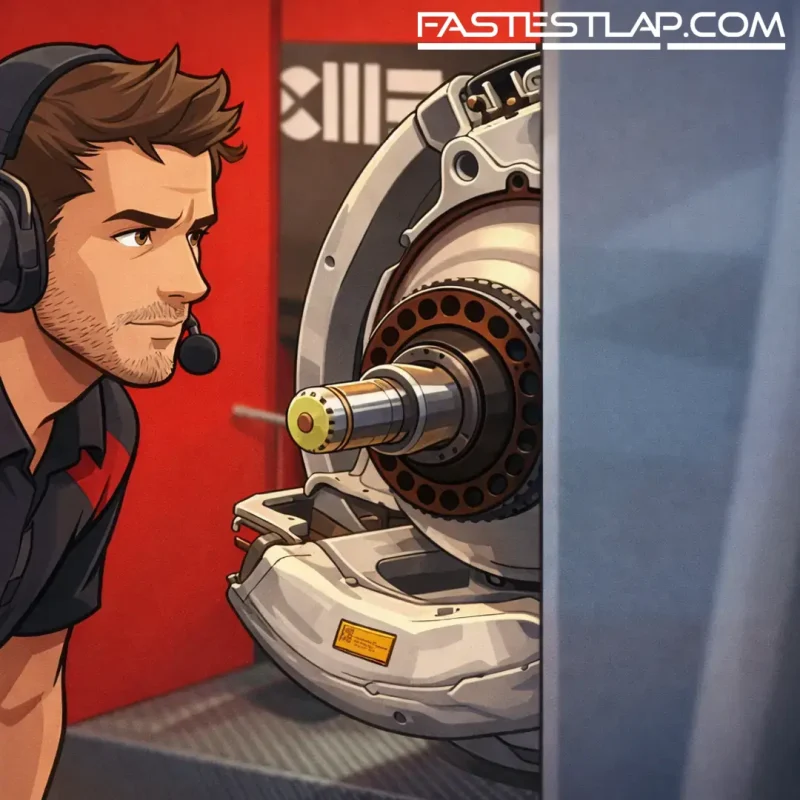
Ferrari will run a split-from-tradition braking setup again in Barcelona, with Charles Leclerc set to switch disc and pad supplier to Carbone Industries for this weekend’s Spanish Grand Prix.
Leclerc has been a long-time Brembo user on that side of the garage, but he’ll now mirror Lewis Hamilton’s configuration: Brembo calipers remain in place, while the discs and pads move to CI — the Safran Landing Systems subsidiary more commonly associated with aerospace hardware than Scuderia lore.
It’s a notable step not because Ferrari is tearing up its supplier relationships overnight, but because it underlines how aggressively the team is chasing “feel” as a performance tool in 2026’s tight midfield-at-the-top. When a driver starts talking about confidence on the brake rather than outright stopping power, you’re in the murky, subjective territory where lap time is real but the fix is never tidy.
Hamilton made the jump earlier in the season, switching his disc and pad supply at the Japanese Grand Prix. The timing of Leclerc’s decision is no mystery. Monaco was messy from the outset, and it ended in the barriers — with Leclerc openly pointing to braking problems throughout the race.
His description afterwards was stark: full braking power at only one corner, no braking power at all from the rear, and a loss of temperature that caught him out under the Safety Car at Mirabeau. Then, at the restart, he went straight on at Antony Noghès and hit the wall, venting his frustration on the radio as the race unravelled. Monaco doesn’t need much help to punish you, but a driver who doesn’t trust the pedal there is effectively driving with one eye closed.
The interesting part is Ferrari’s posture. You might expect a 50-year supplier relationship to come with a degree of institutional stubbornness — the sort that insists the problem must be elsewhere, that the data will vindicate the established solution. Instead, it’s understood Ferrari is backing Leclerc’s push for a change, framing it as a driver-led move aimed at improving the sensations he needs when leaning on the car.
That, in itself, tells you something about how teams now treat the interface between driver and machine. With the margins so fine, “feel” isn’t a soft, indulgent concept; it’s a performance lever. It influences how late a driver will commit, how stable they can keep the platform on entry, how much they’ll trust the rear when rotating the car, and how consistently they can repeat it over a stint. If Leclerc believes the disc/pad characteristics help him access that, Ferrari’s job is to enable it — even if it looks, externally, like an awkward message to a long-standing partner.
Brembo, for its part, didn’t take kindly to the post-Monaco narrative forming in public. While Leclerc didn’t name the company directly, the supplier issued a statement expressing surprise at his comments and pushing back on any implication that conclusions should be drawn before the data had been fully analysed with Ferrari’s engineers. The company also pointed to its breadth of presence across the grid — a reminder that, in F1’s supply ecosystem, reputations are defended quickly and loudly.
Barcelona will provide a cleaner read than Monaco ever could. The circuit’s a more conventional test: repeated heavy braking zones, temperature management that actually behaves like temperature management, and a layout that exposes instability under deceleration without the casino-level variance of street-circuit bumps and low-speed compromises.
For Leclerc, though, this isn’t about proving a supplier right or wrong. It’s about getting back to a braking platform he can attack with. If Hamilton’s earlier switch was a quiet vote of confidence in the CI direction, Leclerc following him makes it a pattern — and in an F1 garage, patterns tend to become policies unless the stopwatch says otherwise.
What’s also hard to ignore is the subtle internal dynamic: Ferrari now has both drivers converging on the same disc-and-pad solution, which simplifies correlation and reduces one variable in a season where Ferrari can’t afford to be guessing. If the team’s data and the drivers’ comments begin to align in Barcelona and beyond, it will look like a sensible response to a specific problem. If it doesn’t, it’ll be filed under the long list of “Monaco-only” dramas that don’t survive contact with a normal racetrack.
Either way, Leclerc’s weekend starts with a clear objective: rebuild trust in the brake pedal. In modern F1, that’s not just comfort — it’s lap time.









