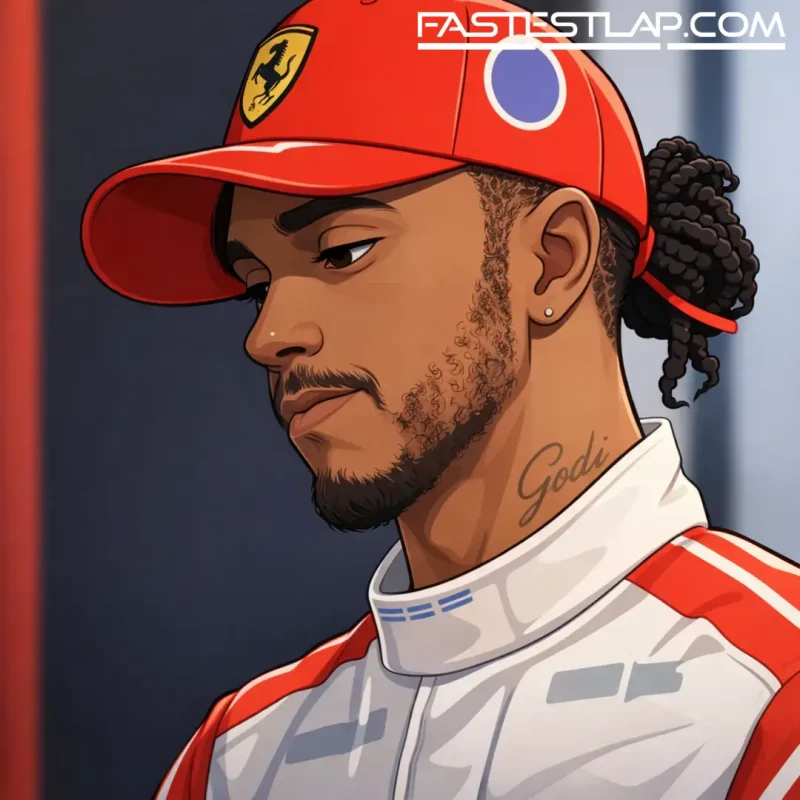
Lewis Hamilton’s Monaco weekend looked clean on paper — third on Saturday, second on Sunday — but his body language in parc fermé told the truer story. This was the kind of result that flatters, while leaving a driver quietly irritated at the bits that got away.
Hamilton’s frustration wasn’t aimed at traffic, strategy, or the usual Monte Carlo lottery. Instead, it was something far more specific: whether Ferrari left performance on the table by not following the rear-wing direction others leaned into once the FIA removed Straight Line mode from the equation.
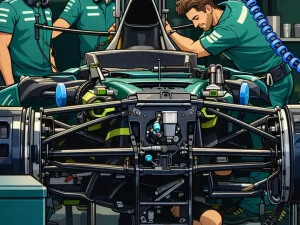
Around the paddock, the visual cue was obvious by Thursday. Mercedes and Red Bull rolled in with rear wings featuring extra winglets added around the activation pod area — a solution geared to claw back downforce now that, in Monaco’s configuration, the rear wing was effectively locked in a fixed position. The intent was straightforward: if you can’t access the usual aero tricks on the straights, you bulk up the car’s baseline load for the corners that actually matter here.
And it wasn’t only those two. The FIA’s upgrades list for the weekend showed McLaren, Racing Bulls, Haas, Audi and Cadillac also revising rear-wing spec to suit the lack of Straight Line mode. Ferrari, however, didn’t arrive with the same eye-catching hardware, and Hamilton admitted it raised his eyebrows.
“All weekend, I think for us, apart from wanting more downforce globally,” Hamilton said in Monaco. “I think when we arrived on Thursday we saw other people, those guys with trick additions to their wing, we didn’t have that, which was a little bit of a surprise.”
That line — “a little bit of a surprise” — was doing plenty of work. In modern F1, it’s rare for top teams to be genuinely caught out by an obvious trend, and Monaco is precisely the kind of outlier event where you expect the big groups to arrive with something slightly bespoke. Ferrari may have had reasons: correlation, production timing, confidence in their baseline platform. But when a driver says it in public, it’s usually because he felt it in the car.
Hamilton’s read was consistent all weekend: Ferrari simply didn’t have enough downforce, and it showed up not as a catastrophic deficit, but as a ceiling. He could be quick; he couldn’t be *quick enough* to seriously lean on Kimi Antonelli when it mattered.
Even within that, the balance story was messy. Hamilton described a car that veered from too much front end in qualifying to a more manageable state only after he’d been forced into a drastic adjustment.
“In general, to go quicker, we needed more front end,” he explained. “We got to qualifying and had a lot of front end, and I had to take out like ten holes of front wing for some reason.
“So, once I took out the ten holes, the car was a little bit more reasonable by my last lap in Q3.”
It’s the sort of compromise Monaco punishes: you’re asking the driver to build confidence run by run, but you’re also asking him to relearn the car mid-session. Hamilton didn’t hide how much that knocked him off his rhythm.
“I needed that balance to start in Q1 and then build upon that, because it’s all about confidence,” he said. “It was completely gone in Q1 and then I was trying to pull back what I could.”
What makes this more interesting is the wider context of Hamilton’s form. The Monaco podium came straight after another runner-up finish in Canada, and that sequence has moved him to second in the drivers’ standings in 2026. The gap to Antonelli remains hefty — 66 points — but the trajectory is unmistakable: Hamilton is settling, the results are stacking up, and the “does he still have it?” noise has started to sound increasingly dated.
“I’m in a really good place with the car,” Hamilton said. “I’m in a really good place with the team, and you can see that I have decent pace still in me.
“There’s no lack of pace, which I’m really grateful for and happy about, regardless of all the negative comments people have made over the times. So, it’s good.
“Just keep on putting the work in and I’ll keep showing up and I’ll keep delivering.”
That’s the sharp edge to this Ferrari chapter: even when it’s going well, it’s rarely serene. Monaco exposed a slightly awkward reality — that Ferrari’s weekend was strong enough for the podium, but not as technically decisive as its rivals in preparing for a one-off regulatory nuance. In a season where small margins have been magnified by tighter competition, those are exactly the weekends that end up haunting a title chase later.
Off-track, Hamilton also brushed aside any suggestion the team’s recent confirmation of Charles Leclerc for 2027 triggers imminent contract discussions on his side. He was blunt: it’s not time, and it’s not something occupying his head.
“No, it doesn’t,” Hamilton said when asked if Leclerc’s deal meant it was time to talk. “It’s quite some time off. I have a lot of time.”
He then framed his own Ferrari future less like a negotiation and more like a formality waiting to be actioned.
“It’s not a thought, it’s not a conversation,” Hamilton added, “but it’s an engagement.”
Maybe that’s the most revealing part of the weekend. Hamilton isn’t talking like a driver searching for stability or reassurance. He’s talking like someone who believes the project is working — and is already picky about the details that could make it work even better. Monaco didn’t convince him Ferrari is short on speed. It convinced him Ferrari can’t afford to miss the obvious tricks when everyone else has spotted them.