George Russell doesn’t sound like a driver searching for excuses. He sounds like one doing the harder thing: trying to separate what he can actually fix from what’s already escaped his grasp.
Two races, zero points. Five races, a 68-point swing that’s taken him from leading the championship to staring at Kimi Antonelli’s rear-view mirror. And in a season where Mercedes’ margins have often been measured in tenths, Russell’s last fortnight has been defined by the kind of administrative and operational errors that don’t show up on a driver’s data trace — but absolutely detonate a title campaign.
Monaco was the latest gut-punch. Russell admitted his pace deficit to Antonelli in Monte Carlo was on him — around four tenths, in his words — and he didn’t dress that up. But the outcome, a points-less Sunday that widened the gap again, was dominated by a pitlane sequence that went from messy to ruinous in seconds.
Mercedes pitted Russell under Safety Car conditions, and the first five-second penalty that should’ve been served during that stop effectively wasn’t. The result was the kind of escalation the regulations are designed to enforce: a far harsher drive-through penalty, delivered at the worst possible circuit to have it, at the worst possible time to take it, with the field tightly packed. Russell went from being in the mix to being nowhere.
“It’s an incredibly difficult pill to swallow,” he said in Monaco, reflecting on the broader arc of his season as much as the specifics of that pit stop. “I don’t ever really believe in good luck or bad luck, but when I look at the season as a whole… there’s not a lot, and the whole season could look totally different.”
That’s the crux of Russell’s frustration: not that he’s been perfect, but that the bulk of the damage — as he sees it — hasn’t been self-inflicted.
He pointed to Canada, where he says he was leading when a breakdown ended his day. He referenced Japan, where a Safety Car appeared just 10 seconds after a pit stop, the sort of timing that can turn a smart call into a catastrophe with no warning. And he returned, inevitably, to Monaco’s penalty farce: a sequence born out of confusion, crossed messages, and a decision tree collapsing in real time.
“I got the drive-through because there was a lot of confusion last minute,” Russell explained. “I was meant to be staying on track, but then the FIA pulled the cars through the pit lane.
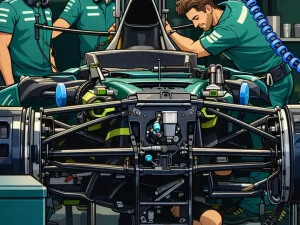
“I was asking the team, ‘am I stopping for tyres or [just] stop?’ I didn’t get an answer, but I saw my set of tyres there. Everything just happened too quick, and I guess the mechanics didn’t get the message that I had to leave the car for five seconds.”
Russell even felt he had the race situation covered. He said he had a 20-second gap to Pierre Gasly behind and was prepared to serve the penalty properly the following lap — a common-sense solution that isn’t available once the rulebook’s been tripped. The stewards don’t grade on intent, and a penalty not served correctly is, by definition, not served. The drive-through was inevitable.
The irony is that Russell’s recounting makes the whole episode sound less like a single blunder and more like a systems failure — the kind that only needs one missing radio answer, one mechanic not hearing the key instruction, one procedure misread at the wrong moment. Monaco is ruthless in that way. It doesn’t ask for much time loss to destroy your afternoon; it just asks for a crack.
Russell’s own summary was brutal. “I probably, with the software glitch, probably gained one tenth of a second in the whole pit lane and lost 13 positions.”
In isolation, a botched penalty is a bad day at the office. In a championship fight, it’s structural damage. Because the points don’t care about context, and neither does the table: Russell left Monaco describing himself as “70 points off the lead,” underlining how quickly a season can flip from attack to triage.
There’s also an interesting subtext in the way Russell frames it. He’s careful to own what’s his — Saturday pace, areas to improve — but he’s drawing a line around what he believes has been taken away by reliability, timing, and team execution. That line matters, because drivers can live with being beaten; it’s being removed from the fight by preventable chaos that corrodes trust, and Mercedes can’t afford that if it wants to keep Russell fully invested in a long chase.
The larger problem is simple: a gap of this size to Antonelli doesn’t just require Russell to be fast. It requires clean weekends, aggressive scoring, and — crucially — an end to the “outside of my control” moments. Championships are won by the teams that can do the boring things flawlessly while still nailing the clever ones. Right now, Russell’s story of 2026 reads like the opposite: the difficult stuff is manageable, the basics have been costly.
He put it plainly: “Some things I need to improve for sure… and it’s just unfortunate.”
Unfortunate, yes. But also unsustainable. If Russell’s going to claw this back, he’ll need more than speed — he’ll need Mercedes to stop handing him the kind of setbacks no driver can drive their way out of.