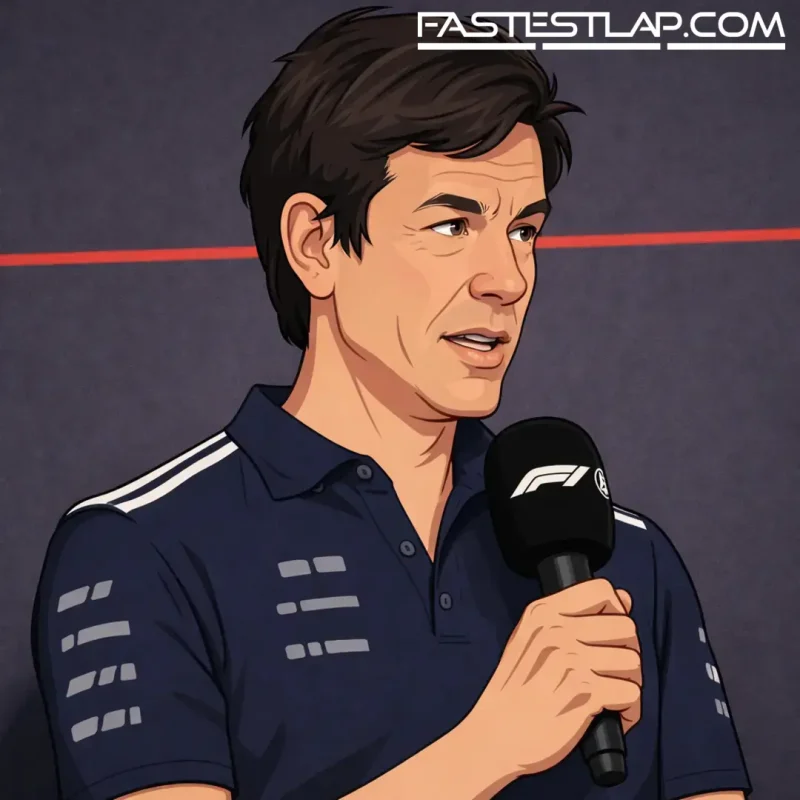
Toto Wolff has tried to pour a bucket of cold water on the first proper flashpoint of F1’s 2026 engine era: the FIA’s early ADUO readout that has Red Bull Powertrains’ internal combustion engine sitting at the top of the pile — and Mercedes, for once, potentially staring at the rulebook for help rather than being the example everyone else points at.
Speaking in Barcelona, Wolff insisted there’s nothing murky in the FIA’s Additional Upgrade Development Opportunities framework, even if the paddock has already started doing what it always does when a technical document lands: reading between lines that, in this case, he says simply aren’t there.
“In my opinion, when you speak to Nikolas [Tombazis], it’s data they have measured and collected,” Wolff said. “There is no political background, there is no favours, but it’s the outcome of their analysis of their torque sensors and the way it’s being done, and that is the result.”
The underlying detail matters because ADUO is one of the key guardrails attached to the new power unit regulations: a mechanism designed to stop the category sleepwalking into another extended period where one supplier bolts the door early and everyone else spends years chasing shadows. The FIA’s findings — based on its measurement and analysis — have effectively marked Red Bull Powertrains out as the reference point so far, with Mercedes among the manufacturers expected to benefit from at least one additional upgrade opportunity as a consequence.
That’s the funny bit in the current tone of the season: Mercedes has started this new era as the team to beat on track, with every race win so far going either to Kimi Antonelli or George Russell. Yet in the engine conversation, the FIA’s numbers have shoved Mercedes into the unusual position of being “behind” in at least one key early metric, even as it’s running the sport at the front.
It’s also why the first reaction around the paddock hasn’t been outrage so much as raised eyebrows. Red Bull’s own people have conceded their DM01 is strong, but there’s been surprise that it’s been labelled outright best, with Mercedes widely assumed by many to have set the early benchmark. Wolff’s response was essentially: don’t argue with the instruments.
And, in typical paddock fashion, he couldn’t resist pointing out how quickly the knock-on effects start. Wolff revealed Alpine executive advisor Flavio Briatore had been in touch — half-serious, half-theatrical — about the uncomfortable optics of being a customer team when the “strongest engine” assumption suddenly isn’t as straightforward.
“I had Flavio [Briatore] calling me and saying the deal was that he’s buying the strongest engine, and found out that it’s not the strongest engine,” Wolff said. “So, what can I say?”
For Mercedes, the subtext is as important as the joke. ADUO isn’t framed as a consolation prize; it’s a development tool, and Wolff made clear he views any extra homologation window as a genuine competitive weapon. The danger of missing out on those opportunities, he argued, is getting jumped by someone who has them.
“A new homologation is definitely something that is helpful, because if you don’t get that, there is quite a possibility of being leapfrogged by somebody else who is able to do this,” he said.
Still, Wolff was careful to underline that none of this is “frozen”. The FIA will revisit the picture every few races, meaning the current classification is more snapshot than verdict. It’s an important distinction, because if there’s one thing teams dislike more than being behind, it’s being told they’re behind permanently.
“We shall see how this pans out over the next time,” Wolff said. “Because we must not forget this is not a frozen situation, but it’s going to be looked at every couple of every few races, and then being judged upon.”
Where Wolff’s comments got more pointed was on the line he doesn’t want anyone crossing. He described ADUO as a “protection mechanism” — a way of preventing a repeat of the kind of runaway advantage the sport lived through at the start of the hybrid era. Mercedes, he admitted, was “on the good end of that” historically, but stressed the whole point now is to protect the health of the grid, particularly with the mix of established and newer projects.
It’s a pragmatic argument dressed up in principle: nobody wants manufacturers embarrassed to the point they reconsider the value of being here. Wolff explicitly referenced Audi’s arrival, Honda’s return as Aston Martin’s partner, and Red Bull Powertrains’ own evolution as the kinds of projects the sport can’t afford to see undermined by an unbridgeable early deficit.
But he also bristled at the idea of going further — and he used the one term that still makes senior F1 figures recoil: Balance of Performance.
“That’s what it is, and that’s how it should be, and now we can say, does it need an engine adjustment, as it is in aero? I get a rush of allergy when talking about BoP,” Wolff said. “This is something that we should stay far away from Formula 1.”
Wolff’s objection wasn’t just philosophical. He framed BoP as a political trap that other categories struggle to escape, one that can sour relationships with manufacturers and create endless arguments about who’s being helped and who’s being punished.
“If there is a mechanism that consists of finetuning in order to make sure that nobody’s embarrassed on the power unit side, I think that’s the right way to go,” he said, before drawing a line between that and any attempt to “agree on how the balance of performance should fall out”.
That’s the tightrope the FIA has walked into with ADUO: create enough elasticity to keep the field healthy without turning the power unit rules into a permanent negotiation. Wolff, perhaps sensing how quickly this conversation can go off the rails, is effectively saying: trust the data, accept the tool, and don’t let it become something else.
For now, that’s easy for Mercedes to say. It’s winning races. If the next FIA reassessment flips the order — or if a rival uses extra upgrade opportunities to land a decisive hit — the politics Wolff claims aren’t there may arrive anyway, because in Formula 1 they always do. The only question is whether ADUO keeps that fight in the factories, where it belongs, or drags it into the stewards’ room and the court of public opinion.