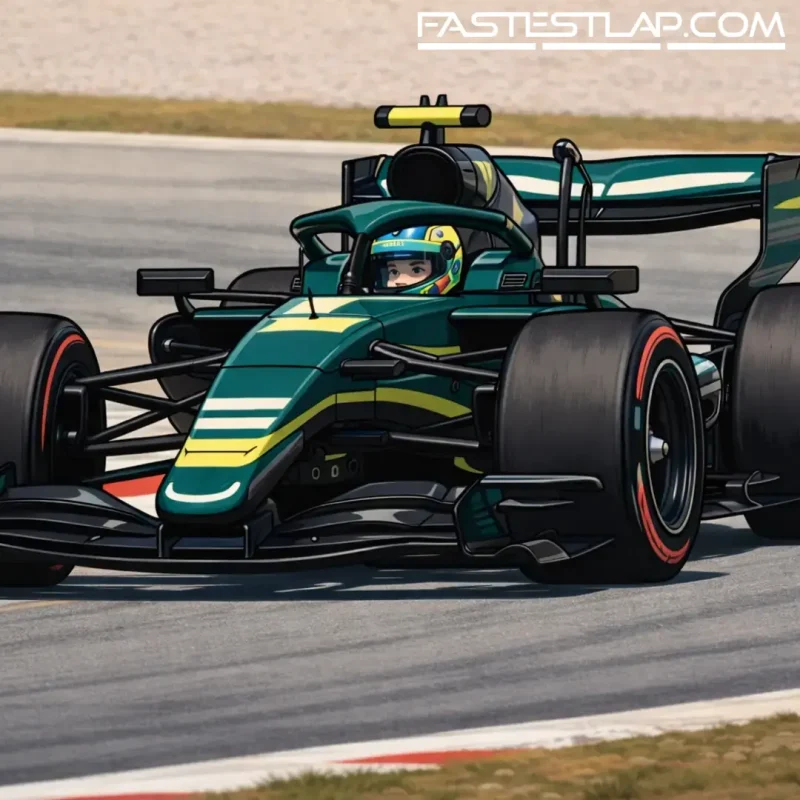
Fernando Alonso didn’t bother dressing it up in Barcelona. After tumbling out in Q1 and ending up dead last on the grid for his home Grand Prix, the Aston Martin driver reached for language that bordered on resignation rather than frustration.
“I came here knowing that we are the last, and we are the last,” Alonso said after qualifying. “No surprises there.”
That bluntness landed harder because it wasn’t delivered in the heat of a missed lap or a traffic complaint. Alonso sounded like a driver reading from a week-to-week reality he’s already accepted — and, crucially, one he doesn’t think will change any time soon. Lance Stroll’s elimination alongside him, leaving Aston Martin with both cars on the back row, underlined the point: this wasn’t a Fernando special gone wrong. It was the team’s baseline.
Asked whether the Circuit de Barcelona-Catalunya — the sort of track that traditionally shines a floodlight on aero efficiency and car balance — had exposed Aston Martin’s weaknesses, Alonso wasn’t having it. In his view, there’s nothing newly revealed here. It’s simply the same problem, repeated.
“No, nothing exposed,” he said. “We know that we have the worst car and the worst engine. We’ve been very clear in every race so far that we have to work.”
For a two-time world champion who has spent much of his career surviving on hope, nuance and the occasional political escape route, calling your own package “the worst car and the worst engine” is as sharp as it gets. It also speaks to an uncomfortable truth for Aston Martin: 2026’s reset was supposed to be an opportunity to reposition themselves, not a trapdoor.
Alonso did at least point to a timeline — and it’s one Aston Martin will be clinging to as the season grinds on. He said changes are due in the second half of the year, referencing both aerodynamic revisions and a new engine arrival. In his words, that’s where the hope lives.
“In the second part of the year arrives a new car on the aerodynamic side, arrives a new engine, and we have the hopes there,” Alonso said. But even that came with a sting. He effectively predicted more of the same at the next stop, suggesting there’s little point pretending the near-term will improve.
“We repeat every weekend,” he added. “We will arrive in Austria in two weeks, we will be last in qualifying.”
What made Barcelona feel particularly grim was the way Alonso described the car’s behaviour over a lap. This wasn’t just a matter of lacking peak downforce or being a few kilometres per hour down on the straights; it was a car that couldn’t be leaned on, changing its demands corner to corner in a way that kills confidence and makes extracting the last few tenths feel like a guessing game.
“I had huge rear locking, some push on the engine,” Alonso explained. “Our engine and gearbox are a bit random, so maybe it was for both cars, or maybe not, but in my car, my case, I had a lot of rear locking under braking in some corners, and the opposite – a lot of push, like half throttle open – in some other braking.
“All in all, it was not easy to drive the car. It has been not easy the whole weekend.”
Those are the kinds of comments engineers hate because they’re so hard to rebut publicly. If your driver is talking about randomness — not just a predictable weakness, but inconsistent behaviour — it suggests a package that isn’t merely slow, but unstable in its operating window. And on a track like Barcelona, where the lap is a chain of linked commitments, instability quickly becomes humiliation.
The subtext, too, is that Alonso has stopped trying to soften the message for morale. The Spaniard has always been adept at applying pressure through the media when he wants movement, and this feels like that: a veteran making it clear that pretending everything’s fine isn’t an option. When a team is this far back, “we’re working hard” isn’t a narrative — it’s a requirement, and Alonso is reminding everyone of it.
For Aston Martin, the immediate concern isn’t just the grid position on Sunday; it’s the risk of this becoming normalised. Once a team gets used to being last, it becomes dangerously easy to shift focus to tomorrow’s upgrades, tomorrow’s engine, tomorrow’s new aero — and allow today’s deficiencies to go unchallenged.
Alonso, at least, is refusing to let that happen. The problem is that a refusal doesn’t move you off the back row on its own.