
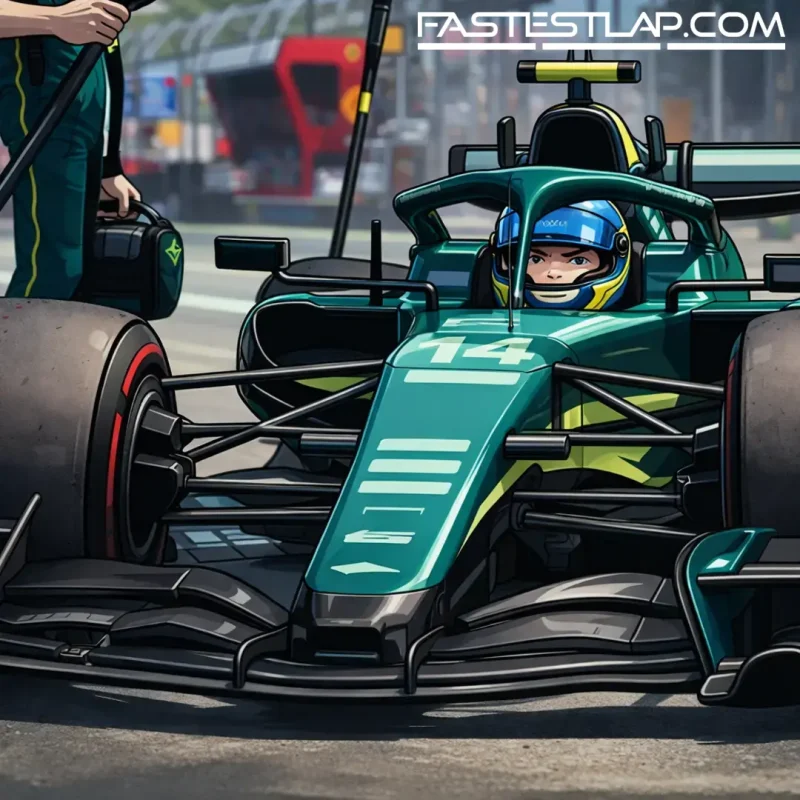
Fernando Alonso’s “last” Formula 1 appearance in Barcelona was already shaping up to be a long afternoon. Aston Martin’s decision to break parc fermé and change key power unit elements has now ensured he won’t even take up a slot on the grid.
Instead, the two-time world champion will start the Spanish Grand Prix from the pit lane after the team replaced the energy store and MGU-K on his car overnight, with the control electronics unit also changed. Under the regulations, that combination — carried out once qualifying had locked the cars down — triggers a pit-lane start.
It’s the kind of procedural footnote that can sound dramatic on paper, but it largely just formalises what Alonso’s Saturday had already telegraphed: Aston Martin is in survival mode here, and Alonso was headed for the very back regardless.
Both Alonso and team-mate Lance Stroll had a bruising qualifying at the Circuit de Barcelona-Catalunya, ending up more than a second adrift of Valtteri Bottas’ Cadillac. For a track still treated in the paddock as a reliable reference — long straights, a spread of corner speeds, nowhere to hide if the platform’s wrong — that margin landed like a verdict.
Aston Martin’s statement was blunt: “Fernando will start today’s race from the pit lane due to a change of ESME and MGU-K.” The follow-up detail matters too. With the control electronics also replaced, Alonso has now used four of each element this season, pushing him beyond his allocation. In normal circumstances that’s a rear-of-grid penalty via cumulative grid drops; because the work was done under parc fermé without permission, the sanction is simply more absolute: don’t line up, start from the lane.
There’s an unavoidable sense this is less about chasing an advantage and more about chasing functionality. When a team takes the pit-lane start hit at a circuit where track position is still valuable, it’s usually because it’s decided the potential upside of a cleaner, healthier power unit outweighs the cost — or because it didn’t like what it saw in the data and doesn’t want to send the car out in race conditions on tired parts.
Alonso, typically, didn’t bother dressing it up after qualifying. He arrived in Spain expecting to be among the slowest cars and said the weekend has delivered exactly that, labelling his package “the worst car and worst engine” on the grid.
“I came here knowing that we are the last, and we are the last,” Alonso said. “No surprises there.”
That’s a remarkably stark public diagnosis from a driver who’s spent much of his career weaponising optimism when it serves a purpose. But this is home soil, the atmosphere is already emotional because of the “last race in Barcelona” framing, and there’s a point at which the politics of positivity stops buying you anything. Alonso sounded like someone tired of pretending there’s a clever way out of a fundamental pace deficit.
From a race perspective, the pit-lane start changes the optics more than the tactics. Aston Martin was already facing a day where points would require chaos and ruthless execution. Starting from the lane may even simplify some decisions: there’s no protecting grid position into Turn 1, no need to gamble on the opening lap to “make” a race that the car’s pace doesn’t naturally offer.
But the bigger tell is what it says about where Aston Martin believes it is right now. Barcelona is the sort of place teams use to confirm whether an issue is track-specific or baked into the car. When a driver of Alonso’s sensitivity is this certain about being last, and the team is already rotating through power unit elements early enough in the year that allocations are being exceeded, it paints a picture of a weekend where the priority has drifted from performance to damage limitation.
Could the fresh components provide a lift? Possibly, at least in terms of stability and deploy consistency. But nobody in green will be under the illusion that a new energy store and MGU-K turns the Spanish Grand Prix into a fair fight against cars that have simply been quicker all weekend.
For Alonso, it’s an oddly fitting bit of Barcelona theatre: the hero of the grandstands starting not in front of them, but behind the pit wall, waiting to be released into a race he already knows will be uphill. The noise will still be there when he emerges — but the circumstances underline the uncomfortable truth he’s already voiced. Right now, Aston Martin isn’t just off the pace. It’s trying to stop the weekend from getting worse.









