Fernando Alonso didn’t need the data screens to tell him how his Barcelona weekend was going to go. The body language gave it away early: a shrug here, a wry remark there, and that familiar tone that sits somewhere between defiance and disbelief when the tools simply aren’t up to the job.
Aston Martin arrived at the Circuit de Barcelona-Catalunya already on the back foot with its Honda-powered package, and Alonso had been bracing for damage limitation. By Saturday night it had drifted into something harsher. Out-qualified by Lance Stroll, Alonso labelled it “the worst car and the worst engine” — the kind of line that lands with extra weight when it comes from a driver who’s seen pretty much every flavour of competitive disappointment Formula 1 can offer.
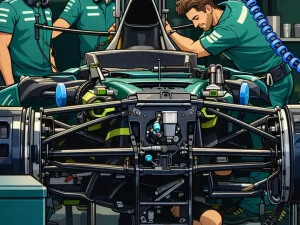
Then came the pit-lane start. Aston Martin changed Alonso’s energy store and MGU-K, a move that effectively admitted the weekend had become a survival exercise rather than a points hunt. Alonso, never one to dress things up for the sake of harmony, told fans he’d rather “stay here to watch the race” with them because it would be “more comfortable than in the car”. It drew laughs at the time. It also turned out to be painfully accurate.
With 25 laps still left on Sunday, Alonso’s race ended at Turn 9. One moment he was circulating, the next he was coasting to a stop and climbing out, his Grand Prix done. There was no slow bleed, no creeping warning signs that a driver can nurse to the flag. It was abrupt.
“No, no, no,” Alonso said when asked if he’d had any notice something was coming. “The engineer came on the radio saying to stop the car and jump out of the car. So I imagine it was an ERS problem when you have to jump out of the car. Apparently it’s the battery.”
It was the latest entry in a season that, from the outside, looks like it’s asking Alonso to spend most Sundays waiting for something — an upgrade that works, a reliability run that holds together, a race that falls his way. Aston Martin has been fighting on two fronts: pace and durability. Barcelona was a reminder that even when you try to fix one, the other can still bite.
“We changed some of the parts that broke in the race, unfortunately,” Alonso added. “We are struggling on performance, but also on reliability, still not bulletproof. So, yeah, we’re still dealing with a lot of issues.”
And yet, the most vivid moment of Alonso’s Spanish Grand Prix had nothing to do with lap time. As he stepped away from the stranded AMR26, the grandstand noise swelled into chants of “bravo, bravo Alonso”. For a driver who has lived through every shade of fandom — adoration, expectation, impatience, the occasional backlash — it clearly landed.
“It was the best part of the weekend,” Alonso said. “The fans were incredible the whole weekend. That was very, very nice feeling. Very emotional weekend for me, maybe the last in Barcelona.”
That last line hung in the air. Alonso’s relationship with this place is threaded through his whole career arc: the home hero, the near-misses, and his most recent win here back in 2013. If this really was his final F1 Sunday at Barcelona, it played out less like a farewell tour and more like a snapshot of why he’s always been so compelling — the ruthless clarity, the refusal to sugarcoat, and the strange ability to still make it feel like the day matters even when the result doesn’t.
He admitted the sting wasn’t just the retirement, but what it meant for the crowd that had turned up for him.
“So, yeah, out the car, I enjoy it every minute, but unfortunately we didn’t give to them what they deserve in terms of results,” he said. “Hopefully our second part of the year we can improve the situation.”
Aston Martin’s pain wasn’t confined to one side of the garage. Stroll retired too, out on lap six with a gearbox issue — another blow for a team that can’t afford to waste weekends, especially when it’s already relying on opportunism to get into the points.
That’s the frustrating subtext to Alonso’s season so far: the one point the team has scored came in Monaco, a reminder that if the race becomes weird enough, Alonso is still one of the best in the business at turning chaos into something useful. But Monaco-style lotteries aren’t a plan. They’re a lifeline.
“We need to stay together, for sure,” Alonso said. “That point in Monaco proves that we are not giving up. Even if we were at the back of the grid, we were able to finish the race and take whatever opportunity. We have hopes for the second part of the year with improvement that we can be a little bit more competitive. We keep on working.”
What Alonso wants now isn’t another heroic salvage job. He’s talking about the basics: a car that actually gets faster when you bolt new parts on, and a package that doesn’t ask him to park it up before the chequered flag.
“But yeah, we need to see some results as well,” he said. “Eventually we need to see some of the upgrades to make the car faster. The last few years, some of the upgrades didn’t make the car really fast as we wanted.
“So there are some things to prove with this year’s upgrades, and we are all hoping for the best.”
In other words: the goodwill is still there, the fight certainly is, and the Barcelona crowd proved the connection hasn’t faded a bit. But if Aston Martin wants more weekends defined by the driving rather than the diagnosis, it has to start giving Alonso fewer reasons to be right about how “comfortable” watching from the grandstand might be.