
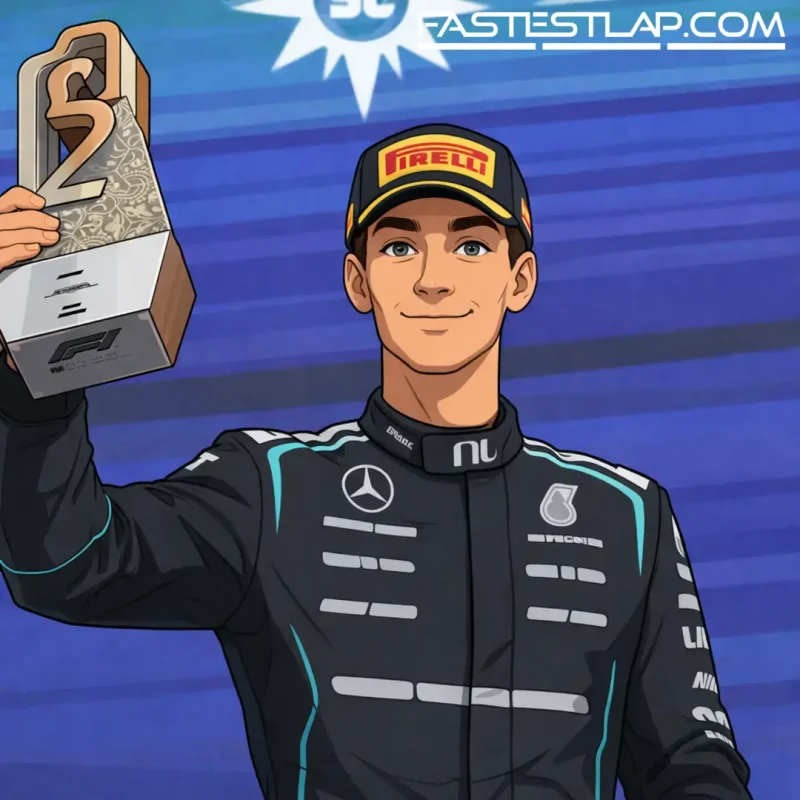
George Russell didn’t sound like a driver panicking about a championship slipping away. He sounded like someone irritated by the parts of Formula 1 that still feel unfair, even when you’re doing most things right.
Second place in Barcelona should have been a statement drive. He’d started from pole and, on paper, had the track position to dictate terms. Instead, the Spanish Grand Prix turned into another chapter of a season that has repeatedly refused to follow the script Russell arrived with in 2026 — and he admitted as much afterwards, describing aspects of this year’s title fight as “hard to accept”.
“It’s tough, you know. It’s not an easy sport,” Russell said after the race. “We work every single day of our life to achieve this dream, and when you know things out of your control go against you, it’s difficult to accept. And if the performance isn’t where you hope for it to be, it’s also difficult to accept.”
The raw numbers paint the same picture. After seven races, Russell sits third in the championship behind Mercedes team-mate Kimi Antonelli and Lewis Hamilton. That would’ve sounded unlikely before the season began, given Russell was widely viewed as the title favourite. And yet here he is, 50 points off Antonelli’s lead — a gap that could’ve been uglier had Antonelli not suffered a late retirement in Spain.
Barcelona itself was telling, because it wasn’t a weekend where Russell disappeared. Quite the opposite. Over one lap he did the job, and in clean air early on he was tidy and assertive. The problem was that he never got the sort of cushion you need to control a modern grand prix, especially once strategies begin to diverge. Hamilton and Antonelli remained within touching distance, and when Ferrari got clever on the pit wall it was Mercedes that ended up reacting rather than shaping the race.
That “canny” Ferrari call forced Mercedes into a compromised approach, and the consequence was brutal: Hamilton pounced for the win while Antonelli’s late-race pace was strong enough to muscle past Russell for second — if only briefly, given Antonelli’s retirement late on.
Russell’s frustration wasn’t dressed up as excuses. If anything, he sounded more bothered by what he felt he could’ve done better than what others did to him. That’s the psychological grind of a season: you can cope with being beaten; it’s the combination of missed points, bad luck and a car that’s not always behaving the way you need it to that starts to needle.
The Canada battery issue while leading already stung. The Monaco penalty that dumped him out of the points lingered. Taken together, those are the kind of moments that turn a straightforward title tilt into a chase. Russell knows it, but he also made it clear he’s not going to let the standings drive his headspace.
Such has been the trajectory of his year that he insists he’s no longer thinking about the championship at all.
“I’m thinking about just controlling my controllables,” he said. “Friday and Saturday I felt like I did everything to the best of my ability and got absolutely the best result possible on almost every single lap I did.
“Today I made a great start. The first stint was solid, but the last two stints on the hard wasn’t good enough, so my head is coming out of this race thinking the performance was not strong enough, and I need to make some improvements.”
That last line mattered. Barcelona was the first proper tyre-degradation race of the season — the first one that didn’t default into an “easy” one-stop. Russell pointed out the contrast himself: six races of straightforward management, then suddenly a grand prix where degradation forced the winner onto a three-stop and punished anyone who couldn’t keep the hard tyre alive.
“It’s a challenging circuit,” he said. “It’s the first race of the year where we’ve had major tyre degradation, the winner on a three-stop strategy. The six races prior have been an easy one stop, so totally different ball game today.”
And that’s where the championship subtext creeps in, whether Russell wants to talk about it or not. A season can pivot when the conditions change. If Mercedes has been strong when races are simple and track position-heavy, Barcelona suggested there’s still work to do when strategy gets messy and tyre behaviour decides the pecking order. Russell didn’t hide from that: the performance “was not strong enough,” and he wants to “make some improvements”.
There was also a human moment in the middle of it, when he referenced Lando Norris and the long lens of ambition — the idea that teenage versions of themselves wouldn’t believe they’d one day be sharing podiums and press conferences with Hamilton. Russell allowed himself that perspective, even as he admitted the obvious: nobody on that podium was there to finish on the sides.
“Now, of course, we both would have been preferred to sit in the middle from the three of us,” he said. “But this is why we do it.”
Austria is next, and Russell says the plan is simple: reassess, refocus, and keep applying pressure. It’s a neat line, but it’s also the only one available when you’re 50 points down and the season is still young enough to rescue — yet old enough for missed opportunities to start leaving marks.
“We’ll reassess in Austria,” he said, “but as I said, I’m going to control my controllables and keep on trying to apply the pressure.”
In 2026, Russell isn’t short on speed. What he’s short on is an uncomplicated run. And in a title fight that currently belongs to his team-mates, that may be the hardest thing of all to accept.









