Lewis Hamilton’s first Ferrari win was always going to be sold as a fairytale. In Barcelona, it landed with something sharper: a reminder that, at this level, emotion is earned as much on the pit wall as it is in the cockpit — and that Ferrari’s internal temperature can change fast when the stopwatch agrees.
Hamilton delivered Ferrari’s first Grand Prix victory since 2024 with a drive that was equal parts aggression and management, but it was the team’s willingness to commit to an unapologetically busy three-stop that turned a Mercedes-controlled opening into a red statement. From the outside it looked almost too bold for modern Ferrari. From inside the garage, it read like a group finally acting on instinct rather than fear.
He started second for the 66-lap race, but the early shape belonged to Mercedes. George Russell held the lead off the line and set a pace that suggested the usual script: control the front, protect track position, force everyone else to blink first.
Ferrari blinked immediately — and that was the point.
Hamilton was the first of the top 10 to pit, coming in on lap 11 for fresh tyres. Mercedes reacted by stopping Russell, a call Russell wasn’t thrilled about, yet he emerged still in front, two seconds clear of Hamilton. On paper, Mercedes had covered the undercut and kept the race in its hands.
But Ferrari weren’t playing a one-move game. When Hamilton stopped again on lap 28 for a second set of medium Pirellis, Mercedes didn’t respond. That decision — whether driven by tyre modelling, traffic fear, or simple reluctance to be dragged into Ferrari’s rhythm — opened the door.
Hamilton, with clean air and licence to push, carved through the traffic phase that usually decides Barcelona races before the final stint even begins. Russell eventually pitted on lap 36, but by then the swing was already happening. As the strategies unspooled, Hamilton found himself leading, helped by seven laps of all-out pace that made Mercedes’ earlier control feel suddenly brittle.
The final twist was the Virtual Safety Car on lap 41 — the kind of neutralisation that can make a strategist look like a genius or a fool depending on where you are on the loop. For Mercedes, it was the moment the whole structure collapsed. For Ferrari, it was the invitation to slam the door.
Hamilton pitted from the lead and returned still in front, his engineer Carlo Santi confirming what mattered: “And you are in front!” Fresh tyres went on the SF-26, and the race ended there in any meaningful sense. Hamilton drove away from the Mercedes pair and won by 19.561s over Russell, with no late-race ambiguity, no nervous tyre cliff, no question about who’d been quickest when it counted.
The radio afterwards was pure release — to Maranello, to his family, to the fans who followed him into the most scrutinised move of his career.
“Grazie a tutti, Maranello,” Hamilton said. “Thank you so much. You’ve helped me achieve this dream, and I can’t thank you enough.
“Thanks for everyone pushing so hard back at home. I’m so proud of you.
“To my family, I love you. To my fans, thank you for continuing to remind me who I am. I couldn’t have done this without you.
“Grazie!”
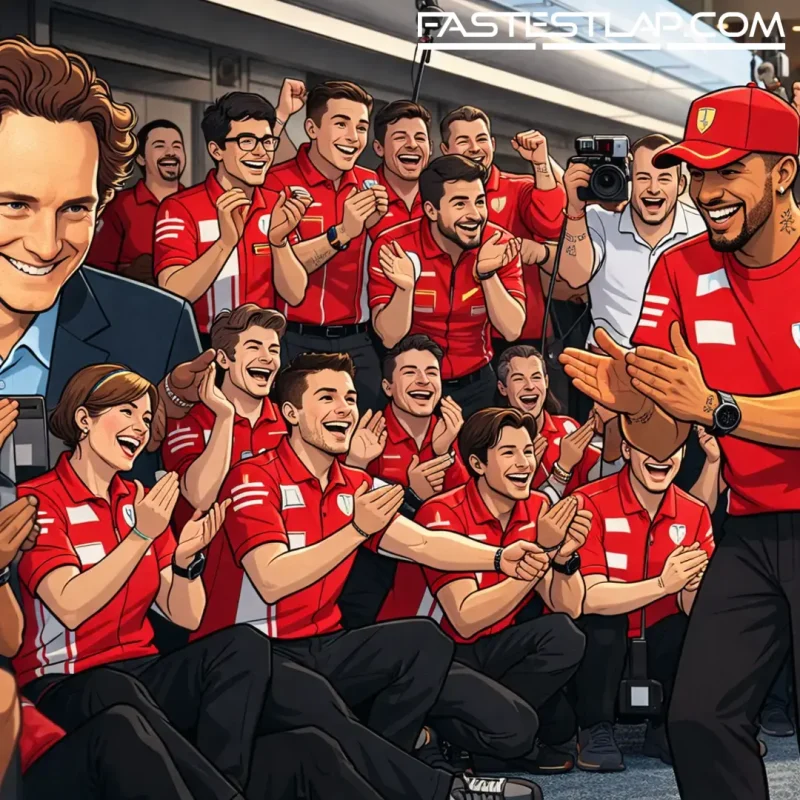
Ferrari chairman John Elkann was quick to put his name to the moment, describing it as “emotional” and “very important” — not just for Hamilton, but for the wider organisation and the fanbase that lives off these days.
“Well done Lewis, on your first great victory with Ferrari: an emotional moment and a very important result, which belongs to the entire team and to all our fans,” Elkann said.
He also used the opportunity to broaden the applause beyond the F1 pit lane, thanking Ferrari’s Le Mans squad for fighting “until the very end” in what he called an “incredibly demanding” 24 Hours.
That warmth is notable not because Ferrari don’t celebrate wins — they do, louder than anyone — but because Elkann’s public tone has not always been so forgiving when the results aren’t there. Only months ago, after Ferrari’s double retirement at the 2025 São Paulo Grand Prix, he aimed a very blunt assessment at the team’s driver line-up, lumping Hamilton and Charles Leclerc into a critique that drew a clear line between the perceived strengths of the mechanics and engineers and the people holding the steering wheel.
“If we look at the Formula 1 championship, we can say that on one hand we have our mechanics, who are actually winning the championship with their performance and everything they’ve done on the pit stops,” Elkann said at the time. “If we look at our engineers, there’s no doubt that the car has improved. If we look at the rest, it’s not up to par.”
He went further, suggesting the drivers should “focus on driving and talk less” as Ferrari chased second in the constructors’ fight — a target they didn’t end up hitting, finishing fourth in 2025.
Barcelona, then, isn’t just Hamilton ticking off a bucket-list item. It’s Ferrari’s first proper piece of leverage in a season where they’ve looked good without always looking dangerous. After seven race weekends in 2026, Ferrari sit second in the constructors’ standings, 49 points ahead of McLaren but 72 behind Mercedes. A gap like that isn’t erased in one afternoon — but the psychological value of doing it once, convincingly, in a straight fight, is hard to overstate.
For Hamilton, the win will be framed as destiny in red. In reality, it was something more practical: a front-running team finally trusting its own calls, and a driver with the experience to turn that trust into a margin that left no room for protest. In Ferrari terms, that’s what a “very important result” really means.