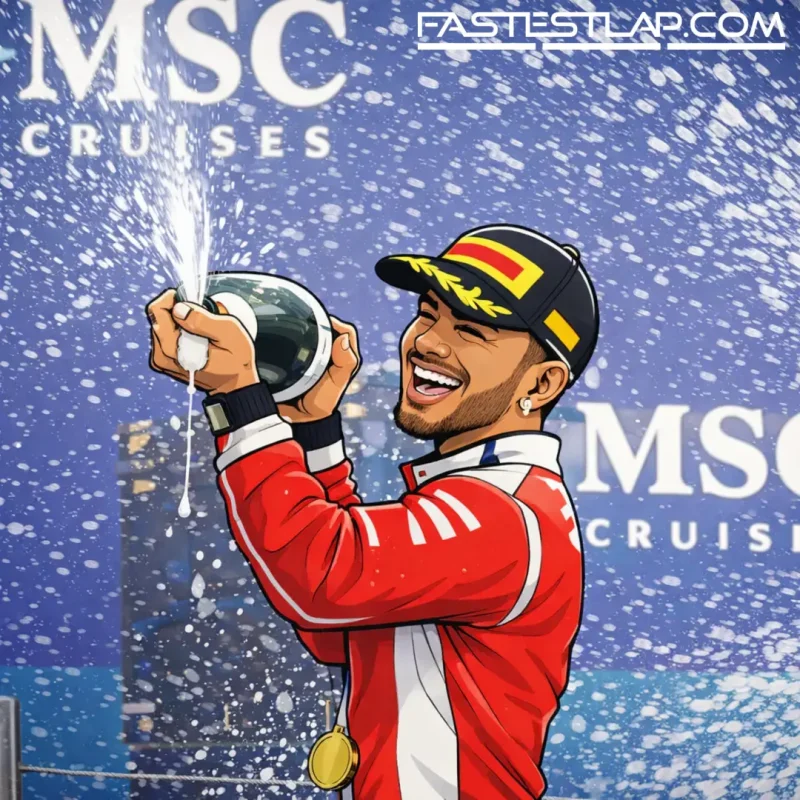
Lewis Hamilton didn’t just win the Spanish Grand Prix — he exhaled.
The grin on the Barcelona podium said plenty on its own, but the more revealing moment came afterwards, when Hamilton finally gave context to what’s been lurking in the background of his first stretch in Ferrari red. The crash in that private pre-season test at the Circuit de Barcelona-Catalunya last year? He wasn’t unhurt after all. Hamilton admitted he carried an injury for “months” following the incident — a detail that reframes a season in which the noise around him got louder by the week.
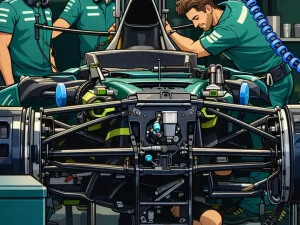
Ferrari’s running at Barcelona in January 2025 was part of the team’s ramp-up with Hamilton and Charles Leclerc sharing an SF-23. Hamilton had driven on the opening day and was back in the car on the morning of day two when he lost control on the final section of the lap — the fast, flowing stretch that ends with two high-speed right-handers. Trackside reports at the time suggested he’d walked away fine. Eighteen months later, standing in the same place as a Grand Prix winner, he quietly corrected the record.
Asked about how much the online commentary about his form had got under his skin — particularly during a first season at Ferrari that brought no podiums — Hamilton didn’t pretend he’s impervious.
“I’m only human,” he said. “There’s moments where I see the stuff and for sure there’s moments where I allowed it to get to me and penetrate deeply.”
It’s not hard to understand why it would. The move to Ferrari was meant to be a late-career ignition, a storybook pairing of the sport’s most successful driver with its most mythologised team. Instead, the first chapter was dominated by doubt: doubt about speed, doubt about adaptation, doubt about whether the calendar had finally outrun him. Hamilton is 41 now — an age that, in F1 terms, invites lazy conclusions — and a year without a podium is the sort of statistic people use to build a verdict.
What Hamilton revealed in Barcelona is that he’d been fighting more than public perception. He didn’t specify the nature of the injury, but he did make it clear it lingered well beyond the test itself, and that it shaped the winter and the year that followed.
His response was typically Hamilton: retreat, reset, and then go again with an intensity that borders on self-punishment.
He spoke about “unplugging” from the “matrix”, spending time around people outside the paddock — “real people”, as he put it — and leaning on family and friends who didn’t treat a rough patch like a personality flaw. And then came the work.
“From Christmas Day,” Hamilton said, “the training that I put in was harder than I’ve ever experienced, to keep myself in good shape… because I think at the beginning of last year I got injured here, actually, and carried that for months.”
The interesting thing isn’t that Hamilton trained hard — he always has. It’s the way he described rebuilding his mindset, almost like stripping back to bedrock principles after a year of second-guessing.
“Never second-guess yourself, never doubt yourself,” he said. “You’ve got to continue to believe in yourself at the core… I’ve rebuilt my mind to this point, to get myself back to where I was.”
Barcelona, then, felt less like a single Sunday finally going right and more like the end of a long rehabilitation — physical and psychological — that he’d largely kept private. The win was his first as a Ferrari driver, and both his and Ferrari’s first victory since 2024. Hamilton’s last Grand Prix win before this came at the 2024 Belgian Grand Prix; Ferrari’s last was at the 2024 Mexico City Grand Prix. For a team and a driver who measure themselves in trophies, that’s a drought — not catastrophic, but uncomfortable.
Hamilton didn’t try to play it cool.
“I’ll look back at this for sure and be like, ‘Damn, I wish I had the right words’,” he said. “How do you find the right words to express an emotion that’s beyond your wildest dreams?”
He spoke about believing in the decision to join Ferrari — not as a marketing line, but as a conviction that had been tested by a year of sideways glances and hot takes.
“I know it started out with lots of excitement and then lots of doubt and lot of negativity that followed through a whole year,” he said, crediting fans, family and friends for getting him through it.
There was also a window into what it means to win with Ferrari, rather than simply for Ferrari: the sight of the mechanics and engineers singing the Italian anthem, the almost childlike pride of wearing the badge.
“I’m probably going to sleep in this red top tonight,” Hamilton laughed. “It’s a good feeling to have the horse on there at top.”
From a championship perspective, the result has bite as well as romance. Hamilton’s 25 points, combined with a DNF for Kimi Antonelli, means Hamilton now trails the championship leader by 39 points after seven race weekends. George Russell sits third, nine points behind Hamilton — close enough to keep the pressure on, not close enough to ignore the warning.
If there’s a broader takeaway from Hamilton’s Barcelona breakthrough, it’s that the “decline” narrative so often attached to older drivers in F1 can be both premature and simplistic. Hamilton didn’t ask for sympathy, and he didn’t use the injury as an excuse. But he did, finally, offer an explanation — and in doing so, made this win feel like more than a good weekend.
Ferrari didn’t just get a victory. They got their Hamilton moment: vindication, catharsis, and a reminder that the story wasn’t finished — it was just waiting for him to be whole again.