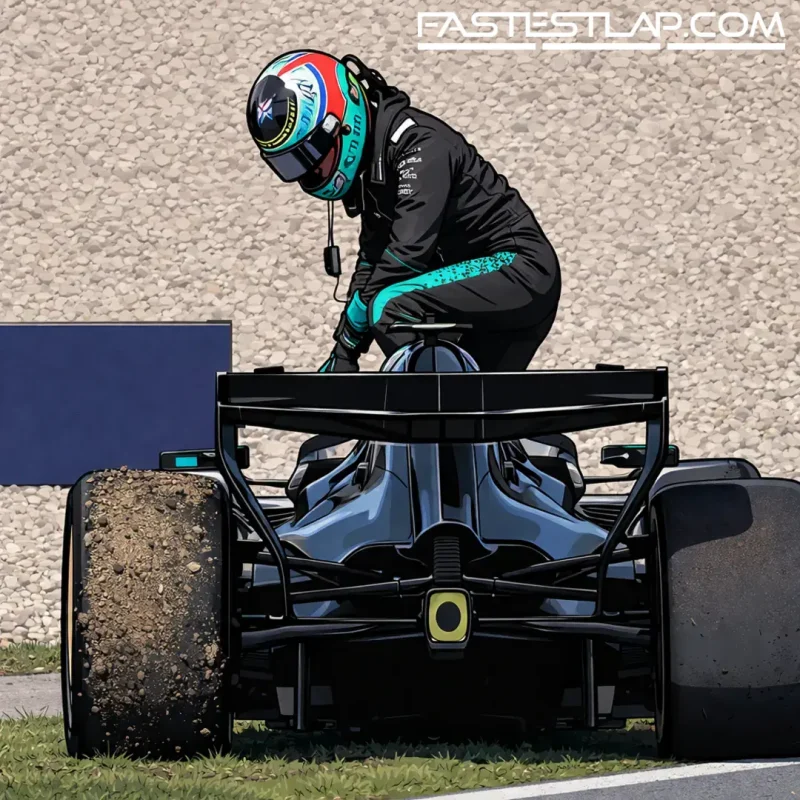
Kimi Antonelli had done the hard bit in Barcelona. He’d managed his tyres, picked his moments, and even had the composure to take a clean, decisive bite out of his own teammate’s race to put himself on course for second. Then, with five laps left and no hint of drama, the Mercedes simply went dead.
Out of Turn 5 the car rolled to a halt, Antonelli climbed out, and Mercedes were left staring at a painfully familiar pattern: another Mercedes-powered retirement that looks, smells and feels like a battery-related switch-off.
The Italian’s read from the cockpit was blunt in its simplicity. No warning, no gradual loss of performance, no chance to limp home and salvage something.
“I think it was something related with battery… it just switched off,” Antonelli said after the race. “I didn’t have any warnings, the car just switched off and I tried to reboot the car completely… but there was no chance, and it was a terminal failure.”
It’s the sort of failure that makes engineers wince because it takes options away. When a car “just switches off”, the driver can’t manage around it, and the pit wall can’t game it with strategy. It’s binary: you’re racing, then you’re not.
For Toto Wolff, the bigger concern isn’t one lost podium in Spain — it’s the drift of a theme across the season. Antonelli’s stoppage in Barcelona looked like the third battery issue of the year to strike a Mercedes-powered car, following George Russell’s in Canada and Lando Norris’ in Monaco. And while Mercedes and its customers have largely kept their noses clean on reliability in this first season of the 2026 rules, the painful failures have been loud ones.
There’s also been collateral damage. Both Oscar Piastri and Norris were unable to start the Chinese Grand Prix due to separate engine issues, and Norris’ weekend in Canada also unravelled with a gearbox problem. None of that adds up to a crisis, but it does add up to a file on someone’s desk in Brixworth that’s getting too thick for comfort.
Wolff, speaking in Barcelona, didn’t try to pretend Mercedes already had a neat diagnosis.
“We don’t know yet what was the cause of the failure,” he said. “Most of the others were battery-related, but different failures. It was not always the same, so we need to understand what it was, but clearly the symptom was quite similar… where the car just switched off.
“We will be really digging deep to make sure that this doesn’t happen again.”
The wording matters. Wolff isn’t describing a single repeat defect with an obvious fix; he’s describing a family of failures that present the same ugly outcome. In a season where reliability was always going to be a defining battleground under the new regulations, that’s the nightmare scenario: problems that don’t rhyme perfectly, because it makes the cure slower and the next hit harder to predict.
It also lands awkwardly for Antonelli, because Barcelona should’ve been a tidy, points-heavy afternoon in a year that’s already looked impressively grown-up. He wasn’t hanging on, he wasn’t clinging to track position, he was doing the kind of race management you typically expect from someone with a few more seasons of scars. Even after the retirement, he sounded more irritated than rattled — the mindset of a driver who knows the championship is a long game, but also knows you don’t get these days back.
“I felt very good today. I felt very strong, especially on managing tyres,” Antonelli said. “It was a shame because we lost a few points… it hurts now, but I think in a couple of days I’ll be fine, and already focusing on to the next one.”
That’s easy to say when you’ve got a cushion, and Antonelli still does. He remains clear at the top of the standings, but the padding has been sliced. His lead has been reduced by 25 points after Lewis Hamilton claimed his first win for Ferrari, the sort of result that doesn’t just swing numbers — it changes tone. Suddenly, the season has another heavyweight storyline running alongside the Antonelli ascent, and Mercedes can’t afford to keep donating weekends through failures that offer no warning and no mitigation.
Barcelona, then, felt like one of those small turning points that doesn’t look dramatic in isolation, but starts to shape how teams behave. Mercedes’ car has often been quick enough, and Antonelli’s form has been strong enough, that the championships picture has looked manageable. But repeated “switch-off” failures have a way of infecting decisions: how hard you run modes, how aggressively you manage components, how much freedom you give drivers to push when they’re in the window.
And while Wolff will rightly point out that the causes haven’t all been identical, Formula 1 doesn’t grade on technical nuance when the end result is the same. It grades on points. Mercedes lost a big haul in Spain; Antonelli lost a near-certain podium; and the rest of the paddock has been reminded that in 2026, speed is only half the job. The other half is simply staying alive until the flag.