Mercedes has pushed the Monaco pit-lane saga one step further, formally triggering a Right of Review with the FIA in an attempt to revisit the stewards’ decision to wipe Pierre Gasly’s post-race time penalty from the record.
The move, confirmed in FIA documentation, is less about Monaco’s podium photo and more about the uncomfortable legal geometry the sport has boxed itself into: one driver gets a remedy because of how his penalty was applied, while others caught in the same net are effectively told to live with it.
Mercedes signalled its intent during the Barcelona weekend, shortly after the stewards revoked two time penalties issued to Gasly after the Monaco Grand Prix. That reversal promoted the Alpine driver from seventh in the provisional order onto the podium and immediately lit up the paddock, not because teams begrudge Alpine a trophy, but because the reasoning exposed a glaring asymmetry in what can and can’t be appealed.
At the core is the pit-lane speed monitoring system and, specifically, an error tied to a timing loop measurement in the Monaco pit lane. Formula One Management supplies the timing infrastructure used to police pit-lane speeding. In Gasly’s case, Alpine was able to present data from the car, alongside an admission from FOM that the loop measurement was incorrect — effectively producing “false positives”. Once the stewards accepted that Gasly hadn’t been speeding, the original sanction couldn’t stand.
The complication is that Alpine could only get in the door because Gasly’s penalty had been converted into post-race time added to his final classification — the sort of decision the International Sporting Code allows to be reviewed under the Right of Review mechanism if significant new evidence emerges. Drivers who served their punishment during the race, by contrast, don’t have the same clean procedural route back to the stewards. Same detection system, same underlying issue, different access to justice.
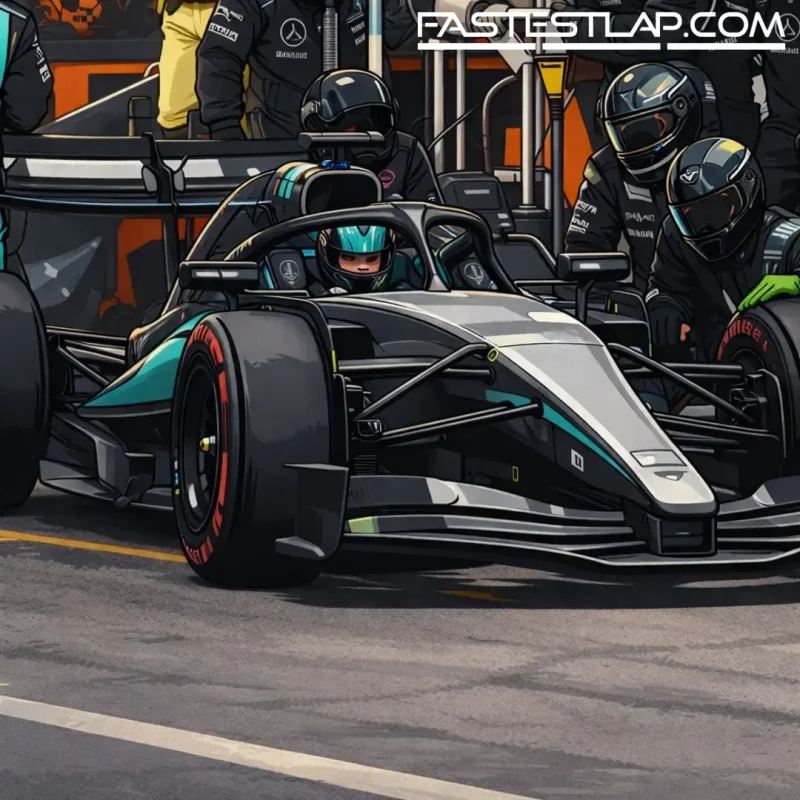
George Russell’s weekend is the obvious counterpoint. The Mercedes driver was also pinged for pit-lane speeding in Monaco and initially received a five-second penalty. But when that penalty wasn’t served correctly at his first stop, the situation escalated into a drive-through. No post-race time addition, no easy trigger for a review — and, from Mercedes’ perspective, no way to test whether Russell was one of those “false positives” without forcing the issue.
That’s what Mercedes is now attempting.
According to the stewards’ document, Mercedes lodged a petition for review under Article 14.1.1 of the FIA International Sporting Code on Friday 12 June 2026, relating to the Monaco decision concerning Car 10 and a breach of Article B1.6.3a of the FIA F1 regulations. A Mercedes representative has been summoned to report to the stewards on Saturday 20 June at 09:00 CEST, with proceedings set to take place via video conference.
The bar for getting anywhere is high, and Mercedes knows it. The first hurdle is procedural: the team must demonstrate a “significant and relevant new element” that wasn’t available to the stewards at the time the decision was made. Only if it clears that threshold does it earn a full hearing on the substance, where that new evidence is weighed.
Toto Wolff has already sounded like a man arguing for a principle he doesn’t fully believe will be upheld.
“We wrote to the FIA for a right of review as well,” Wolff said in Barcelona. “To be honest, I’m not sure this is a realistic outcome, because you open up a can of worms.”
He also pointed to the chain reaction that would follow if Russell’s case were reopened in a meaningful way — including where Russell might have finished had Monaco been judged differently. “Normally, if you haven’t done that, you get a stop and go, and you didn’t do it, it’s 20 seconds. That 20 seconds would put George back to P4. But then what are all the other consequences? So, I don’t think this is going to hold with the judges, but we have to do it for George’s benefit.”
That “can of worms” line is doing a lot of work. Because the sport’s problem here isn’t simply whether a timing loop was mis-measured — it’s what happens when a system error is acknowledged in one case, then fenced off procedurally in others. The stewards, in Gasly’s situation, were effectively compelled to act: Alpine brought new evidence, FOM conceded a fault, and the penalty could no longer be justified. But the resulting revised classification has created a sense of sporting unfairness that the ISC is supposed to protect against, not amplify.
Mercedes’ petition is, in that sense, a stress test of governance. If the “new element” is essentially the same admission and technical correction that helped Alpine, the FIA then has to decide whether the sport can tolerate a split reality where only certain penalty formats are reviewable. If it can’t, the next question is what remedy exists for those already punished under a flawed measurement — and whether the rules even allow for meaningful redress without detonating the finality of results.
For now, this is not about re-litigating Monaco for entertainment. It’s about whether Formula 1 can credibly argue that two drivers caught by the same faulty net should be treated differently simply because one sanction was appended to the classification and the other was served on track.
Mercedes has thrown that question back to the FIA. The stewards now have to decide whether there’s truly something “new” to consider — or whether the sport is content to let a technical mistake become a procedural precedent.