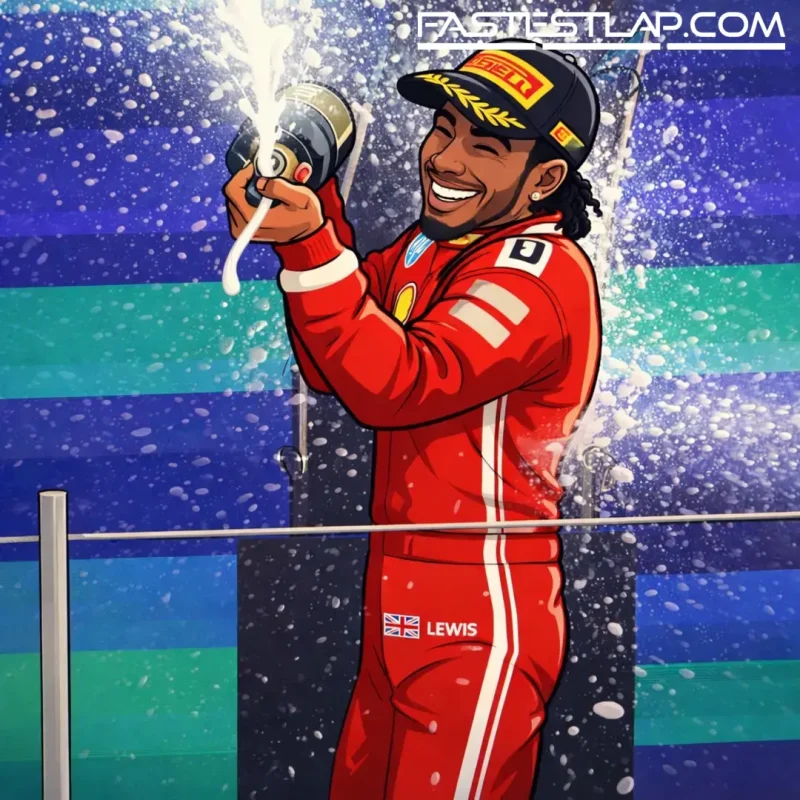
Lewis Hamilton’s first win in Ferrari red at the 2026 Spanish Grand Prix wasn’t just a feel-good headline — it was a reminder of how quickly this paddock rewrites its own storylines when the stopwatch shifts.
Three podiums had already hinted that Hamilton’s Ferrari project was finally finding traction, but Barcelona was the moment it stopped looking like progress and started looking like a threat. And, inevitably, it’s dragged one of the season’s favourite pub debates back into the open: did Hamilton ever actually “lose it”, or were we just watching a great driver stuck in a bad loop?
Valtteri Bottas has offered a characteristically straightforward take. Having spent five championship-winning seasons alongside Hamilton at Mercedes, Bottas reckons the upturn isn’t mysterious at all — it’s basically coded into Hamilton. Call it muscle memory, competitive instinct, whatever you like. Bottas described it as being in Hamilton’s “DNA”: when the pieces around him begin to resemble something he can build with, the level returns fast.
It’s an interesting framing because it resists the temptation to romanticise the Barcelona win as some miraculous reinvention. Bottas’ point — at least as it lands in the paddock — is that Hamilton hasn’t become a different driver in 2026. He’s simply reconnected with the conditions that allow his best work to show up: belief in the car, belief in the direction, and the freedom to drive on the front foot rather than constantly managing around limitations.
Hamilton, for his part, hasn’t tried to pretend the dark moments never existed. In fact, his own version of the story is harsher. He’s admitted that during the low points of 2025 he found himself entertaining the thought every ageing champion fears: maybe there really is a day when you “lose it”, when the edge dulls and you don’t even notice it happening until the results start shouting for you.
That’s the bit that gives Barcelona its bite. Drivers can talk about process and patience all they want, but self-doubt at this level is never abstract — it turns into tiny hesitations, into second-guessing, into overdriving, into trying too hard to “prove” something that used to be effortless. Hamilton saying out loud that he’d wondered if the decline narrative might be real is revealing, not because it’s shocking, but because it’s human. And because it neatly explains why this win looks like it’s brought relief as much as joy.
The bigger question now is what Ferrari does with this momentum. Barcelona can be a launchpad or a one-off, and the difference is rarely about the driver’s mood. It’s about whether the team can keep feeding the machine: operationally clean weekends, a car that stays in its window, and a development path that doesn’t wander off chasing the wrong problem. Ferrari doesn’t need to “manage” Hamilton’s resurgence; it needs to make it repeatable.
Elsewhere, the sport’s governance continues to provide the kind of subplot that makes team principals grind their teeth and lawyers rub their hands.
Monaco is still rumbling after Pierre Gasly’s pit lane speeding penalties were rescinded — a rare sentence in itself — with Mercedes, McLaren and Red Bull all formally launching appeals. That combination tells you everything: if three of the grid’s biggest operators have decided it’s worth the time and political capital to escalate, they’re not doing it for entertainment. They believe there’s something structural at stake, something that touches precedent and power as much as it touches one driver’s penalty sheet.
The messy part, as ever, is that F1’s ecosystem doesn’t do “simple fixes”. You’ve got the FIA, you’ve got Formula One Management, you’ve got teams with competing interests, and you’ve got a regulatory framework that’s meant to be consistent while operating in a sport that changes by the weekend. The Gasly reversal has become a lightning rod because it speaks to the fear every team shares: that outcomes can be nudged by interpretation rather than only by performance.
Martin Brundle has been warning that there’s “no easy solution” to the Monaco penalty situation, and he’s right. Even if the appeals process delivers a clean outcome on paper, the bigger challenge is restoring confidence that the rules are being applied with the same logic on Sunday that they were on Friday — and that everyone can explain that logic without tying themselves in knots.
And then there’s Red Bull, dealing with a very different sort of problem: the kind that costs you metres at the worst possible time.
Isack Hadjar has publicly pushed the team to simplify what he called a “way too complicated” start procedure after another setback in Barcelona. His line that he’s “not a computer” landed because it cuts through the usual corporate varnish — and because it hints at a genuine tension between system and instinct. Starts are high-pressure, high-variance moments where over-engineering can backfire. If a driver is spending mental bandwidth trying to execute a checklist with surgical precision, that’s bandwidth not being used to react, adapt and attack.
Hadjar saying “it’s not working” is more than a rookie venting. It’s a driver effectively arguing that a process designed to reduce risk may be creating it. Red Bull will take note, because when those tiny losses stack up across a season, they stop being “details” and start being results.
All of which means Barcelona might be remembered for Hamilton’s breakthrough, but it also sharpened a broader theme of 2026: the margins aren’t just in lap time. They’re in the confidence a driver has in his own hands, the confidence a team has in the people making the calls, and the confidence the grid has that the rulebook means the same thing to everyone — even when it’s inconvenient.
Hamilton’s win felt like a door opening. Monaco’s fallout feels like one that won’t close quietly.