Max Verstappen’s relationship with the FIA has never really had a “live and let live” phase, and the latest flashpoint is peak 2026 Red Bull: a frustrated weekend, a car that’s clearly not doing what he wants, and a radio message that didn’t even make the broadcast.
Untelevised audio from the Barcelona Grand Prix has revealed Verstappen asking the FIA to intervene over a rival allegedly failing to respect blue flags. Pierre Gasly is believed to have been the driver in question. On its own, it’s hardly a scandal — drivers moan about traffic and blue flags every other Sunday — but in the current context it lands differently. Verstappen isn’t calling for a warning or a quiet word. He’s calling for a penalty, and that says something about where his head’s at right now.
Barcelona was already a bruising outing. Verstappen finished 40 seconds behind the winning Ferrari of Lewis Hamilton, a margin that would’ve sounded absurd not that long ago. When a driver of Verstappen’s calibre starts reaching for the rulebook mid-race, it’s usually less about that single incident and more about the accumulation: the sense that nothing is bending his way — not strategy, not car behaviour, not other people’s awareness, and certainly not the competitive order.
That’s the other part of the equation. Red Bull’s start to the 2026 season has been disappointing by its own standards, and the Verstappen-to-someone-else whispers have predictably returned. Ralf Schumacher has claimed Mercedes made a “lowball” offer to Verstappen; Jos Verstappen has pushed back hard on that, rejecting the suggestion outright and accusing Schumacher of spreading false information.
The timing is no coincidence. It’s understood Verstappen has an exit clause that could allow him to look elsewhere for 2027 if he’s outside the top two in the drivers’ championship at the summer break. As things stand, he’s seventh. That doesn’t mean he’s gone, or even that he’s packing boxes, but it does mean every difficult weekend feeds the same carousel of speculation — and every slightly spiky moment with the FIA gets read as evidence of a bigger unraveling.
Elsewhere in the paddock, there’s a different kind of unease at Williams. Multiple sources say Carlos Sainz is questioning his future with the team, with Audi once again emerging as a potential alternative. Sainz was heavily linked to Audi after Ferrari confirmed his departure back in early 2024, before opting for Williams instead. The gamble looked understandable at the time: a team with ambition, a clear rebuild narrative, and a regulation reset for 2026 that could scramble the grid.
But Williams hasn’t met its own expectations under these new rules, and when you’re a driver trying to anchor your prime years to the right project, “jam tomorrow” only stays convincing for so long. If Sainz is genuinely looking at options for 2027, you can bet he’s weighing more than raw pace — he’ll be looking at organisational trajectory, technical stability, and whether the team can actually turn its rhetoric into lap time.
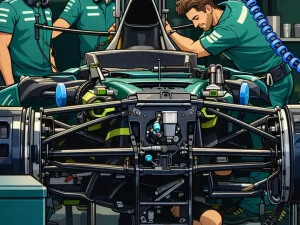
Aston Martin, meanwhile, is leaning fully into the long game — and openly admitting it’s painful in the short term. Mike Krack has described the situation as “very difficult” after Adrian Newey chose not to chase quick fixes, instead committing to a sizeable upgrade scheduled around the summer break next month. Newey has effectively acknowledged what many suspected: Aston Martin rushed to get the AMR26 ready for this season, and now the bill is coming due.
There’s a certain brutal honesty in that approach. It’s also a dangerous one. Leave too much performance on the table early and you risk writing off a season before it’s properly started, especially with development curves moving fast in the first year of a new formula. But Newey doesn’t do “cosmetic”. If Aston Martin has decided its best chance of relevance is to stop throwing parts at symptoms and treat the underlying concept, the rest of the grid will be watching closely — because a genuine Newey-led step change tends to arrive suddenly, not gradually.
And then there’s Ferrari, which right now feels like the opposite story: clarity, momentum, and a driver who sounds re-energised. Hamilton’s Barcelona win wasn’t just a headline because of the red car; it came with a telling detail from inside the garage. Hamilton says race engineer Carlo Santi has helped “reignite the love” he has for being a racing driver, following Ferrari’s decision to move Riccardo Adami into a new role in January.
In modern F1, the driver–engineer relationship isn’t a nice-to-have. It’s the operating system. If Hamilton is genuinely feeling that click with Santi — an engineer who previously worked with Kimi Räikkönen — it helps explain why Ferrari’s weekends suddenly look calmer, cleaner, and more decisive. When the car’s good enough to win and the communication is sharp, a team can start to feel inevitable again.
Which leaves Verstappen in an unfamiliar place: not controlling the narrative through results, and not necessarily enjoying the lack of control. The blue-flag radio is a small moment, but it’s a revealing one. When champions start sounding like they’re pleading for order, it’s usually because their own world has got messier than they’re comfortable admitting.