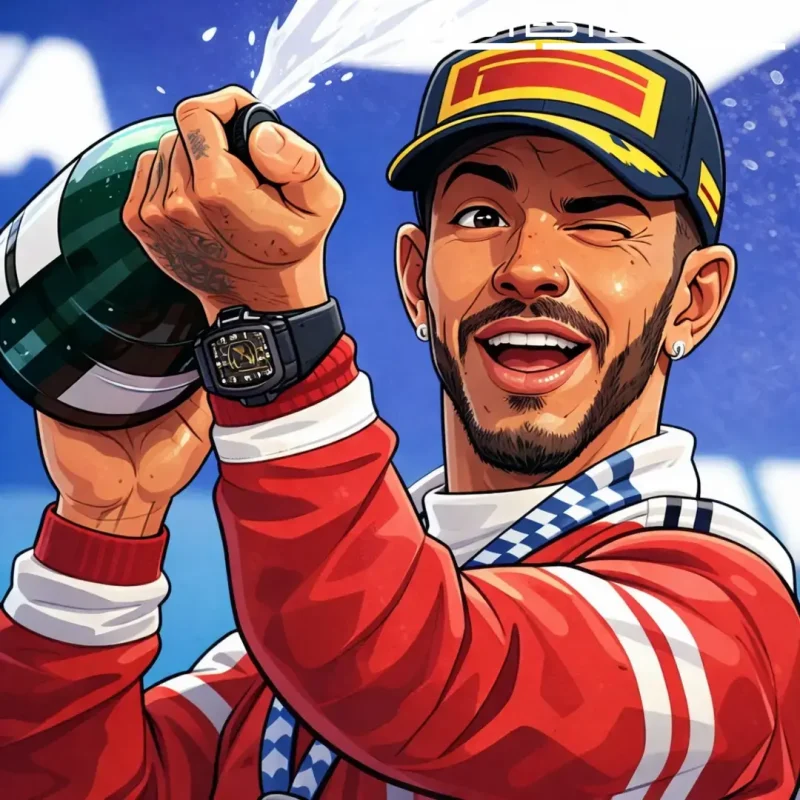
Lewis Hamilton’s first win as a Ferrari driver should’ve been the sort of moment that drags you, willingly or not, into big-picture talk. Barcelona was the “now it’s on” race: champagne in scarlet, a grandstand primed for theatre, and a points swing that would make any title fight feel suddenly alive.
Hamilton isn’t buying that narrative — not yet.
Yes, the numbers look better. His victory at the Circuit de Barcelona-Catalunya chopped 25 points out of Kimi Antonelli’s lead after the Mercedes driver retired, pulling the gap down to 41. Hamilton’s also firmly established himself as Mercedes’ nearest challenger in the standings, having already reeled in George Russell since the early-season phase and extended that buffer again in Spain.
But listen to the way Hamilton frames it and you hear a driver who’s enjoying the breakthrough without kidding himself about the machinery underneath it.
“Honestly, with the way that the year started out, I have not really been thinking about it like that,” he said after the race. “I’ve not been thinking about an eighth.”
That’s not false modesty. It’s a neat summary of where Ferrari actually are in 2026: close enough on certain weekends to land a punch, still not consistently armed for a 24-race brawl against what Hamilton keeps describing — with a little emphasis — as a “blistering” Mercedes package.
The win in Barcelona was historic on several levels. It took Hamilton’s career tally to 106, made him the first driver over 40 to win a grand prix since Nigel Mansell in 1994, and the first British driver to win with Ferrari in the 21st century. It also validated the most scrutinised move of his career: leaving the comfort and familiarity of Mercedes to try and become a champion again in red.
Yet the day after the celebration, the conversation in Maranello and at the track will still be about the same uncomfortable detail Hamilton has been flagging for weeks: the Ferrari SF-26 is a strong base, but it’s not the benchmark.
Hamilton pointed to a power deficit relative to Mercedes, with the Brackley team’s internal combustion engine rated ahead in F1’s ADUO findings, and he didn’t stop there. In his view, it isn’t simply a straight-line problem — the W17, he suggested, is also a step ahead as a chassis.
“And Mercedes have come out the gates with a blistering car and blistering pace, both drivers doing such a great job,” Hamilton added. “We know we have this power deficit. There’s going to be tracks where we go to with long, long straights where that makes it even harder.”
That’s the sort of assessment that matters more than the champagne photos. A title campaign isn’t built on proving you can win once; it’s built on knowing what happens when you arrive at a circuit that exposes your weaknesses and you have to limit the damage. Hamilton’s basically warning that Ferrari’s ceiling is high, but their floor still drops too low when the calendar leans towards horsepower.
What Barcelona did, though, was give Ferrari something more valuable than points: direction. Hamilton’s post-race talk quickly shifted from the romance of “winning in red” to the very modern grind of development meetings, aero packages, and deciding where the next tenths come from.
“But as I said, we’ve got a great car at the core,” he said, “and if we keep adding performance and we can go through the corners quicker, maybe we can narrow that deficit down a little bit until we improve or until we close the gap on power.”
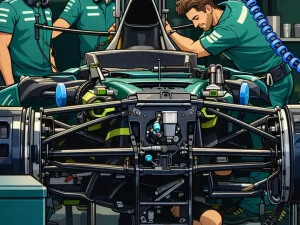
It’s a telling line. Ferrari don’t have a quick fix for an engine shortfall mid-season, but they can mask it — at least partially — by building a car that’s sharper in the sequences that define lap time. That’s not as glamorous as “Ferrari are back,” but it’s exactly how teams claw back performance in a regulation set where gains are incremental and weaknesses are brutally track-dependent.
Hamilton’s focus now is on the unglamorous bit: going back to the factory, downloading the weekend, and pushing the development plan harder — or steering it in a slightly different direction if his feel for the car demands it.
“I’ll be at the factory next. We’ll do a download, we’ll speak to the aerodynamicists, looking at all the different things that are in the pipeline, when they’re coming, what effect they’ll have, re-steer if I need to in whatever direction I feel that the car needs to go,” he said.
The subtext is clear enough. This isn’t 2021, where Hamilton was playing a season-long chess match in a car he knew inside out, against a rival he’d studied for years. This is Hamilton in a new ecosystem, pushing and pulling on a programme still shaping itself around him, trying to accelerate a timeline that — by his own admission — normally takes time.
And then there’s the cold reality of that 41-point gap to Antonelli. Hamilton noted he’s taking it “one race at a time” and “one week at a time”, which is a familiar phrase in F1, but it lands differently when paired with the statistic that this margin has never been overturned to win a world title. Hamilton is too experienced to pretend history doesn’t exist; he just refuses to let it dictate his next two weekends.
“We just keep pushing and enjoying it,” he said. “We have to just have fun with it as well.”
It’s a surprisingly healthy outlook for a driver with nothing left to prove and plenty still to chase. Barcelona didn’t suddenly make Ferrari favourites. What it did do was remind the paddock that Hamilton in a competitive car remains the sport’s most uncomfortable problem — and that even a “not quite there” Ferrari can still win on the right Sunday.
The rest of the season will decide whether this was the start of something sustained, or simply a glorious spike. Hamilton, as ever, sounds like he already knows the only part he can control: making sure Ferrari’s next steps are the right ones, before the calendar reaches the long-straight tracks that will test their resolve.