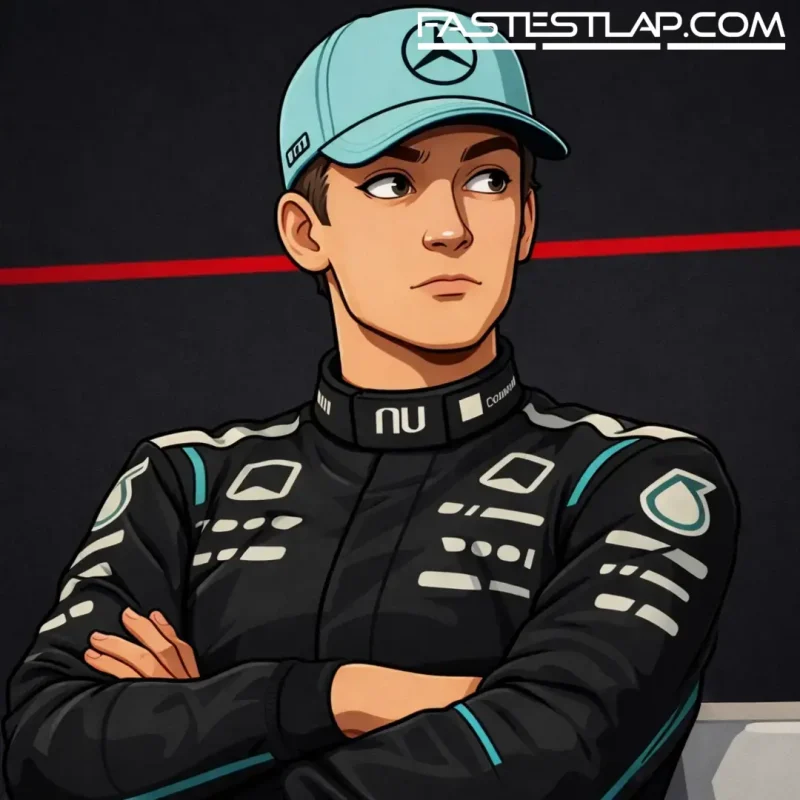
Mercedes has walked away from its Right of Review request over George Russell’s Monaco Grand Prix penalties, and Russell has been refreshingly blunt about why: there simply wasn’t enough there to win.
After Pierre Gasly’s Monaco time penalties were rescinded in a separate case, the paddock inevitably went hunting for precedent. Mercedes was among the teams to test the boundaries, filing its own review request with the FIA regarding Russell’s sanction from Monte Carlo — only to withdraw it a few days later. The message from Russell on Friday was clear: the team pulled the plug because it had to.
“Having looked at every single possibility with the team to overturn the penalty from Monaco, unfortunately we did not have a case,” Russell wrote on Instagram. “It’s behind us now and looking forward to maximising the upcoming doubleheader.”
It’s a tidy line, but it also reads like a driver drawing a line under something that’s been a slow-burn frustration in the opening phase of 2026. Russell hasn’t won since the season-opening Australian Grand Prix back in March, and Monaco ended as a double whammy: a messy procedural penalty sequence and, ultimately, no points, with Russell classified 12th.
The original issue was straightforward enough: Russell was hit with a five-second penalty for speeding in the pit lane. That penalty, however, wasn’t properly served, and the situation escalated into a 20-second time penalty applied at the chequered flag. With the Gasly decision then landing like a thunderclap, it’s no surprise Mercedes took a long, hard look at whether Russell’s outcome could be revisited too.
Toto Wolff had already signalled that Mercedes would explore its options, arguing the team had to pursue any avenue available, even if there was only a “millimetre of chance” of overturning it. That wasn’t posturing; it was Mercedes doing what front-running teams do when points are thrown away in unusual circumstances. In a season that’s already proving volatile, you don’t casually donate results to the stewards’ room.
But Mercedes’ statement explaining the withdrawal pointed to a different calculation: fight the paperwork battle, or take the political win of pushing the FIA and Formula One to acknowledge the Monaco mess and tighten up the process. Mercedes says it chose the latter.
“Following the decision to rescind Pierre Gasly’s time penalty, it was important for us to explore all available options to address the impact of George’s pitlane speeding penalty on his race result,” the team said.
“Our subsequent collaborative discussion with FIA and Formula One has shown their determination to review the unique circumstances arising from the Monaco Grand Prix and to proactively address the factors that caused them.
“In the face of this clear determination, we have concluded that further pursuit of our Right of Review application will not serve our team or the sport, and thus we have withdrawn our submission.”
That language matters. Mercedes isn’t pretending it backed down out of goodwill; it’s presenting the withdrawal as leverage successfully applied. The subtext is that it wanted clarity, consistency and a commitment to fix whatever procedural tangle Monaco exposed — and, once it felt it had that, there was no value in dragging Russell’s case through a process it didn’t expect to win anyway.
The awkward part is what Mercedes can’t get back: the points. Russell remains scoreless from Monaco, and with his win drought stretching back to Melbourne, the team can’t really afford many more weekends where an administrative wrinkle becomes a sporting one. In the tight margins of modern F1, “we didn’t have a case” is an honest conclusion — but it’s not exactly comforting when the penalty sequence itself felt like the sort of thing that should be unarguable in the first place.
It also leaves the sport with a slightly uneasy split-screen. Gasly’s penalties being rescinded has already prompted McLaren and Red Bull to lodge appeals with the FIA’s International Court of Appeal, with McLaren arguing the episode “raises important questions concerning sporting fairness, regulatory consistency and the integrity of competition.” Mercedes, meanwhile, is stepping out of the legal queue and effectively betting on governance improvements instead.
Whether that’s noble or simply pragmatic depends on what happens next. If Monaco leads to clearer, sturdier procedures — and fewer “unique circumstances” that end up defining results — Mercedes can argue it helped force the issue without turning the championship into a courtroom drama. If not, the withdrawal risks looking like a team that lit the fuse and then walked away when it realised the blast wouldn’t move the wall.
For Russell, at least, the tone suggests he’s done chewing on it. No theatrics, no insinuations — just a driver acknowledging the limits of what even a top team can reverse once the stewards have moved on. The double-header he referenced now becomes the only meaningful response: bank the points on track, and don’t leave anything to interpretation.