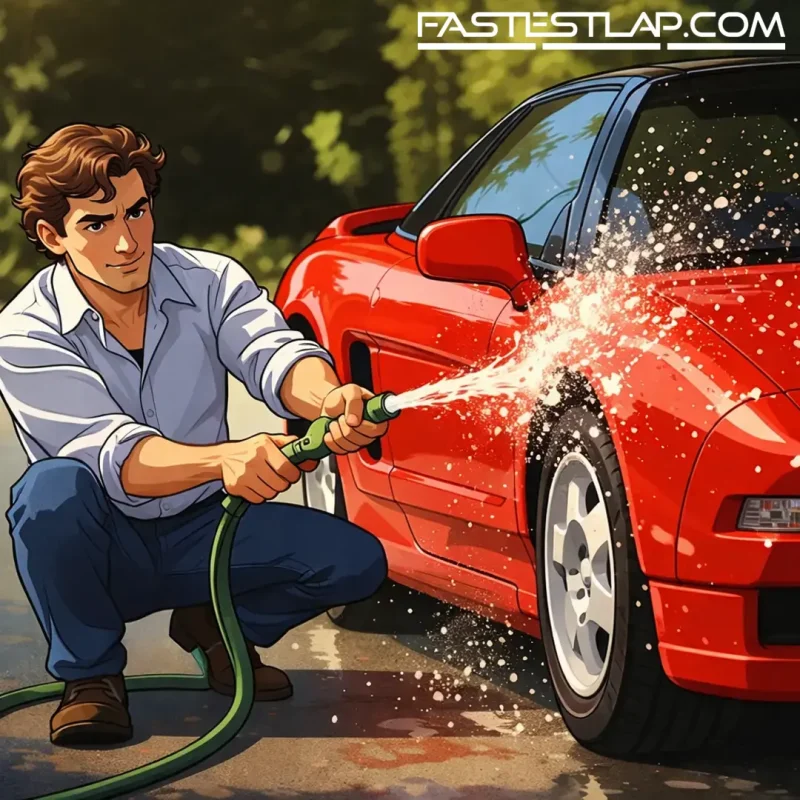
There are plenty of expensive NSXs out there now, but only one that carries the slightly surreal image of Ayrton Senna hosing it down himself after a spirited drive — and that’s the one RM Sotheby’s is putting in front of collectors this autumn.
One of the three Honda NSXs supplied to Senna for his personal use during his McLaren-Honda years is heading to auction in London in October 2026, at RM Sotheby’s flagship sale at the Peninsula London. The estimate is exactly where you’d expect it to be for an object that sits at the intersection of road-car mythology and grand prix history: a guide price starting at £500,000, with expectations it could stretch towards £800,000.
This isn’t just “Senna once sat in it” provenance. The car is deeply woven into the story of how the NSX became what it is — and why it remains, even now, the most emotionally loaded Japanese performance car of its era.
Senna’s relationship with Honda was never the distant, transactional type you sometimes see between star driver and manufacturer. It began at Lotus in 1987 and only intensified once he moved to McLaren in 1988, when Honda’s turbo power and the MP4/4 helped him clinch that ferocious championship fight against Alain Prost. By the time Honda was developing its new halo road car, the company didn’t simply want a famous name attached to the project; it wanted his judgement.
The now-familiar anecdote matters because it’s part of the NSX’s DNA: Senna sampled the early prototype and felt the chassis was “a little fragile”. Honda, unusually for a major manufacturer with a project already rolling, didn’t just nod politely and move on. It responded — stiffening the frame significantly and refining the suspension tuning based on his feedback. That’s how the legend hardened into something tangible: not a marketing slogan, but a technical nudge from a driver whose baseline for feel and rigidity came from the sharp end of Formula 1.
By the start of 1991 Senna was a double world champion, and Honda rewarded him with the use of three NSXs as the model moved from concept to production reality. Two were black. The third — the one up for sale — is the standout: red with a black roof, chassis number T000233.
Its paper trail is unusually detailed for a celebrity-associated road car, which is one of the reasons auction houses salivate over examples like this. It was first imported by Honda Automobil de Portugal and registered on 22 March 1991, then kept in Lisbon for Senna’s use when he was in the country. He owned property at Quinta do Lago, and the NSX effectively became part of his European routine.
That routine, crucially, was caught. Studio Colombo photographed Senna arriving at Estoril’s F1 drivers’ car park in 1991, and the car later appeared in the 1992 documentary *Ayrton Senna: Racing Is In My Blood*, including footage of him driving it with intent and — in the sort of detail that turns an already-valuable car into a culturally “sticky” artifact — washing it himself.
After Senna’s death at Imola in 1994, the records show the NSX was transferred to Laboa Etablissement in Lisbon, and Honda paperwork has since been used to confirm the link. RM Sotheby’s says the car will be supplied with copies of that documentation, along with the warranty book and full Portuguese ownership history.
From there it lived the life many important cars do: not permanently hidden away, but circulated carefully between owners who understood what they had. It moved to the Algarve in 2009 after being bought by the owner of MSCAR Comércio de Automóveis SA, then to the UK in 2013 when it was purchased by Robert McFagan. It was registered for road use in May 2016.
In 2024, the NSX returned to Japan with its current owner, before coming back to the UK again for this sale — a tidy reflection of where its story began and where its legend resonated most loudly.
The public appearances have only added layers. In 2019 it went to Imola for the 25th anniversary of Senna’s death, with circuit boss and former F1 team owner Giancarlo Minardi driving it for a lap — a small but poignant gesture given the place and the date. Five years later, it featured in a Senna tribute along the Hamilton Straight at the Silverstone Festival, in what was described as the largest vehicle-based commemoration of Senna’s life: the NSX joined by 11 F1 cars and a broader spread of machines he’d raced or driven across categories.
If you’re trying to make sense of why an early-’90s Honda road car can command supercar money in 2026, it isn’t about raw performance figures. It’s about narrative density. The NSX already holds a special position as the Japanese car that helped rewrite what a mid-engined performance machine could be day-to-day. Add Senna’s fingerprints — literal and figurative — and you’ve got a collector piece that plays on more than rarity.
RM Sotheby’s leans into that in its pre-sale description, calling it “No road car model more associated with the life of F1 legend Ayrton Senna than the NSX.” That’s not hyperbole, and it’s not simply because he drove one. It’s because Honda built part of its identity into the car through him, then quietly let him live with it like a normal person might: commuting, arriving at circuits, driving it on camera, washing it in the driveway.
In a sport that’s increasingly mediated by corporate polish, that’s the detail that still cuts through — and, in this case, the detail that will likely decide how far beyond the guide price the bidding goes when the hammer finally drops in London.