
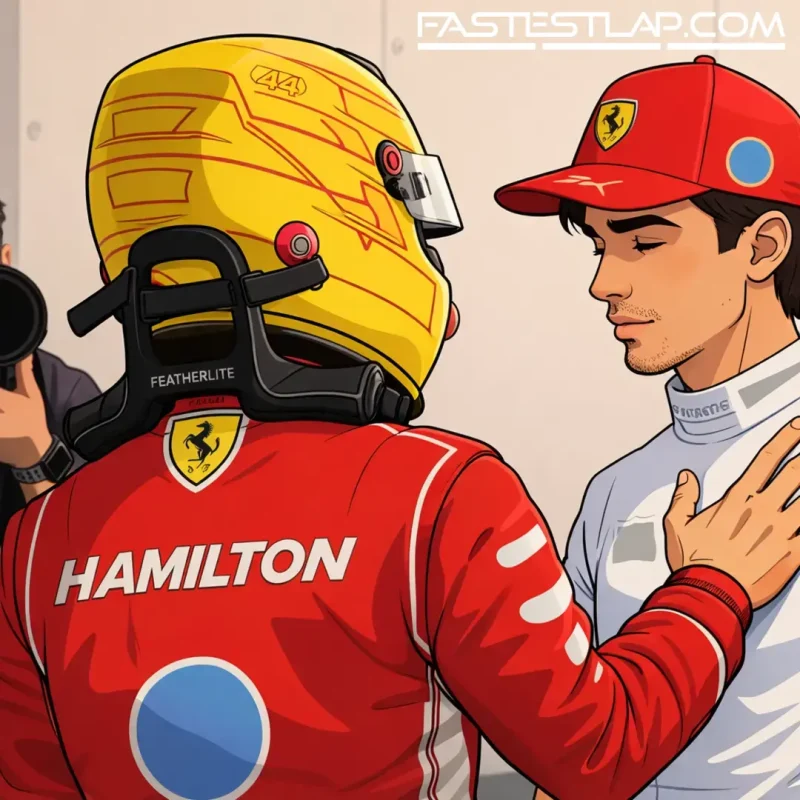
Lewis Hamilton’s Ferrari season has started to develop an edge that didn’t seem inevitable a few rounds ago. Charles Leclerc spent the early part of 2026 looking like the clear reference point inside Maranello, the driver with the car’s habits baked into his muscle memory and the team’s default language flowing through him.
Then the rhythm shifted — and when it shifts with Hamilton, it tends to do so loudly.
Leclerc hasn’t reached a grand prix chequered flag ahead of his team-mate since Miami. Hamilton followed back-to-back second places in Monaco and Montreal by converting in Barcelona for his first win in red, and he arrives at the next stop with a 40-point cushion in the intra-team fight. More than the numbers, it’s the familiarity of the pattern that will sting: the longer Hamilton goes without needing to “learn” Ferrari in public, the more he starts to shape Ferrari around him.
Claire Williams, the former Williams deputy team principal, put it bluntly this week: if Hamilton really is back to his best, Leclerc may be about to find out what kind of fight this becomes when the other guy is a specialist at making it personal without ever saying it’s personal.
“It will be a test of personality, probably, at the end of the day,” Williams said on the High Performance Racing podcast, framing it as a question of Leclerc’s “maturity” and “psychological strength”. She reached for the most obvious parallel — Hamilton versus Nico Rosberg at Mercedes — and it’s hard to argue with the comparison. Hamilton didn’t just beat Rosberg in their early championship exchanges, he overwhelmed him, forcing Rosberg into a famously extreme, marginal-gains obsession to finally get over the line in 2016.
The detail matters because it speaks to the kind of pressure Hamilton can apply without needing politics or theatrics. Rosberg’s response wasn’t a new driving trick; it was a life recalibration. He stripped weight, leaned hard into mental coaching, and pared away anything that wasn’t about beating Hamilton. It worked — and he quit days after winning, as if the cost of doing it again was too high.
That’s the cautionary tale sitting behind Williams’ point. Ferrari doesn’t just have a points gap on its hands. It may have a dynamic problem: a seven-time world champion who, once he senses a team’s operating system beginning to match his, becomes exceptionally difficult to dislodge. Leclerc can drive his way out of plenty of situations. The harder question is whether he can live his way out of this one if it becomes an endurance contest of belief.
Rob Smedley, who worked at Ferrari from 2004 to 2013 before moving on to Williams, went even further in describing Hamilton’s specific craft. He called Hamilton a seasoned pro at “dominating” team-mates — not in the tabloid sense, but in the day-to-day accumulation of small wins that add up to a driver feeling the garage tilt.
“He knows how to beat teammates year in, year out. He knows,” Smedley said, before noting that even Rosberg’s title-winning season required what he described as a “balance of luck”. Hamilton had stoppages and failures that year, and Rosberg still only “just nicked it”.
It’s a loaded observation, because it hints at a grim reality for anyone across the aisle: even when you’ve done almost everything right, Hamilton can still make the margin feel uncomfortably thin.
And yet, there’s an important complication Ferrari can’t ignore. Smedley acknowledged it himself: George Russell’s late-era Mercedes seasons provide the counterexample. Russell outscored Hamilton in 2022, their first year together, and again in 2024 before Hamilton left for Ferrari. That doesn’t erase Hamilton’s history; it simply proves he isn’t immune to being beaten inside a top team when the conditions are right.
Which raises the most interesting question about Leclerc’s current predicament: is this a pure “Hamilton has arrived” moment, or is it Ferrari’s internal environment changing in a way that’s amplifying his influence? Hamilton has spoken about Ferrari taking his feedback onboard, and you can see how quickly that becomes self-reinforcing. Better feel leads to better results, better results lead to more confidence in direction, and suddenly the garage isn’t split between two interpretations of the same car — it’s converging on the interpretation that’s delivering.
If you’re Leclerc, that’s the trap. You don’t just need to beat Hamilton on Sundays; you need to stop the slow gravitational pull of a team drifting towards the veteran’s way of doing things, especially when the veteran is also the most decorated driver the sport has ever had.
Next up is Austria, where both have happy history: Hamilton won at the Red Bull Ring in 2016 and again in the 2020 Styrian Grand Prix, while Leclerc took victory there in 2022. But the sharper context isn’t the stat sheet — it’s the timing. Leclerc needs a weekend that reasserts him, not merely a clean points haul. Because if Hamilton leaves Spielberg still in front, still setting the internal tempo, that 40-point advantage begins to look less like a swing and more like a statement.
Ferrari has lived through enough intra-team tension to know how quickly these things can become defining. The uncomfortable bit for Leclerc is that this one may not be about fireworks at all. It may be about who can keep their footing when the other guy keeps finding another half-step — and makes it feel inevitable.









