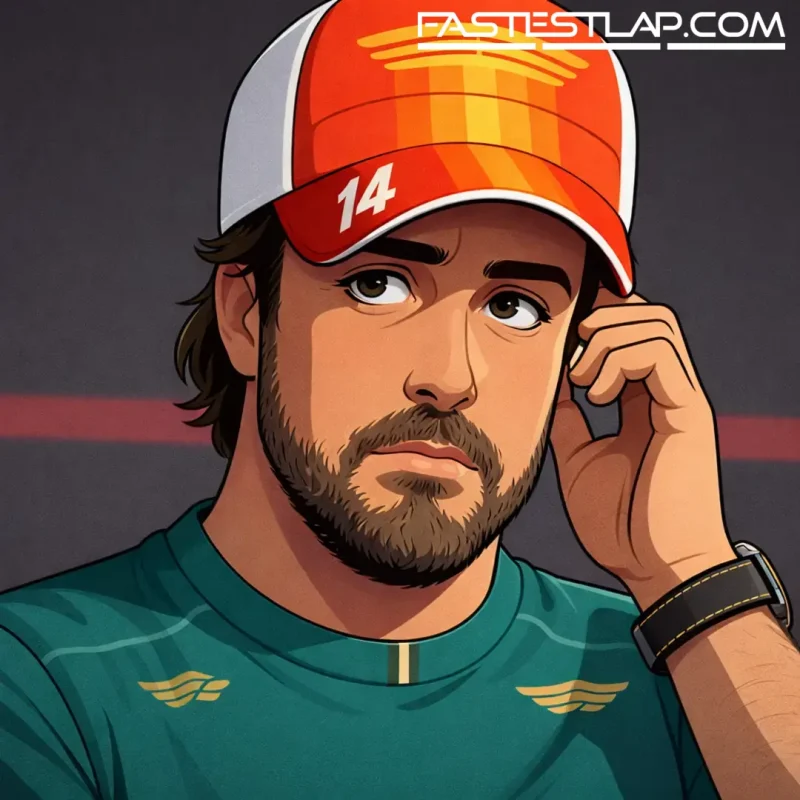
Stefano Domenicali doesn’t often step into the contract-noise of the driver market, but in Barcelona he made an exception — and it was telling. With Fernando Alonso openly weighing up what comes next at the end of 2026, Formula 1’s CEO went public with a plea: don’t go anywhere.
It wasn’t framed as nostalgia, or even as a reward for longevity. Domenicali’s argument was simpler: the grid still needs figures who feel bigger than a Sunday. “It’s a fact that we need heroes,” he said, urging the two-time world champion to stay “for a long time” if the right car and project can be found.
That, of course, is the rub. Alonso is 44, still driving like someone with a point to prove, but currently trapped in a season that’s become a weekly exercise in damage limitation. Aston Martin’s 2026 campaign has landed with a thud: one point in seven race weekends — Alonso’s P10 in Monaco — alongside a bruising list of eight retirements and an average finishing position around the fringes of the top 15. Lance Stroll has been on the wrong end of the attrition too, including being non-classified in Australia, 15 laps down.
For a team that has spent big and spoken bigger, it’s a grim balance sheet. Lawrence Stroll has poured resources into a new headquarters and wind tunnel, and the arrival of Adrian Newey was supposed to be the signature move — the kind that signals a serious tilt at the front. Yet the stopwatch, as ever, has the final word, and right now it’s not saying “title push”.
Alonso, typically, isn’t dressing it up.
“I don’t have anything in mind, and after summer I will take the decision,” he said in Spain, making it clear the next few months will shape whether he stays with Aston Martin, calls time altogether, or takes what would be a spectacular detour back to Alpine.
That last option has been gathering momentum since Miami, with paddock talk increasingly centring on Alpine’s interest in bringing Alonso home again — and on the fact the team is once more under the influence of Flavio Briatore, Alonso’s long-time manager. Multiple sources have indicated Alpine is pushing hard, and that the chance to reunite with Briatore for one final push is part of what Alonso is turning over in his head. It’s not described as done, but it’s not being dismissed either.
Domenicali, for his part, sounded less like a promoter chasing headlines and more like someone who understands the value of continuity in a sport that churns storylines as fast as it burns tyres. Alonso isn’t just another driver negotiating a deal; he’s a reference point — for fans, for younger racers, and frankly for the competitive temperature inside the paddock.
“I suffer a lot for Alonso, because I have a lot of respect for him and I know he’s fantastic,” Domenicali said. “He will have the opportunity, I hope, if they give him a good car to show the talent he has… He needs the right project.”
And that’s the subtext: give Alonso something worthy of him, and F1 gets to keep one of its most watchable characters — the driver who still treats every Q1 as a personal insult and every radio call as a debate to be won.
There’s also a more human layer to this decision than we’re used to hearing from Alonso, who has historically kept sentiment at arm’s length. He’s become a father, and he’s admitted it’s changed how he views time — not in the way many would assume, but in a way that might actually keep him on the grid a little longer.
“I have some thoughts, I cannot lie. It does change the way you see life,” Alonso said. “I have to say that it is going in the other direction. I want to race so he sees me racing.”
It’s a striking line, partly because it’s so unguarded, and partly because it exposes the strange arithmetic of a late-career great. Alonso talked about wanting his son to be old enough to understand what the paddock is, to have real memories — to sit in the car, to live those moments that become permanent. But he also acknowledged the other side: he doesn’t want to sign up for “four or five years again” just to chase that.
So the decision is no longer purely about whether Aston Martin can turn infrastructure into lap time quickly enough, or whether Alpine can offer a more convincing short-term platform. It’s also about what an extra season or two actually means — not just to Alonso’s legacy, but to Alonso’s life.
Domenicali said he isn’t willing to entertain the idea of F1 without Alonso just yet. “It’s not the time to talk about that because I want to see him here for a long time,” he insisted.
In the coming weeks, the market will do what it always does: brief, leak, posture. Aston Martin will have to decide whether it can sell Alonso a future that doesn’t feel like waiting for promises to mature. Alpine will have to decide how far it’s prepared to go for a reunion that would light up the headlines and, potentially, stabilise a team still searching for direction.
And Alonso will do what Alonso has always done: look past the noise, stare at the numbers, and make a choice that won’t be explained until after it’s already reshaped the grid.