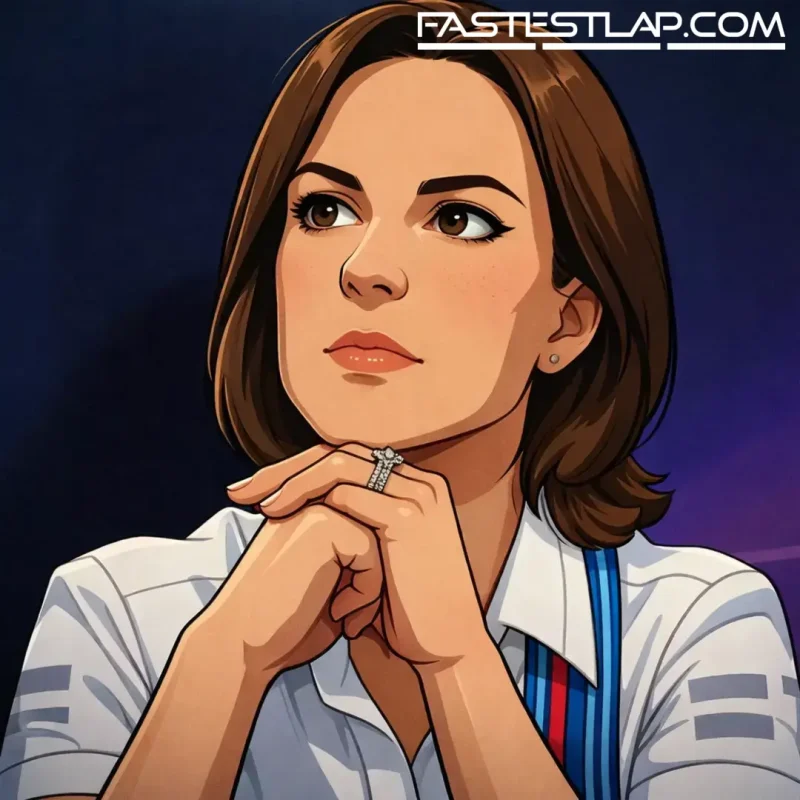
Claire Williams has never pretended Formula 1 is a gentle place, but six years after stepping away from the family team she’s still being dragged back into the firing line by the sort of online sniping the paddock has learned to live with — and she’s had enough of it.
Speaking on the High Performance Racing podcast, the former Williams deputy team principal described the steady drip of abuse that continues to find her, even long after the Williams family sold the outfit to Dorilton Capital in 2020. One message in particular, sent recently, struck a nerve: a stranger branding her “the woman that brought your dad’s team down”.
Her response was blunt, unfiltered, and very human. “F**k off,” she said, before challenging anyone with that view to front up in person rather than “hide behind a keyboard”.
In F1, where public scrutiny is constant and the line between analysis and pile-on is often thin, Williams’ comments land awkwardly because they expose an uncomfortable truth: fans see the results, the headlines and the politics, but they rarely see the full context — and the people inside teams are incentivised to keep it that way.
Williams made a striking claim that will resonate with anyone who’s watched the sport weaponise narratives. Asked how much of what she went through while effectively running Williams day-to-day is actually known publicly, she didn’t hedge.
“Not even 10 per cent,” she said.
That figure matters less as a measurable statistic and more as a warning about how easily the story of that era has been flattened into a meme: famous name, famous team, rapid decline, therefore it must be down to the person whose face fans recognise. It’s a neat storyline, and neat storylines travel quickly online. The messy reality of contracts, resource constraints and internal pressures doesn’t — largely because in Formula 1, you don’t talk about those things.
Williams pointed directly at that dynamic. Teams can’t publicly unpack commercial agreements, personnel situations or the day-to-day crisis management that defines the back end of the grid. So when performance nosedives, the vacuum fills itself with certainty from people who weren’t in the room.
And for someone in her position, she said, it compounds the internal burden rather than replacing it. When you’re already “beating yourself up more than anyone else could possibly do,” the outside noise isn’t a critique you can learn from — it’s just another weight.
There’s also a wider point here about how the sport treats leadership, especially in the kind of period Williams endured. In 2013 she took on the deputy team principal role, inheriting the operational responsibility from her father, Sir Frank Williams. The early part of the turbo-hybrid era offered a rare stretch of sunshine: Mercedes power, a car that worked, and third in the Constructors’ standings in 2014 and 2015.
Then it unravelled. The team slid backwards through the latter half of the decade and, by 2020, ended a season without scoring a point. That’s the part everyone remembers because it’s clean, visible, and reducible to a table in a Wikipedia entry.
What Williams is pushing back against isn’t analysis of that decline — it’s the assumption that the decline is all anyone needs to know in order to pass judgement on the people involved. She suggested that if the full story ever came out, “jaws would fall to the floor,” but was equally clear about why it hasn’t: too private, too sensitive, potentially too damaging. She said it’s one reason she hasn’t written a book.
There’s an irony in that. The more the sport professionalises its messaging and locks down information, the more it invites the kind of simplistic blame culture Williams is describing. Fans aren’t wrong to have opinions — F1 is built on them — but the certainty with which some deliver verdicts, often in the harshest possible terms, is a by-product of a system that reveals almost nothing until years later, if at all.
Since Dorilton’s takeover, the Williams name has remained on the grid, and the team has managed three podiums in that era. Today it’s led by James Vowles, with Carlos Sainz and Alex Albon driving, and a stated ambition of dragging the operation back towards the front. That’s the new Williams story — the one the sport would prefer to sell.
But Claire Williams’ podcast appearance was a reminder that the previous chapter didn’t just end with a sale and a press release. It ended with people carrying scars, still getting heckled for decisions and circumstances outsiders don’t fully understand, and still expected to accept it as part of the deal.
She’s not accepting it anymore. And in a sport that loves to talk about mental resilience when it suits, that’s probably a healthier message than the cheap shots she’s responding to.