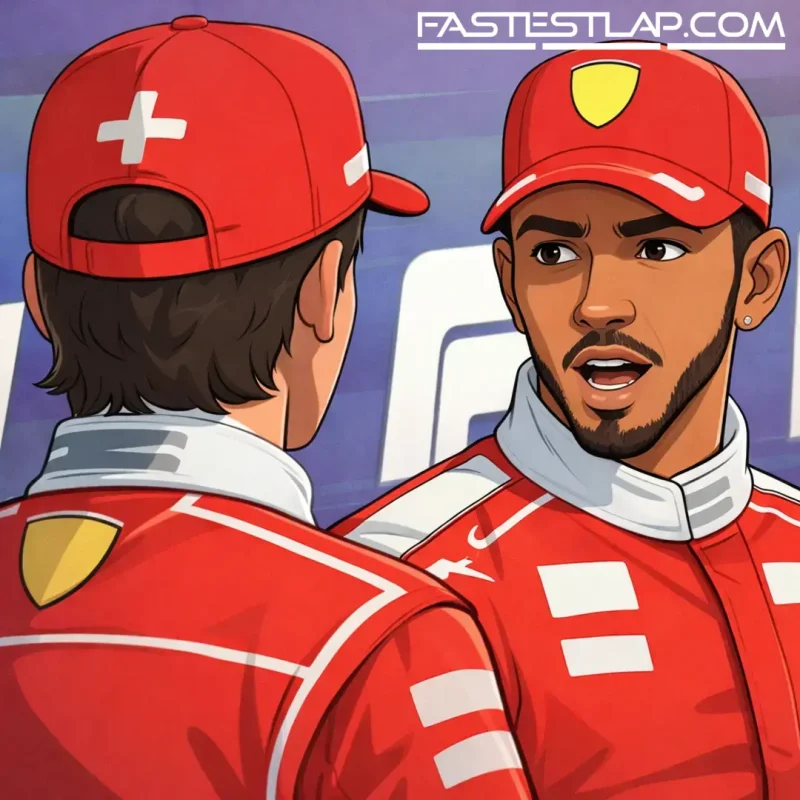
Charles Leclerc wasn’t in the mood for comfort blankets after Spielberg.
Yes, he’d started on the front row. Yes, he’d edged Lewis Hamilton in qualifying to level their 2026 Saturday scoreline. And yes, by the end of Sunday he’d trailed his new Ferrari team-mate home by nearly 20 seconds. But when it was put to him that Austria might represent a small step closer to Hamilton, Leclerc bristled at the premise.
“That’s a long shot,” he said, in a tone that made it clear he considered the question a triumph of optimism over evidence.
On a day when the Red Bull Ring baked under scorching heat and tyre life became the currency that mattered, Ferrari looked like a team trying to buy dinner with the wrong notes. Hamilton could salvage fifth with a late-race scramble that included another attempt at a three-stop strategy, but even that felt more like damage limitation than any kind of statement. Leclerc’s afternoon was harsher: front wing damage, rear grip that never really arrived, and a long slide to eighth.
“It was just an incredibly difficult race,” Leclerc admitted. “Very, very low grip overall. Just struggled to have the car, and the tyres especially, in the right window. Especially the rears, just missing a lot of rear grip.
“Still a lot of work to be done.”
It’s not the first time in 2026 that Leclerc has walked away sounding like he’s still trying to decode his own car. In fact, the most telling line wasn’t about the balance swings or the tyre window — it was the self-diagnosis underneath it all.
“I think I’ve been working very hard in the past weeks,” he said, “because there was always one reason or another that made me struggle on the Sunday, or on the Saturday, but at the moment there’s always a reason why there’s a struggle.
“That probably means that I don’t really have a clear picture of what I want from this car. I’ve got to find that.”
In a championship era where small set-up calls can mean the difference between leading a stint and bleeding lap time, that’s a more serious admission than it might sound. Drivers always ask for “more front”, “more rear”, “better traction”, but the top ones arrive with a fairly sharp internal compass — a sense of where the car should sit and what compromises they’re willing to accept. Leclerc is essentially saying that compass is spinning right now.
Austria exposed it because the weekend demanded decisiveness. The SF-26 looked decent enough over one lap — not exceptional, but workable. Over a race distance, in those temperatures, it became something else: a car that fell out of the tyre window and never quite climbed back in. Leclerc suggested the story was, at its core, still the familiar one: oversteer, understeer, the constant fight for a platform that stays consistent.
“There’s a lot down to that,” he said. “Also, car characteristics swings a lot of performance this year as well, because this weekend we see we’ve been a lot more on the back foot. Especially in the race, because in quali we weren’t too bad.
“But we’ve been less competitive as a whole, so a bit of everything, but probably car balance.”
That’s the key difference between outqualifying your team-mate and genuinely “closing the gap”: on Saturdays you can mask problems. On Sundays, they bill you with interest. Hamilton, even while wrestling his own tyre management issues, got the better of the opening phase — a good start, track position, and the kind of calm, repeatable pace that comes from experience in messy races. Leclerc didn’t hide from it.
“Lewis got a good start, and then got track position, which maybe helped a little bit at the beginning,” he said. “But even when we were in free air, I think he had a bit more pace than I did.”
Ferrari had arrived in Spielberg as a team worth watching. Hamilton’s Barcelona win had sharpened the focus, and Leclerc lining up on the front row only added to it. The expectation wasn’t necessarily domination, but at least a weekend where Ferrari looked like it knew what it was doing. Instead, Austria played like a reminder that this is still a team searching for continuity — in performance, in execution, and in how both drivers are able to lean on the SF-26.
There was also the question of development direction. Ferrari had introduced a major upgrade package in Barcelona and followed it with further revisions for Austria. When results suddenly wobble after new parts arrive, the paddock reflex is to wonder whether the car has been pushed into an awkward set-up corner — one step back before two forward. Leclerc didn’t buy that, insisting the changes weren’t the kind that should have scrambled Ferrari’s understanding.
“I don’t think so,” he said. “Because the upgrades we brought were quite straightforward, and we knew what to do with this. It’s not the kind of upgrades where you’ve got to change the philosophy of the way you set up the car. So, I don’t think so.”
Which leaves Ferrari with a more uncomfortable conclusion: the pace and tyre usage simply weren’t there, upgrade or not, and Leclerc’s current relationship with the car isn’t stable enough to compensate when a weekend turns hostile. That matters because the calendar doesn’t pause while you “find” a feeling. Leclerc hasn’t been on the podium since Suzuka, and the next stop is Silverstone — a circuit that rewards commitment, but punishes uncertainty.
Leclerc will take heart from the fact he’s still very much in the qualifying fight with Hamilton. But if Austria showed anything, it’s that matching a lap time on Saturday doesn’t necessarily mean you’ve matched the reference on Sunday. And right now, Leclerc doesn’t sound like a driver who believes he’s caught up — he sounds like one trying to work out where he’s supposed to be aiming.