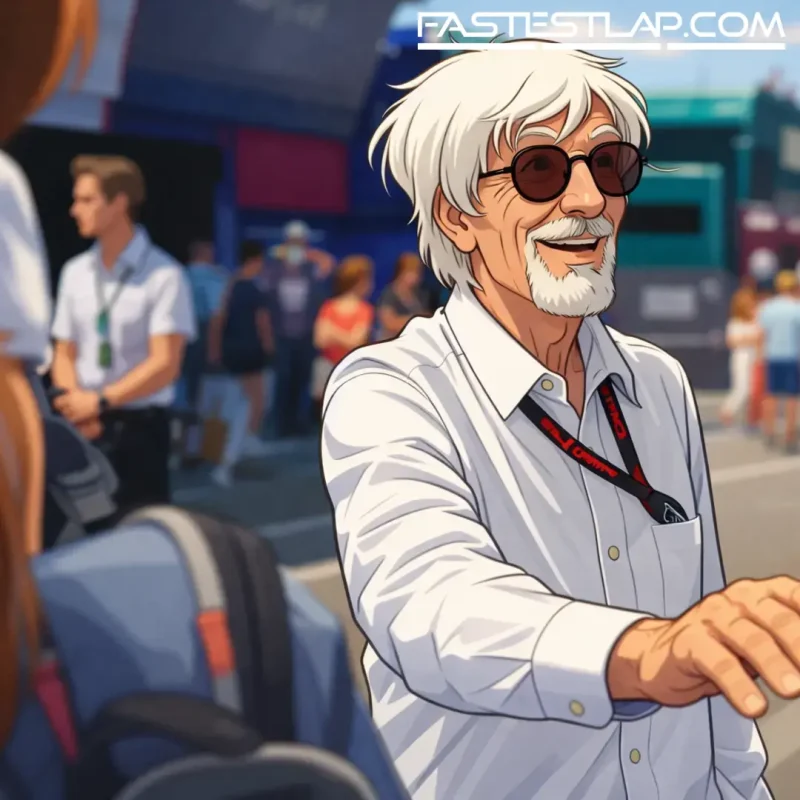
Bernie Ecclestone doesn’t do nostalgia like most people. He’ll happily tell you he misses the deal-making and the machinery of running Formula 1, but he’s never been the type to romanticise the past just for the sake of it. And yet, in the Red Bull Ring paddock this weekend, the subtext to his comments was pretty clear: F1’s modern obsession with “more” — more races, more formats, more complexity — has come at a cost.
Ecclestone, in Austria as something closer to an occasional visitor than a returning statesman, used a brief media chat to land a familiar message: the sport would be better served by a simpler engine formula, and it’s lost its way with a 24-race calendar and sprint weekends.
Liberty Media’s decade at the helm got a backhanded compliment. Ecclestone described F1 as having been made “a little bit more American”, which he framed as precisely the point — and, to be fair, no one can argue with the commercial momentum. He even joked that Liberty’s greatest achievement was buying the rights “cheap”, a line delivered with the sort of dry grin that still cuts through a room.
But while he conceded the current regime is doing “all the things that look good” — and stressed that optics do matter — his real frustration was aimed at the sport’s operational sprawl. In Ecclestone’s view, a 24-round calendar isn’t just hard on teams; it’s hard on the audience too.
“24 races is wrong for everyone, including the public,” he said. His reasoning was classic Ecclestone: scarcity drives value. If fans miss one weekend, the next one is almost immediately around the corner, and the sense of occasion erodes. It’s an old-school promoter’s argument, rooted less in sentiment than in the economics of attention.
The sprint format drew even less patience. Ecclestone didn’t dress it up with diplomatic qualifiers or the usual “it’s good for some markets” hedging. “I’ve no idea what that’s all about,” he said — an unusually blunt dismissal even by his standards.
There was, though, an intriguing aside beneath the grumbles: Ecclestone admitted he still misses parts of his old life in the sport, particularly “putting things together on the financial side”. He wasn’t pretending to be a racing purist. He never was. In fact, he noted he rarely stayed until the end of a race when he was in charge. For Ecclestone, F1 was always a business first — and he spoke like a man who still measures a weekend by the balance sheet as much as the chequered flag.
That business-first lens also explains why he was so enthusiastic about FIA president Mohammed Ben Sulayem, whose leadership he described as “a super job” despite what Ecclestone characterised as a messy inheritance. Ecclestone pointed to the FIA’s latest financial results — an operating profit of €6.7 million for 2025 after an operating loss of €24 million in 2021, with revenues up 75 per cent over the same period — as proof that the governing body is finally being run like an organisation that intends to stand on its own feet.
“There’s no reason why the FIA, if they make money, it’s criminal,” Ecclestone said, pushing back against the idea that profitability and regulation can’t coexist. In his telling, a financially stable FIA is a functional FIA: able to keep the lights on, support clubs, and invest in the work it’s supposed to do. He also insisted Ben Sulayem isn’t in the role for personal financial gain, noting the president “doesn’t take any money”.
It was striking how far Ecclestone went in defending the current FIA administration. “I’m trying to think of anything he’s done wrong,” he said, before essentially concluding he couldn’t. He allowed that no president can be “1,000,000 per cent right all the time” and hinted there were “one or two things” he’d like to see improve, but he didn’t expand — at least not in the way anyone expected.
Because when pressed on what he’d change, Ecclestone went straight for the heart of the modern F1 debate: engines.
“Three-litre engines!” he said, before adding he didn’t particularly care whether they came as a V8, V10 or V12. The point, for him, was the direction of travel — away from the intricate, politically delicate power-unit era that has defined F1’s identity for more than a decade.
It’s a line that will always find an audience in the paddock, even among those who’d never admit it on the record. The sport is entering 2026 with new regulations and a new competitive order to establish, and Ecclestone’s timing is no accident: moments of transition are when big ideas get aired, even if they’re impractical in the short term. His pitch wasn’t a detailed technical proposal so much as a reminder of what he believes F1 should be selling — noise, theatre, and a product the public instantly understands without needing a primer.
Whether anyone in power is listening is another matter. But Ecclestone, at 95, still knows how to do what he always did best: walk into a busy paddock, deliver a couple of blunt sentences, and force everyone else to argue about them for the rest of the weekend.