George Russell’s Austrian Grand Prix win will be filed as the headline, but the more interesting story from Spielberg is how quickly the pecking order is tightening — and how brutally the margins are now punishing anyone who guesses wrong.
Russell needed this one. Not for the points alone, but for the tone it sets after a couple of weekends where the underlying pace didn’t translate cleanly. In Austria it did, and in a way that felt grown-up rather than merely quick: emphatic pole, clean air when it mattered, and a race that never slipped into the sort of messy, reactive decision-making that has bitten Mercedes at times this season. Toto Wolff’s post-race description of Russell’s “just drive” reset told you plenty about what’s been going on internally. The pressure of a fast young team-mate can make even the established guy start chasing perfection. In Spielberg, Russell stopped chasing and started executing.
That theme — execution — is why Max Verstappen left the Red Bull Ring wearing a grin that didn’t quite match second place. For the first time in a while, this looked like a Red Bull that could lean on a race win without needing chaos or a perfectly-timed safety car. Verstappen was 1.6s short at the flag and, crucially, it didn’t feel flattering. Even his Q3 crash had the sting of a missed opportunity rather than a weekend-ruiner: he’d just lit up Sector 2 purple against the Ferraris before it all went wrong.
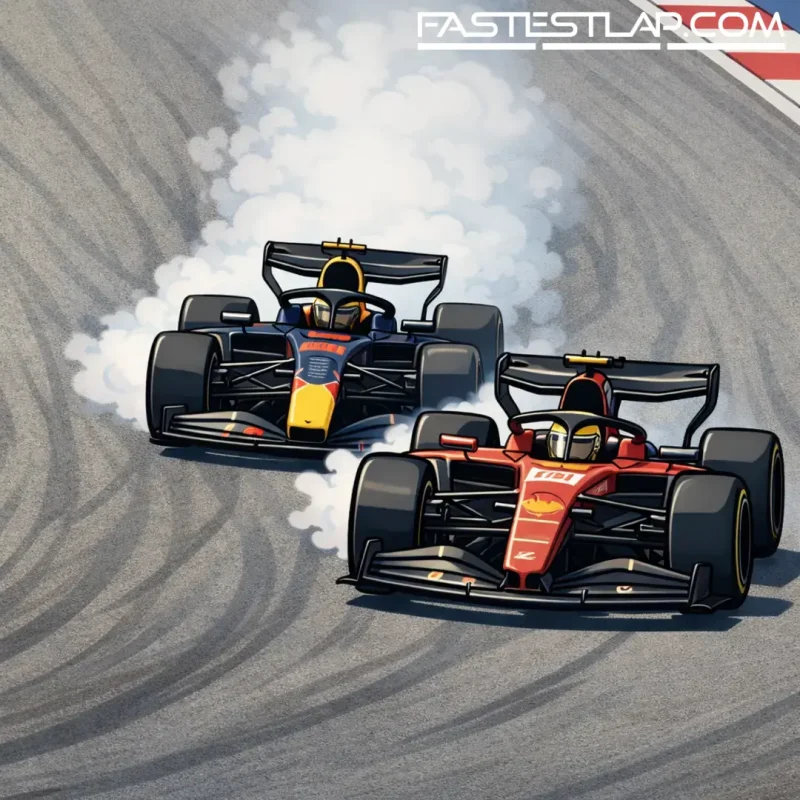
Sunday’s race gave us the sort of Verstappen-Hamilton skirmish that still drags everyone to the edge of their seat. Verstappen trying to go the long way round at Turn 6, Hamilton doing exactly what you’d expect a seven-time champion to do, and Verstappen instantly lobbying on the radio even as he knew full well what he’d attempted. He cleared the Ferrari soon enough, but the important bit came after: Verstappen’s pace wasn’t theoretical. He could live with the Mercedes.
Red Bull’s one real regret will be the final stint call. Russell stopped six laps earlier, and while tyre offsets can make that look clever or foolish depending on how the degradation curve behaves, Verstappen couldn’t quite get the closing speed needed to force a move. Red Bull had also banked a medium set from Saturday that, in another universe, might’ve changed the late-race feel — though Verstappen himself wasn’t keen to play Monday-morning strategist afterwards. What he did flag was more intriguing: halfway through the race something “felt off” at the rear, bumps and kerbs suddenly turning into a problem, traction “completely gone”. And still, he finished on Russell’s gearbox in the grand scheme of things. That’s the sort of weekend that calms nerves, not fuels them, especially with the usual 2027 noise never far away.
If Verstappen and Russell were the clearest winners, Ferrari were the weekend’s hard lesson in how quickly “we’re in this” turns into “we’ve got work to do”. Two weeks after Barcelona showcased the SF-26 as a race-winning car, Austria snapped the elastic. The new ADUO-upgraded engine arrived with the promise of momentum. Qualifying teased it, too: Charles Leclerc briefly holding provisional pole, Lewis Hamilton tucked in behind, and only Russell’s final run keeping them off the front.
Then the race arrived and Ferrari chased the wrong ghost.
In similar heat to Barcelona, Pirelli again dangled the two-stop/three-stop dilemma. Ferrari committed early to three stops — Hamilton in on lap 12, Leclerc on 13 — and paid for it. The deeper issue wasn’t simply “wrong strategy”; it was that tyre life on the Ferrari seemed to fall off a cliff once the stint settled, leaving the pit wall with little choice but to keep pulling the trigger. Fred Vasseur admitted Ferrari were “too focused on Mercedes” and “reacted too aggressively”, which is a polite way of saying they let the race come to them rather than shaping it.
Hamilton was blunt. He’d wanted to start on softs, Ferrari put him on mediums, and he called it “suboptimal” — before undercutting his own point by saying it wouldn’t have mattered anyway. “It doesn’t matter what tyre you put on our car today,” he shrugged. That’s the kind of line that lands heavily in Maranello, because it reframes the problem from a one-off call to a more structural limitation.
And there’s a second layer: straight-line performance and deployment. Hamilton talked about being down on Friday and suggested Ferrari’s deficit isn’t pure combustion grunt so much as how the electrical side tails off relative to Mercedes. Whether that’s the full story or only part of it, the message is the same. Barcelona might’ve been a breakthrough, but Austria looked like a reminder: the SF-26 can win races, yet it’s not consistently imposing itself on weekends where the tyre picture and the power picture are less friendly. Leclerc’s eighth place, and his description of a car with a strong front and “no rear” in race trim, only underlined the variability.
Mercedes, by contrast, left looking like the most complete package right now — not just fast, but predictable. That predictability also helped a rookie who didn’t actually have a bad weekend, just a slightly human one. Kimi Antonelli finished third and, for once, you could see where experience still matters. His choice to back off under yellow flags in Q3 was defensible, but Russell’s rulebook instincts drew the line between pole and playing catch-up. Antonelli then tried to win the weekend back in the opening stint and admitted he overdid it: small errors, big lap-time bleeding. The sting for him will be knowing that, across the final two-thirds, his pace stacked up with Russell and Verstappen. The comfort is that the deficit was execution, not speed.
In the midfield, Racing Bulls quietly stitched together another proper haul. Liam Lawson and Arvid Lindblad made it three straight double-points finishes, and there was a nice historical footnote in all four Red Bull-powered cars landing in the top 10 at Red Bull’s home race. The only messy moment was intra-team: Lawson was told to manage brakes and not expect to be attacked, then found Lindblad muscling through anyway. Racing Bulls resolved it with an undercut back in Lawson’s favour, which Lindblad admitted he saw coming. Harmless on paper; the sort of thing teams file away for later.
Alpine, meanwhile, had one of those Sundays that raises more questions than it answers. Pierre Gasly called it the toughest race of the season: inconsistent balance, heavy degradation, three stops just to survive. Coming off Barcelona’s race-pace turnaround, Austria’s drop-off — especially with broadly comparable demands — will worry Enstone. Gasly hinted the new front-wing direction needs deeper understanding, and right now the car looks like it can surprise Alpine in ways the engineers didn’t intend.
Audi didn’t score, but it didn’t go unnoticed either. On a weekend where points were just out of reach, the bigger step was operational: clean sessions, clean race, and a sense of extracting what was there. Gabriel Bortoleto and Nico Hülkenberg finishing 11th and 12th isn’t glamorous, but Allan McNish’s assessment that the chassis is “very good” at medium-to-high speed tracks adds to the feeling that Audi are circling a breakthrough — provided the whole package aligns on the right weekend.
Cadillac had the opposite: a weekend that collapses before it even begins. Both cars were gone within minutes due to overheating, with Sergio Perez pointing to traffic effects that the team underestimated. It’s the sort of mistake new operations do make, but Perez didn’t disguise his irritation, calling it “totally unacceptable” and admitting it felt like “four or five steps backwards” despite aerodynamic progress. With his 2027 decision looming, this was awful timing — for him and for a team that needs credibility as much as it needs lap time.
Austria, then, didn’t just reshuffle the points. It sharpened the season’s edges. Mercedes look stable and fast, Russell looks re-centred, Verstappen looks newly convinced Red Bull can give him a car worth staying for, and Ferrari look like a team still trying to build a championship rhythm out of weekends that swing wildly. In 2026, that rhythm is everything.