Ferrari arrived at the Red Bull Ring looking like it might finally have a clean, uncomplicated Sunday: second and third on the grid, a race that often rewards track position, and conditions that usually expose the soft underbelly of anyone who can’t manage their tyres.
Instead, Austria turned into the sort of afternoon that makes engineers stare at graphs long after the paddock has started packing up.
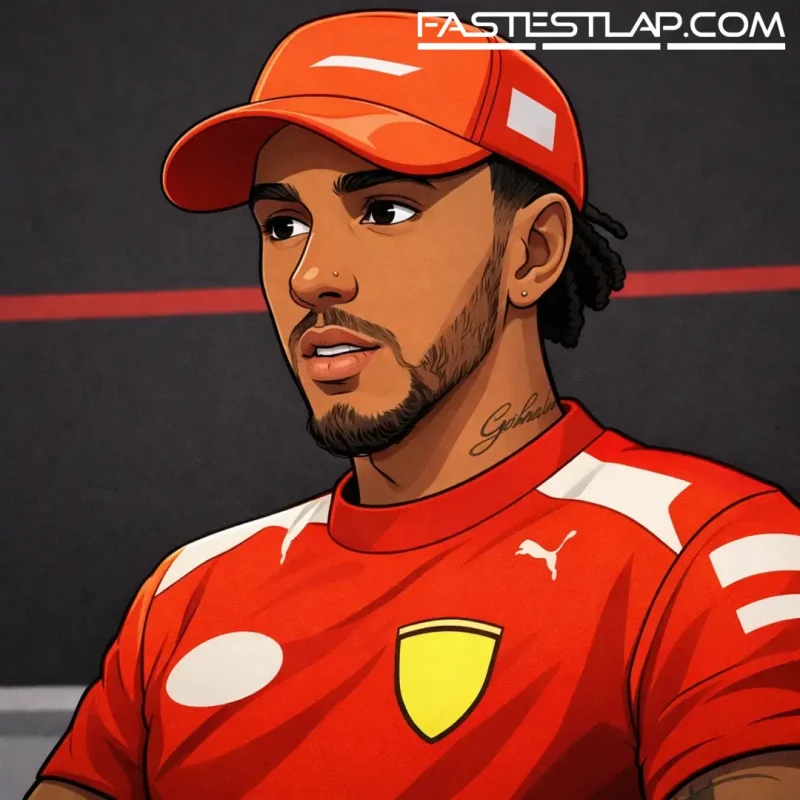
Lewis Hamilton came home fifth, Charles Leclerc slipped to eighth, and the uncomfortable truth was that neither result felt particularly unlucky. On a sweltering day with track temperatures pushing into the low 60s°C, Ferrari spent the race trying to defend rather than dictate — and it showed in the tyre life, the pace curve, and the ease with which others picked them off.
Lando Norris, who was one of the drivers to pass Leclerc on track, summed it up with a line you don’t often hear directed at Maranello: sympathy.
“The shock was Ferrari, struggling so much,” Norris said after the race. “So, to be honest, I feel bad for them.
“I mean, when you have no power, you have to push like hell in the straights, in the corners, and you can’t do that with these front tyres. A tough race for them.”
It’s an interesting choice of words — “no power” — because it points to the vicious loop Ferrari appeared trapped in on Sunday. If the car’s not giving you the straight-line performance you need to hold position, you end up compensating everywhere else: leaning on the tyres on corner entry, hustling the car in the slow stuff, asking more of the fronts on a circuit that already punishes them when it’s this hot. In 2026, with these cars, you can’t keep cashing that cheque for long before the tyres bounce.
And once the surface goes away, the race comes at you quickly.
Hamilton and Leclerc were both overtaken on track by Max Verstappen, Kimi Antonelli and Oscar Piastri. Leclerc, in particular, became a target as the stint wore on, also losing out to Isack Hadjar and Norris. Whatever Ferrari had on Saturday — enough to lock out the second row behind George Russell’s Mercedes — wasn’t there in the heat of the race, when the grip levels change and the car’s balance lives and dies by how gently you can treat the tyres.
What made it sting more was the timing. This was the immediate follow-up to Hamilton’s breakthrough win for Ferrari in Barcelona, a victory he controlled to the tune of 20 seconds. In Austria, he finished 26 seconds behind Russell. The pendulum didn’t just swing; it snapped back.
Hamilton didn’t hide from it. If anything, he sounded like a driver trying to stop one perfect weekend from distorting the team’s internal picture.
“I think it’s more of a reality check,” he said. “I think we don’t know why we were so competitive on Sunday in Barcelona. I think that’s a very strong track for me. I chose a strategy that I thought from experience would work with the deck that we had… But then today I think we were hit more with reality, which is that we still do have a good car, but we are down compared to Mercedes just in our pace, they just are quicker.”
That context matters, because Hamilton’s Barcelona win had inevitably sparked the usual conclusions: Ferrari’s turned a corner, the new environment has lit a fire under him, the title fight has a new axis. But Austria was a reminder that the margins in 2026 can still be brutally track-dependent, and that one standout Sunday doesn’t automatically mean your baseline is where it needs to be.
The other sharp detail from Hamilton was where he thinks the deficit still lives.
“We still have to keep developing,” he said. “It doesn’t mean we can’t close that gap… We’ve got a lot of work to do. We still have to continue to add performance to the car, particularly power is where we’re going to have to keep working on pushing.”
He also referenced Ferrari’s second ADUO engine upgrade — not as a magic bullet, but as part of the hard yards still required. And that, more than the finishing positions, is what Austria may end up underlining inside Ferrari: if you’re forced into a high-energy driving style just to hang onto track position, your tyre life becomes the first sacrifice. On a day like this, the bill arrives fast.
There was a championship consequence too. Hamilton lost second in the drivers’ standings to Russell on Sunday, a swing that felt almost inevitable once Mercedes’ pace advantage became clear in race trim. From the outside, it looked like Russell had the race in hand while Ferrari’s afternoon gradually deteriorated into damage limitation — and in modern F1, those are the days that quietly decide whether you’re a genuine title threat or just a weekend-to-weekend nuisance.
Ferrari will insist — correctly — that the car is still good, that the ceiling shown in Barcelona is real, and that the season is long. But Austria was the sort of race rivals love: one where you can point to conditions, tyre behaviour and outright pace and say, with a straight face, “that’s the baseline.”
And when even a competitor like Norris is saying he “feels bad” for you, you know the problem was visible from every cockpit on the circuit.