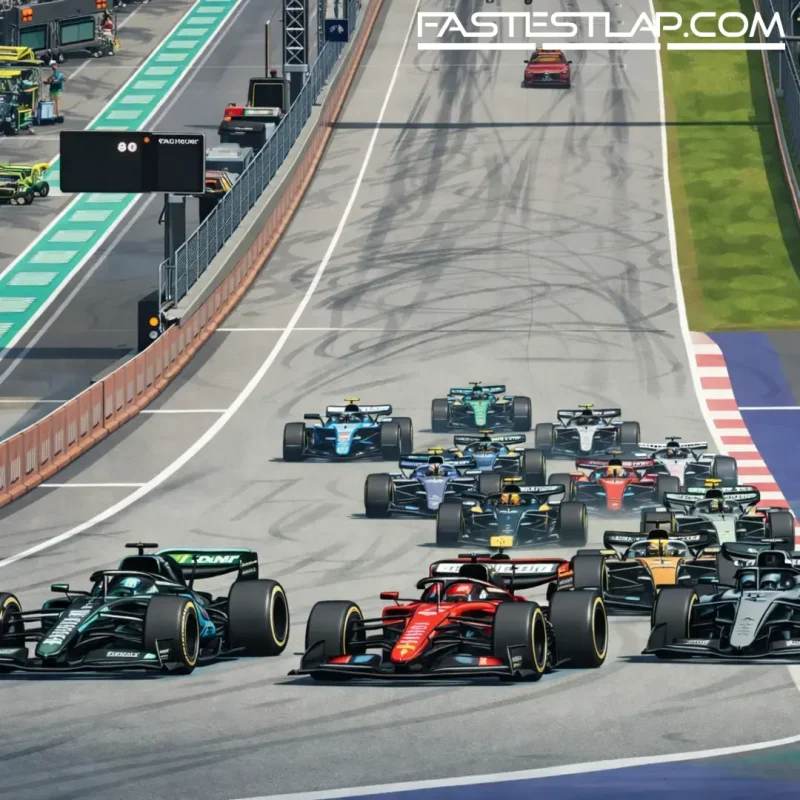
The Austrian Grand Prix weekend at Spielberg ended with a sobering reminder that Formula 1’s biggest limiting factor isn’t always tyre life, brake temperatures or battery deployment — sometimes it’s simply the humans standing out in it.
The FIA confirmed a marshal, Harald, suffered a heart emergency before Sunday’s race and was airlifted to a nearby hospital, where he received medical treatment. The governing body didn’t disclose the cause, but its message carried the right tone: best wishes for a full recovery, and an acknowledgment of the commitment marshals continue to give the sport. In a paddock that increasingly talks about sustainability and duty of care, it’s worth repeating that marshals are almost always unpaid volunteers.
Spielberg was declared a heat hazard as ambient temperatures pushed above 31°C, part of an unusually warm spell across Europe. On-track, the conditions were even harsher: track temperatures exceeded 46°C across the weekend, leaving little doubt why the FIA reached for the “heat hazard” trigger in the first place.
That declaration has a direct technical and operational consequence. Teams are required to fit the components for the driver cooling system — a vest with tubing that circulates cold fluid — but the final call on actually wearing it remains with the driver. And, as ever in F1, “available” doesn’t automatically mean “usable”.
Isack Hadjar was blunt about it in the pre-race build-up, describing a system that sounds better in the briefing room than it feels in the cockpit.
“I really don’t like it because there’s just too many tubes, too many things happening in the cockpit and not very comfortable,” said the Red Bull driver. In his view, it buys you a brief window of relief — “like 10 minutes” — before the benefit tails off and you’re left managing the discomfort of extra kit in a space where drivers obsess over millimetres.
Hadjar also framed the bigger point in a way plenty of racers will recognise: if the day is so brutal you *need* the vest, you may already be in a situation where the car is the bigger problem. “If I need it, that means the car as well can’t handle it and we can’t drive. So, I think the car will give up before I do, in any case.”
Oscar Piastri offered a more measured take, suggesting the system can be worthwhile when it’s working properly — and hinting at the downside drivers worry about in a sport that’s full of “helpful” solutions that become liabilities the moment they malfunction.
“I used it a couple of times last year,” Piastri said. “There’s obviously the risk if it goes wrong and if it fails, then yeah, it’s worse than not wearing it. But I think if you get the system working well, then it can help a bit. It’s not a complete game changer but when I used it last year, it was okay.”
That’s the compromise in a nutshell. Teams have to carry the weight in the car anyway under a heat hazard, so there’s a natural “we might as well use it” logic. But drivers aren’t weighing it up like an engineer with a clipboard — they’re thinking about physical restriction, cockpit clutter, and the possibility of the thing becoming a distraction at 300km/h when they’re already battling heat soak, dehydration and fading concentration.
What happened to Harald will inevitably sharpen the conversation around where the sport draws its safety boundaries when extreme weather turns a race weekend into an endurance event for everyone involved — not just the drivers. F1 has become far more sophisticated in how it manages risk at the sharp end, but the workforce that makes a Grand Prix possible still spends long hours exposed to the elements, often with far less control over their environment than anyone inside the paddock.
Silverstone, for now, is expected to offer more manageable conditions, with the heatwave not due to hit the UK until the following week. After Spielberg, that will feel less like a footnote and more like a collective exhale.