
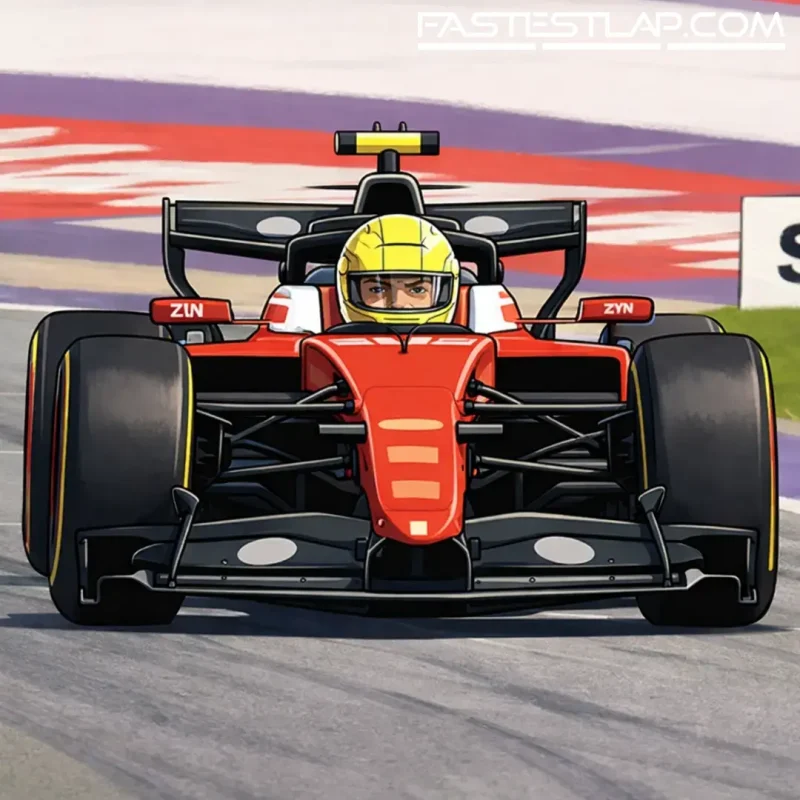
Lewis Hamilton didn’t need a data trace to recognise what was happening in Austria — he could feel it in the cockpit.
Ferrari left Spielberg with another uncomfortable reminder that, in 2026, power isn’t a single headline number. Yes, the SF-26 struggled on tyre life, and yes, it looked short of straight-line speed at points across the weekend. But Hamilton’s bigger concern is subtler and, in many ways, more awkward to solve: the way Ferrari’s energy deployment appears to fade when rivals, particularly Mercedes, keep pulling all the way to the braking zone.
It was obvious enough that even a rookie noticed. In the cooldown room after the race, George Russell raised Ferrari’s lack of pace and Kimi Antonelli didn’t bother sugar-coating it. “They were so slow. They were deploying so weirdly,” Antonelli said, before explaining he “almost crashed” into Charles Leclerc into Turn 1 on lap two because the speed differential caught him out — claiming he was “probably 30kph up”.
That’s not the kind of comment you want being made about your car in public, and it’s not the kind of moment you want a rival nearly punting into your Ferrari because your acceleration profile isn’t what it should be.
The backdrop made it sting more. Ferrari started the Austrian Grand Prix wedged between the two Mercedes: Russell on pole, Leclerc alongside on the front row, then Hamilton third with Antonelli fourth. By the flag, Mercedes had converted that into a win for Russell and a podium for Antonelli, while Hamilton and Leclerc slumped to fifth and eighth. The Ferrari that looked like it belonged on the first two rows on Saturday became a car that couldn’t live with the front in race trim.
Hamilton’s read on the problem is telling. He isn’t describing an engine that feels gutless out of the corner — the initial punch is there — but a car that stops delivering at the exact point where modern F1 cars make their time: the sustained push along the straight after the first hit of traction.
“On Friday we were down six tenths just in straight-line speed,” Hamilton said afterwards. “I have to go and see what the case was today, but I’m sure it was not insignificant. But also just grip wise we just couldn’t keep up with everyone today.”
That’s the public-facing version. The deeper frustration came when he compared Ferrari’s behaviour to Mercedes’ in the same fight.
“When you’re around these guys, it’s deployment,” Hamilton explained. “It doesn’t necessarily feel so much as power, because when you come out of the corner, it feels like you’ve got the grunt, but it’s just deployment at the end. Ours tails off, and particularly Mercedes, they just keep going.”
That “tails off” line is the warning. If you’re simply down on horsepower, you chase a power upgrade, tidy up your drag level, maybe find a little efficiency. But if the car is running out of usable electrical deployment earlier than the competition — or delivering it in a way that leaves performance on the table — you’re into a more structural argument: how the team is harvesting, storing and releasing energy over a lap, how aggressively it can spend it, and whether the control strategy is compromising the second half of the straight.
And that’s why Hamilton’s message to Ferrari wasn’t just “bring more power”. It was “find out why,” with the clear implication that the answer won’t arrive in time for the next race or two.
“We’re going to have to push really, really hard to see when we can get the next power upgrade,” he said, before adding the part that should worry Maranello: “So we’ve got to look at why and how we can improve that. But that’s not going to come for a while.”
In other words, this isn’t a quick calibration tweak you upload between sessions. If Ferrari’s energy management architecture is leaving them exposed late on the straight — the phase rivals use to finish the job — it becomes a compounding weakness. It makes overtaking harder, it makes defending nearly impossible, and it forces you into compromises elsewhere: higher downforce to protect tyres and corners, which only worsens the straight-line pain; or lower downforce to claw back speed, which punishes the tyres and exposes the car in race stints. Austria had a bit of all of that.
There’s also a psychological edge to it. Drivers can manage understeer, they can work around a nervous rear, they can even live with a tyre that drops off. But when you’re in DRS range and the car simply doesn’t keep accelerating the way you expect — when you feel the push ebb as the braking zone approaches — it’s one of the most demoralising deficits in the sport. You’re doing the hard part to get close, then the car stops paying you back.
Silverstone is next, and that’s where this gets uncomfortable fast. It’s not that the British Grand Prix is a pure power track — it isn’t — but it’s full of long, loaded sections where carrying speed and sustaining deployment matters. If Ferrari is still “tailing off” there, it won’t be something you can hide behind strategy or tyre management. It’ll be visible in the most painful way: by watching a Ferrari hang on through the corner and then get eased out of contention on the next straight, again and again.
For now, Hamilton has done what top drivers do when the problem is bigger than a setup call: he’s put a spotlight on it, in public, and made it clear he expects Ferrari to treat it like a priority. The uncomfortable bit for Ferrari is that the solution, by his own admission, may not arrive on a timetable that flatters anyone.









