For 10 laps in Spielberg, Formula 1 briefly slipped back into muscle memory.
Max Verstappen had the faster Red Bull, Lewis Hamilton had track position, and the pair went at each other with the kind of stubbornness that used to turn Sundays into slow-burn arguments about etiquette. The difference, this time, was what happened after the flag: a grin, a handshake, and a “good race” exchanged like two drivers who know exactly what they’ve just given the crowd — and don’t particularly feel the need to dress it up.
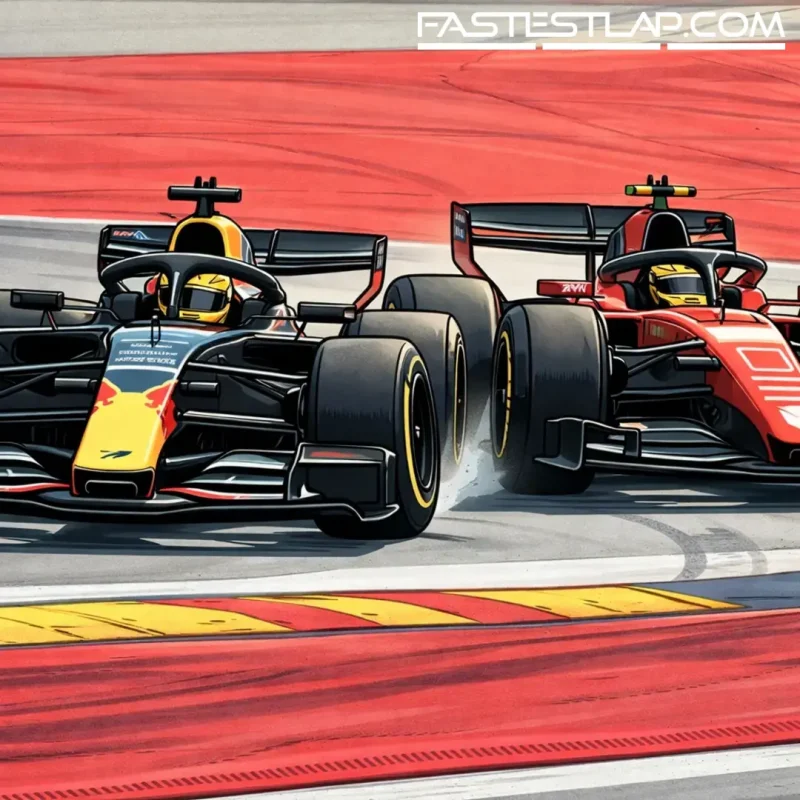
The flashpoint came early, when Verstappen closed onto Hamilton and launched the first serious attempt on lap 11 into Turn 3. The move itself was orthodox; the aftermath wasn’t. Hamilton held his line through the sequence that follows, Verstappen tried to hang it around the outside, and the margin disappeared in the way it always does at the Red Bull Ring when someone refuses to blink. With his wheels flirting with the gravel, Verstappen abandoned the outside run and filtered back in, unimpressed.
On the radio to Red Bull, his verdict was immediate: “Clear penalty!”
Hamilton’s response later was just as blunt, and very Hamilton in its framing — less about outrage, more about hierarchy and consequence.
“He went off the outside. You don’t expect to go around the outside of a champion,” Hamilton said afterwards. “I wouldn’t expect to go around the outside of him there and hold the line. So he was behind at the apex, and therefore he should have backed out.”
If that reads like a lecture, it’s because Hamilton’s always treated wheel-to-wheel as a kind of contract. The words matter less than the subtext: he’s not going to open the door simply because Verstappen is arriving at speed, and he’s not going to apologise for doing the thing Verstappen has built half his reputation on — committing to a corner and daring the other guy to decide.
The fascinating part is how quickly the day moved on from the complaint to the consequence. After the first round of pit stops, Verstappen got his second bite — and this time he didn’t ask the question around the outside. He went the direct route, attacked the inside, and made sure the corner belonged to him early enough that there was no debate left to have on exit.
Jolyon Palmer, watching on for F1TV, was practically purring at the intent behind it.
“It’s brilliant racing from him,” Palmer said. “I love the aggression that he’s throwing, inside or outside. He knows that he needs to clear this Ferrari… It’s not an easy place to throw a lunge… But he sent it in… the move was done on the entry. It was a great pass.”
That, really, was the story of Verstappen’s afternoon: when the first attempt turned into an argument about space, he returned with a version of the move that removed the argument. Austria encourages that sort of clarity. There are corners here where you can posture and squeeze and still pretend it was all unavoidable. There are others — and that later pass was one of them — where if you’re ahead at the point of commitment, you’ve effectively written the closing statement.
Verstappen converted the pace into second place. Hamilton, despite starting ahead, ended up fifth. In isolation, it’s simply a swing in a race where Red Bull looked the sharper package over distance. In context, it also felt like a small signal: Ferrari and Red Bull are close enough, at least on this weekend, that the Verstappen-Hamilton plotline isn’t just nostalgia bait. It could be operational again.
And yet the mood in the media pen afterwards was strikingly light. With both drivers in the same scrum, Hamilton turned to Verstappen first.
“Good race, man,” he said.
Verstappen smiled. “Yeah!”
“Good job, mate,” Hamilton added, and they shook hands.
No edge for the cameras. No performative frost. Just two elite competitors acknowledging that they’d spent the afternoon doing something difficult at high speed without turning it into something stupid. For anyone still emotionally trained by 2021 to expect permanent hostility, it was almost jarring.
But it also made sense. Hamilton is older, operating now from Ferrari, and picks his fights carefully — on track and off it. Verstappen, for all the fire, is rarely interested in dragging a spat beyond the moment unless he feels something was taken from him. In Austria, nothing was taken. A tough first exchange, a better second one, and a result that reflected the day’s pace.
That’s what should make the rest of this season intriguing. If Ferrari and Red Bull really are converging, these are the kind of races we’ll get more often: not the chaotic, crash-or-conspiracy theatre, but the leaner, colder form of combat where both drivers are convinced they’re right — and the only real way to prove it is to be ahead at the next braking zone.
Spielberg reminded everyone that Hamilton and Verstappen don’t need a championship decider to make a grand prix feel like it has teeth. They just need to be near each other, in cars good enough to argue with, and in the right mood to stop conceding.