Adrian Newey doesn’t do excuses, but he’s also never been one to hide behind PR gloss when the numbers are ugly. Eight race weekends into 2026, Aston Martin have one point, a car that arrived overweight and under-aeroed, and a season that was supposed to announce the team as a genuine force in Formula 1’s new rules era already feels like it’s slipped into survival mode.
And yet the most interesting part of Newey’s assessment isn’t the blunt diagnosis of what’s gone wrong — it’s the decision he’s taken on what to do next. Aston Martin aren’t going to nibble at this with small updates and hope the curve turns. Newey has pushed the team into a high-stakes, all-in development play: hold fire, regroup, and deliver a “major update” timed for the Hungarian Grand Prix, just before the August break.
That’s a gamble in itself. In a cost-capped world, skipping incremental upgrades can look like either clarity or desperation, depending on whether the big swing lands.
The backdrop matters. Aston Martin went into 2026 with Honda power and Newey in charge as team principal, having joined in March 2025. The internal expectation — and, frankly, the external hype — assumed that combination would put them on the front foot when the regulations reset. Instead, Newey admits they started the race already several laps down.
By his own telling, the team didn’t start serious work on the ’26 car until mid-March 2025 and didn’t get a model into the wind tunnel until mid-April. In the modern development race, that’s not “a bit late”; it’s the sort of delay that forces compromises into the DNA of the project.
Newey’s point is not that the staff lack talent. It’s that the organisation wasn’t yet functioning like a single, well-drilled unit — the kind you need when everything is moving quickly and the penalty for a wrong turn is months, not weekends. Add in “sky-high” expectations and you get the sort of pressure that can make a team chase too many things at once, too soon.
The technical picture is messy because it’s not one failure, it’s several piled on top of each other.
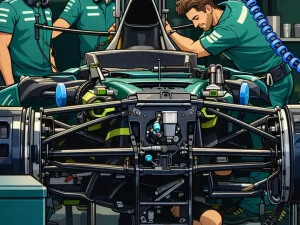
The AMR26 has been overweight — the deadliest kind of problem under a new regulations cycle because it robs you everywhere, and it’s rarely quick to fix. Newey concedes some of that came from integration work and vibration issues with the Honda power unit, but he also makes it clear Aston Martin didn’t execute well enough on weight saving in their own design. Rushed design, as he puts it, is when “weight is the first thing that suffers” because optimisation time is the first thing you don’t have.
Then there’s the aero concept. Newey says the team went in a bold direction — “largely pushed by me” — but without the time to explore multiple concepts properly. That’s a fascinating admission from a designer whose career has been built on picking a sharp concept and making it sing. Here, the concept may not be “fundamentally wrong”, but it’s thrown up challenges they didn’t anticipate. Translation: even if the idea is sound, the operating window is narrow and the correlation work hasn’t been clean enough to understand how to unlock it.
On top of that, both Fernando Alonso and Lance Stroll have pointed to gearbox-related drivability issues. When the mechanical platform isn’t giving the driver confidence — especially under braking and on traction — it doesn’t matter how clever the aero surfaces look on a CAD render. It just turns weekends into damage limitation.
The timeline from testing into the opening rounds reads like a slow-motion pile-up. Aston Martin’s pre-season was consumed by trying to get the power unit working correctly with the chassis and gearbox; Newey describes the first proper running as not happening until Free Practice 3 in Melbourne. That’s not just lost mileage — that’s lost learning. Barcelona and both Bahrain tests should have been about understanding the car’s traits and iterating quickly; instead they were firefighting.
“Melbourne was the wake-up call,” Newey says, and you can see why. If you arrive at the first race effectively still in test mode, you’re already spending race weekends collecting basic data while rivals are refining. The performance gap becomes structural.
So why go big in Hungary?
Because Aston Martin’s problem isn’t a single weak area that a new floor or a revised front wing can mask. They’ve got weight, aero, and mechanical integration all fighting each other. In that context, Newey’s stance makes sense: stop reacting, stop scattering resources, and package the fixes so they arrive as a coherent step — one that actually moves the car’s baseline rather than just changing its symptoms.
There’s also a cultural element in the way he describes the response inside the AMR Technology Campus. Once the “initial shock” passed, Newey says the reaction was positive, with the team pulling together around two priorities: get out of the hole with the pre-break update, and “build the foundations properly for the future”.
It’s an important line because it hints at what this season may really be about for Aston Martin. Not a fairy-tale “Newey arrives and everything changes overnight” narrative, but the harder work of turning big facilities and big ambition into a development machine that actually functions under pressure. Newey talks about introducing better systems and processes — the unglamorous stuff that, in practice, decides whether an organisation can execute.
That doesn’t guarantee Hungary will be a turning point. A major update can just as easily expose further correlation problems if the underlying model isn’t trustworthy, or if the car’s sensitivities remain. And the constructors’ table doesn’t wait politely while you fix yourself — Aston Martin sit 10th with one point, ahead only of newcomers Cadillac.
But if you’re looking for the moment that defines Aston Martin’s 2026, it may not be the miserable early results. It’ll be whether this decision — to take a breath, accept the pain, and swing hard with a properly integrated package — produces a car that finally behaves like it belongs in the new era they set out to lead.