McLaren’s message to the paddock is essentially this: don’t mistake the noise around upgrade frequency for panic spending.
As rivals mutter about who’s going to hit the 2026 cost-cap ceiling first, Andrea Stella insists Woking went into this new rules cycle with its eyes open — and with a deliberate buffer set aside for exactly the kind of development arms race that always follows a reset.
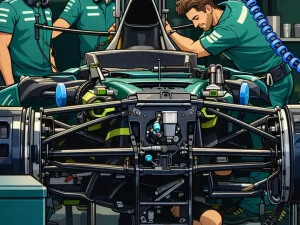
Eight race weekends into the season, the MCL40 is still a young car in the broadest sense. Everyone’s learning where the performance is hiding, and the teams that can iterate fastest are going to define the shape of the early championship. McLaren’s already had to play that game in layers: its first major performance step arrived split across Miami and Canada, with the team bringing a spread of new components spanning the floor, chassis, wings and bodywork.
There were additional tweaks at Monaco, followed by minor changes at Barcelona and Austria. Barcelona, in particular, brought a noticeable front-wing revision — the sort of highly visible piece that invites instant judgement from the outside, even if the real lap time is often buried in the less glamorous details underneath the car.
The Austria weekend also offered a small window into how tight the modern development process is. McLaren had an adaptation of the so-called ‘Macarena’ wing ready to appear, only for the plan to be shelved when it didn’t pass final sign-off checks. That’s the reality now: you can arrive with a part in the garage and still end up running the weekend without it because the compliance and validation steps won’t let you roll the dice.
The wider paddock context matters here, because the suspicion isn’t really about McLaren — it’s about the sheer volume of new parts some of the front-running teams have been able to push through. Ferrari, in particular, has already delivered two big upgrade packages, first in Miami and then again in Barcelona, and it hasn’t gone unnoticed.
Carlos Sainz summed up the mood succinctly when he admitted “everyone is scratching their heads” at how the top teams are managing their output within a $215 million budget cap. Toto Wolff went further, arguing that the spend rate is effectively unsustainable and predicting that some outfits will simply run out of cap space later in the year — leaving them unable to keep feeding updates into their cars.
That’s the pressure point: not whether teams are legal today, but whether the accounting realities of the cap will catch up with them in the second half of the season. Every front wing, floor revision and bodywork rework has a cost. Every rushed manufacturing cycle has an opportunity cost. And the 2026 calendar offers no mercy — the car that’s merely “pretty good” in early summer can be swallowed up by one that keeps evolving through late-season.
When McLaren was asked directly whether it risked being one of the teams that burns too hot, too early, Stella’s response was telling in its simplicity. He said the team had planned for this scenario, financially as much as technically.
“We always said… irrespective of the starting position it was going to be a battle of development,” Stella explained in Austria. The key line was the one that followed: there’s “no point” acknowledging a development war if you can’t afford to fight it. So McLaren, he said, allocated its cost-cap budget with a protected amount specifically for upgrades.
In other words, Stella wants it understood that McLaren isn’t discovering the cost-cap trap in real time. The team expected the opening phase of a new regulations era to be defined by aggressive iteration, and it budgeted accordingly. From his perspective, the limiting factor right now isn’t money — it’s execution. Can McLaren consistently produce aerodynamic and mechanical upgrades that move the car forward, and can it do it while also improving the tyre “conditioning” work Stella referenced, the unflashy but essential part of turning performance into usable race pace?
It’s a pointed stance at a moment when McLaren’s own competitive position demands clarity. After eight race weekends, it sits third in the constructors’ championship on 159 points, a hefty 143 behind Mercedes at the top. That gap is large enough to sharpen every conversation about upgrades, and small enough — in a season this young — to keep hope alive that development momentum can still tilt the trajectory.
The irony is that cost-cap anxiety is often the loudest when a team is doing the visible stuff: new wings, new bodywork, new floors. Yet the decisive gains can come from the less obvious decisions — how you sequence packages, how you avoid dead-end concepts, how often you can bring parts that work first time rather than needing a weekend of correlation damage control.
For McLaren, Stella is betting that the preparation done last winter wasn’t just about designing the MCL40, but about designing a season-long plan to keep it moving. The paddock can debate who’s spending what. McLaren’s stance is that it’s spending where it meant to — and, crucially, that it can keep spending there for a while yet.