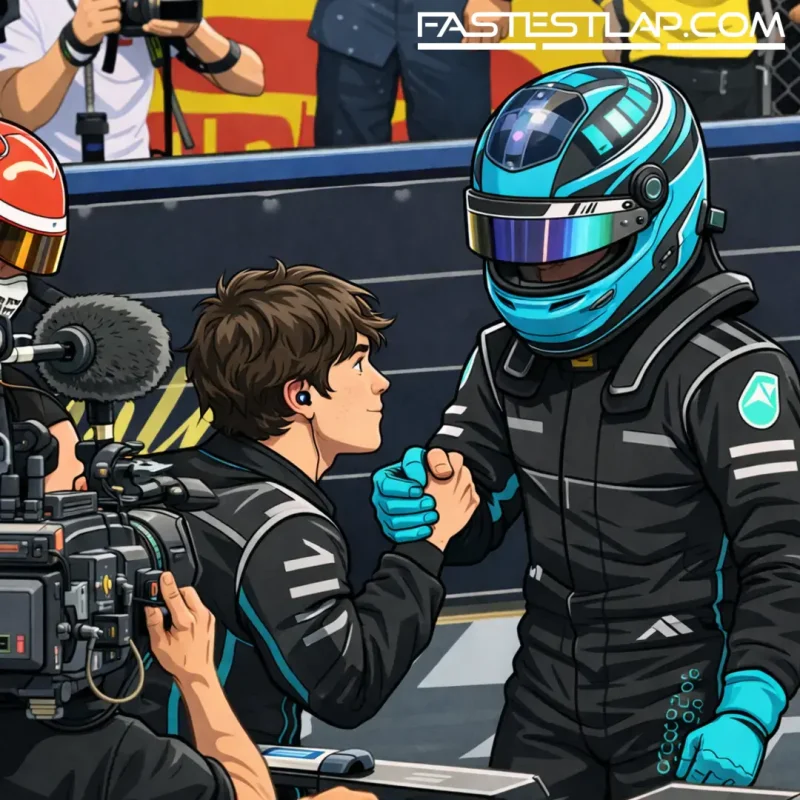
George Russell’s season is starting to acquire an uncomfortable pattern: the peaks are high, but they’re arriving too sporadically to keep a teammate like Kimi Antonelli in check.
Mercedes has turned qualifying into its private domain in 2026, yet the intra-team numbers tell a story the Brackley pitwall won’t be able to ignore for long. Antonelli leads Russell 6–3 in their qualifying head-to-head, and in a year where track position has been gold, that edge has landed with real weight.
Mark Webber, speaking at Silverstone, put his finger on what’s separating them. Not raw speed—Russell clearly has that—but repeatability. The ex-Red Bull driver’s argument was simple: Russell can still produce a “big lap”, but Antonelli is living on a higher baseline, session after session, circuit after circuit.
Austria was the perfect illustration of Russell’s upside. He delivered what Webber called a brilliant pole, combining experience with a sharp reading of the rule book to keep just enough throttle on under yellow flags while still nailing the lap. It was the sort of seasoned, high-stakes judgement you don’t teach a rookie.
The problem, as Webber sees it, is that those Saturdays are arriving like special occasions rather than weekly currency.
“He has big laps… we saw a few in Austria,” Webber said. “But, his big laps are just enough to hang with Kimi’s mean line of his laps. In terms of his average lap… he just is stronger at the moment. That’s the headache for George. He has to somehow get the consistency in qualifying.”
That headache was obvious again at Silverstone. Antonelli stuck the Mercedes on pole; Russell was fourth, 0.370s off his teammate’s pace. In a tight field it’s a chasm, and it left Russell staring at another Sunday where he’d need the race to bend his way rather than controlling it from the front.
The sting for Russell is that, when he does reach pole, he’s been nearly as ruthless as Antonelli at converting it into wins. The Briton’s only had two poles so far—Australia and Austria—but he’s turned all but one into victories. Antonelli, though, is building an entirely different kind of pressure: not just speed, but an assumption of inevitability when he starts first.
He’s won five straight from China to Monaco when launching from pole, and would likely have made it six had a wheel shield on his W17 not broken at Silverstone. That one failure to convert is almost the point—Antonelli’s been so clinical that it takes an odd mechanical gremlin to interrupt the rhythm.
Russell has managed to trim Antonelli’s championship lead down to 25 points, which keeps the fight alive on paper. But anyone watching the Saturdays can see why Webber framed qualifying as the lever that decides whether Russell can genuinely sustain a title campaign rather than merely puncture his teammate’s momentum.
What’s particularly impressive—perhaps irritating, depending on which side of the garage you’re standing in—is the breadth of Antonelli’s form. Webber noted that he’s been brilliant “in the new regulations at all tracks”, through changing conditions and different circuit demands. That matters, because it suggests this isn’t a honeymoon run built on a narrow window of car behaviour. It looks, at least right now, like Antonelli has found a stable platform and is exploiting it with the confidence of someone who expects to be quickest.
Russell, meanwhile, sounded genuinely baffled by what he was experiencing at Silverstone. His qualifying included an odd moment at Luffield, where he ran wide and nudged the barrier with the front wing. But his bigger concern wasn’t that single error; it was what he described as a persistent straight-line deficit that the team hadn’t yet explained.
“There was no damage, but all weekend we’ve been losing lots of time in the straights,” Russell said. “Yesterday in Q3, it was almost three tenths I lost in the straights. Again today in qualifying, you look at the speed traps, it’s 3k down middle sector, 6k down in the last sector compared to my teammate and compared to the McLaren cars. The team are working super hard to understand why that is.”
That kind of gap can come from plenty of places—set-up divergence, deployment, drag levels, even something as mundane as how cleanly the car is harvesting and releasing energy—but Russell’s point was clear: he didn’t have the same tools on the straights that Antonelli did. And if he’s already trying to chase consistency while also questioning whether his car is giving away free lap time, the job only gets heavier.
This is where the title fight inside Mercedes takes on its sharper edge. Russell doesn’t need pep talks about speed; he needs weekends where the “average lap”—Webber’s phrase, and a telling one—doesn’t leave him having to invent his way back into contention on Sunday. If he can stabilise his qualifying execution, he can dictate starts, strategy windows, and the tone of races. If he can’t, Antonelli will keep forcing him into reactive racing, and those are the campaigns that tend to die by a thousand cuts.
Antonelli is still young enough that people will keep waiting for the wobble. But so far, 2026 has been a season of him refusing to provide it. Russell is close enough to make this interesting. He’s also far enough away on too many Saturdays for it to feel comfortable.