
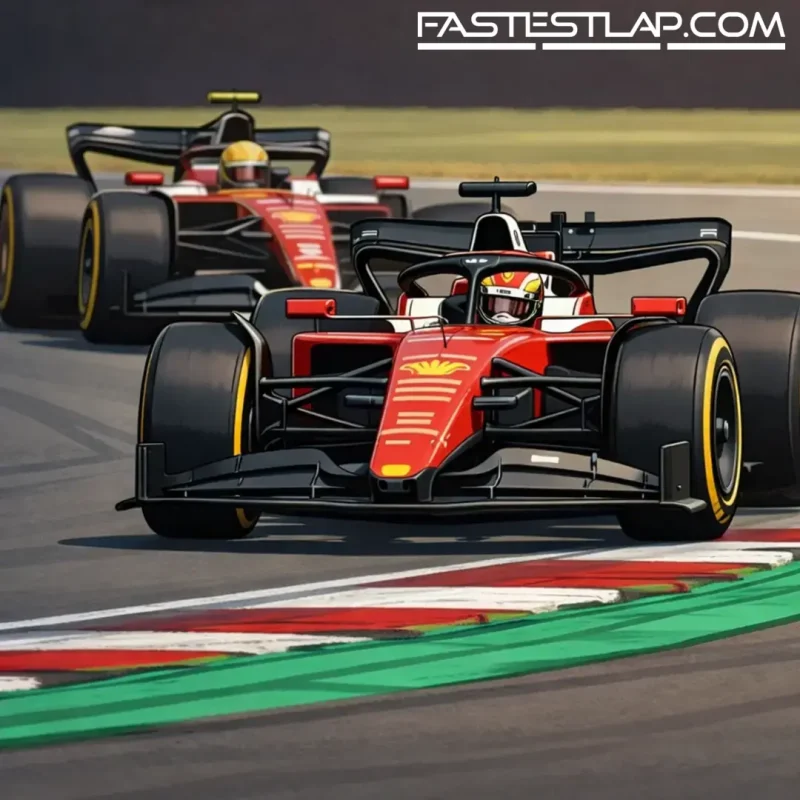
Silverstone had the feel of a reset button being slammed with intent — and not just because the British weather finally gave everyone a weekend where set-up choices actually mattered.
Ferrari arrived with the kind of internal tension that only a big-name pairing can generate. Lewis Hamilton had been hogging the oxygen since Barcelona, and Charles Leclerc’s recent crashes had handed the narrative merchants plenty to work with. But when the lights went out on Sunday, it was Leclerc who looked like the driver with the clearer head, the cleaner plan and, crucially, the car that made sense underneath him.
Hamilton had looked the sharper Ferrari across Friday and in Sprint running. Then Leclerc and his side of the garage pivoted for the Grand Prix, and that decision ended up defining the race. Hamilton later pointed to a wing-setting divergence that left him fighting a car that wouldn’t respond early on — he took wing out, got understeer, and watched Leclerc disappear.
Leclerc didn’t need to oversell what the win meant; his tone did it for him. There’s been “noise” around him and the team, he admitted, and he’s had to avoid getting dragged into the social media spiral. But the key line was the simplest: he didn’t become a bad driver overnight — he lost the feel, and Silverstone was where it came back. On a circuit that punishes hesitation, he finally had the confidence to lean on the car again.
The broader significance isn’t just one trophy in the cabinet. It’s momentum inside a team where politics are never far away. Fred Vasseur has already been blunt about Ferrari not picking sides for the championship, and this was Leclerc’s reminder that if anyone thought the Hamilton storyline meant the leadership dynamic had quietly shifted, they might want to check the timing screens.
It also didn’t hurt that the ADUO-upgraded Ferrari power unit appeared much happier in Silverstone’s lower temperatures and altitude, with the aero package behaving itself. Leclerc was right to caution against assuming the “battle with this car” is suddenly over, but this didn’t look like a lucky Sunday papering over cracks. It looked like a car and driver re-aligned.
Kimi Antonelli, though, left with that particular kind of frustration only a front-running weekend can create — the sense you’ve done the hard part and been denied the ending. He beat Hamilton in the Sprint, took pole position, and spent the Grand Prix working his way into a position where a late fight with Leclerc felt inevitable.
Antonelli’s pace story was already strong; what stood out was his response once it started to unravel. A wheel shield failure — and possibly more than that, in Antonelli’s view — wrecked the car’s behaviour. He described corners where it simply “wouldn’t turn anymore”, to the point it felt fundamental rather than superficial. Even when the team suggested retiring, he stayed out and scrapped for whatever was still available until the Safety Car eliminated even that.
Championship-wise, he took a hit — his lead trimmed again, now down to 25 points — but it was another weekend where his execution looked cleaner than George Russell’s. If there was meant to be a “home advantage” swing, Antonelli didn’t appear to have read that memo.
Over at Red Bull, it was the sort of weekend that turns background unease into loud questions. Max Verstappen’s race ended early and, by the team’s own description, “unacceptable”, after what appeared to be a rear wing aero attachment issue pitched him into the gravel. Bad luck? Possibly. But the timing was brutal.
Red Bull’s underlying performance already looked less convincing than Austria’s upgrades had suggested. Then came the Dutch reports that Verstappen has been frustrated by not feeling listened to, and unhappy about being overruled when he wanted to start from the pitlane with a set-up change. “Ask the team, as I would have done things differently,” he said before the race — the kind of public line that lands with weight because it’s so un-Red Bull in tone.
Laurent Mekies defended the call afterwards, explaining the team felt Verstappen had a better chance from his qualifying position. But the bigger issue is what Verstappen’s DNF implied: if your driver starts doubting the stability and safety of the thing he’s throwing into Copse, you’ve got a performance problem that doesn’t show up on a dyno.
The weekend also carried a heavy dose of Red Bull symbolism. Christian Horner returned to the paddock for the first time since last season’s British GP weekend events, greeted warmly by fans at the gates and swarmed by media on the way into hospitality. Red Bull’s year since his firing has hardly been calm, and the car still seems to swing wildly depending on track characteristics.
There were other telling details. Chief engineer Paul Monaghan was absent — and is widely expected to end up at Cadillac after gardening leave. It’s fair to ask, without overreaching, whether the presence of someone with that level of experience might have helped catch a looming reliability or assembly risk. And in the background, the ongoing ADUO findings have become another political pressure point, with sources suggesting Ferrari and Mercedes have simply done a better job exploiting the system — and that Red Bull’s new leadership hasn’t found the same rhythm in paddock trench warfare as the previous regime.
Even in the mess, there was a quieter positive: Isack Hadjar’s season continues to build away from the main spotlight. Fifth place was solid, even if it came with its own oddity — a sudden loss of front wing downforce that required a wing change, after which his aero load returned to the tune of two seconds a lap.
McLaren, meanwhile, endured the kind of anonymous Silverstone that makes last year’s 1-2 feel like it happened in a different era. Lando Norris salvaged fourth and, by Andrea Stella’s own admission, it was an “overachievement” rather than a reflection of underlying pace. Norris did at least deliver in the Sprint for an unlikely podium, but Oscar Piastri’s Sunday was effectively sunk by first-lap contact with Liam Lawson, which led to damage, wing failure and an early repair stop.
Stella also pointed to a less comfortable reality for a customer team: there’s time to be found in power unit exploitation, and McLaren feels it’s not extracting what Mercedes’ works squad is. He was careful to stress the relationship with Mercedes HPP remains strong — but in F1, those “conversations” are rarely had unless the stopwatch is forcing them.
Racing Bulls were the opposite: efficient, opportunistic, and increasingly hard to ignore. Sixth and seventh made it four straight double points finishes, helped by Safety Car timing and others’ problems, but also underpinned by what’s becoming a clear strength — tyre management. Liam Lawson spoke about the team starting weekends stronger now, with less chasing of the set-up and more fine-tuning. Arvid Lindblad lost out to Lawson due to a deployment issue, but the bigger picture is that the package is working, and Racing Bulls are now just a point behind Alpine in the scrap behind the top four.
Williams had a weekend to file under “damage limitation, minus the limitation”. Alex Albon’s race was essentially wrecked on lap one after contact with Esteban Ocon, earning a penalty despite the usual first-lap tolerance. From there it turned into a rolling test session — scanning front wing settings, gathering data — before retirement near the flag. Albon didn’t argue the call, instead pointing to a familiar weakness: front locking and inside wheel lift that gets dramatically worse when you’re side-by-side, making him feel like a passenger in situations like Turn 6.
Carlos Sainz, who is set to decide his future over the summer break, was even more candid: he’s “worried” about Williams. The reduced weight and upgrades haven’t delivered the step they hoped for, and once the early optimism of a strong start faded, Alpine and Audi simply drove away.
One of the brighter midfield notes belonged to Franco Colapinto. After a floor issue sent him off in qualifying and left him 19th on the grid, he produced a sharp opening phase and pulled himself into points contention, then made it stick. An undercut on Pierre Gasly played a part — Gasly emerged into traffic and paid the price — but Colapinto had put himself within range to take advantage. For Alpine, ninth and 10th was the tangible reward; for Colapinto, it was another reminder that messy Saturdays don’t have to ruin Sundays.
Silverstone tends to expose the truth, and this year it exposed several. Ferrari’s pecking order isn’t going to be rewritten by headlines alone. Antonelli’s title bid has substance, even when the parts don’t cooperate. And Red Bull, for all its talent and resource, has drifted into the kind of instability where the questions stop being about lap time and start being about trust. That’s the sort of problem that can turn a season — and a team’s future — in a hurry.









