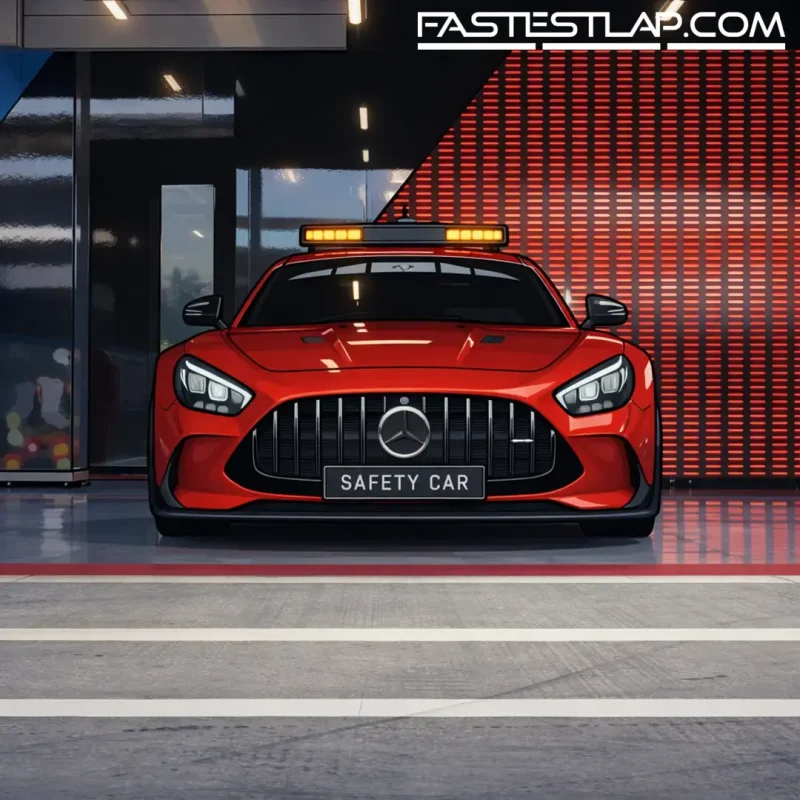
Silverstone got the finish everyone hates: a big, famous race decided at jogging pace behind the Safety Car, with the leader free to manage the restart that never really comes and everyone else effectively frozen in place.
Charles Leclerc will quite rightly take the win and move on. George Russell and Lewis Hamilton will bank a podium and points. But the sport will spend the week arguing about something else entirely: whether Formula 1 should still allow races to end under Safety Car when, in theory, there’s a sliver of time to get back to full speed.
The trigger was Max Verstappen’s late trip into the gravel at Stowe, which brought out the Safety Car on lap 48 of 52. The Red Bull was recovered, and on lap 51 the lapped cars were instructed to overtake the Safety Car to unlap themselves — standard procedure, and the kind of administrative step that always looks deceptively simple from the outside. That’s where the clock beats you. Unlapping isn’t just “let them go”; it’s a controlled release, a reset of the queue, and it costs time you often don’t have at the back end of a race.
For a moment, viewers were led to believe there would be a final green-flag lap. A message appeared indicating “Safety Car in this lap”, the cue for everyone to tense up and for strategists to immediately review who’s on what tyres and who’s brave enough to attack. Instead, the Safety Car was redeployed for the last tour, effectively confirming a neutralised finish.
The FIA’s explanation afterwards was blunt: Race Operations followed its own regulations. The relevant rule dictates that one lap must be completed after the unlapping procedure, which in practice means that if you unlap late enough, you’ve already spent the opportunity to go racing. The “Safety Car in this lap” message, the FIA said, was simply a software error.
In other words, the sport found itself in the worst possible place: the rules were applied as written, yet the presentation suggested something else was about to happen. That combination is gasoline on a paddock fire because it makes everyone feel like they’ve been robbed, even if the system did exactly what it’s designed to do.
Naturally, the comparisons to Abu Dhabi 2021 surfaced within minutes. Not because Silverstone was handled the same way — it wasn’t — but because the memory of that finale still shapes how people interpret any late Safety Car procedure. If the sport has a scar, this is where it shows.
What makes this debate so stubborn is that there’s no clean fix. Fans want racing to the flag, and so do plenty of people inside the sport. But “find a way to end every race at full speed” sounds easier than it is once you start writing the policy that would make it happen.
The obvious suggestion, already doing the rounds again, is a late-race red-flag trigger: if a Safety Car is deployed in the final few laps, stop the race, clear the incident, and restart for a sprint to the line. It’s guaranteed drama, it’s simple to understand, and it sells the product.
It also changes what a Grand Prix is.
A mandated red flag isn’t a neutral act; it’s a strategic intervention. It resets gaps, it hands out a “free” tyre change, and it can turn a driver’s hard-earned margin into nothing because somebody else made a mistake or suffered a mechanical failure. If you’re leading comfortably, it feels like punishment for doing your job properly. If you’re chasing, it feels like justice. That’s precisely the problem: the same rule will be praised and condemned depending on who it helps.
There’s also the inconvenient reality that the last thing the FIA needs is a new “entertainment lever” when it’s spent years insisting its primary mission is safety and sporting fairness. Introduce a “red flag for a better finish” mechanism and you’ll be inviting the sport to litigate intent every single time the race is stopped. Even if it’s objectively safer to halt proceedings in some scenarios, people will assume the decision was made with the show in mind.
And then there’s weather. Anyone who’s watched Silverstone, Spa or Suzuka turn dark in minutes knows that you can’t legislate your way into a clean green-flag finish when conditions are turning. A late Safety Car in heavy rain may be the only sensible option, no matter how much the grandstands want a restart.
That’s why this isn’t really an argument about whether Safety Car finishes are “good” — they aren’t, aesthetically. It’s an argument about what the sport values when the grid is bunched, the laps are running out, and the rulebook has to pick a side between purity and spectacle.
If Formula 1 wants to reduce the number of neutralised finishes without breaking the competitive model, it may be better served looking at the margins: the speed and clarity of the unlapping process, the accuracy and resilience of the messaging systems that communicate decisions, and the internal thresholds for when it’s safe to go green. Silverstone showed how quickly a couple of procedural steps can eat the remaining race, and how damaging one wrong on-screen cue can be when everyone is already primed to distrust the process.
In the end, Leclerc’s British Grand Prix win will stand, and it should. But Silverstone has reopened an old question with a new annoyance: not just that the race ended under Safety Car, but that it briefly looked like it wouldn’t — until it did. In a sport obsessed with precision, that kind of confusion is avoidable, and it’s exactly why the conversation isn’t going away.